The Hong Kong Palace Museum opened *Qing Court in Four Seasons: Life and Culture of the Imperial Household* to the public on 4 November 2026. The exhibition brings together 187 treasures from the Palace Museum and follows the activities of the Qing court across the annual calendar. It is jointly organised by the two museums and occupies Gallery 2, the Hong Kong institution's largest exhibition space. Where an earlier opening exhibition explored a single day in the Forbidden City, the new presentation follows the imperial household through an entire year, linking objects to the rhythms of court ceremony, travel, work and celebration.
A year inside the Qing imperial household
The Hong Kong Palace Museum opened *Qing Court in Four Seasons: Life and Culture of the Imperial Household* to the public on 4 November 2026. The exhibition brings together 187 treasures from the Palace Museum and follows the activities of the Qing court across the annual calendar. It is jointly organised by the two museums and occupies Gallery 2, the Hong Kong institution's largest exhibition space. Where an earlier opening exhibition explored a single day in the Forbidden City, the new presentation follows the imperial household through an entire year, linking objects to the rhythms of court ceremony, travel, work and celebration.
For a traveller interested in decorative art and the material culture of historical elites, the approach is unusually useful. Objects made for a court were not merely signs of wealth; they were often connected to calendrical rituals, the management of territory and the organisation of daily life. The exhibition encourages visitors to look at craftsmanship in relation to purpose. A clock might be part of a larger understanding of time, while a painting might express an ideal of agricultural responsibility. The museum is presenting a historical collection, not inviting comparisons with modern imperial authority or making claims about contemporary ownership of the displayed objects.
Four seasonal rooms and a changing palette
The museum says the presentation takes place within a gallery of approximately 1,700 square metres. Its curatorial team has selected colours inspired by the four categories of the *Complete Library of the Four Treasuries*, the encyclopaedic project commissioned during the Qing era. Verdant green marks spring, vermilion summer, moon-white autumn and charcoal-grey winter. The result is more than visual decoration. A changing palette guides visitors through the passage of the year and helps separate the activities associated with different seasons, turning a large collection of historical objects into a sequence that can be followed.
Designing a museum around time rather than the usual divisions of material, dynasty or technique offers distinct interpretative advantages. It allows a visitor to see how a ceremonial vessel and an illustrated album might relate to the same moment in the calendar, even though the objects are physically and artistically different. There are limits to the approach: no single exhibition can reconstruct every aspect of court life, and the selection is curated rather than comprehensive. The museum also states that some objects will be rotated every three months, meaning that a visitor returning later may encounter a different selection within the same broad narrative.
Spring brings agriculture and silk production into focus
The spring section, titled *Tilling and Weaving*, examines rituals associated with agriculture and sericulture. The museum singles out the *Pictures of Tilling and Weaving* album, whose pages will be displayed in rotation, six at a time. It depicts Prince Yinzhen, later the Yongzheng Emperor, and his consort in the roles of a farmer and a silkworm breeder. The exhibition notes that poems inscribed by the prince reinforce the significance assigned to productive labour. Such imagery reflects the court's desire to express respect for agriculture and silk production, essential activities in the wider society it governed.
There is a subtle tension in these objects that rewards close viewing. Portraits of ruling figures engaged in agricultural occupations need not be mistaken for evidence that they lived ordinary farming lives; they are carefully fashioned images of duty and values. A vase representing flowers of the twelve months connects material beauty to seasonal observance, while the museum plans to introduce a painting of the Yongzheng Emperor performing an agricultural sacrifice from the first quarter of 2027. The announced rotation is an important detail. The future painting should not be described as already on display on the exhibition's opening weekend.
Summer reveals the court beyond Beijing
During the hot months, Qing emperors often moved to the Chengde Mountain Resort. The Hong Kong Palace Museum's summer section, *Escaping the Heat*, examines that journey and the activities that continued there. The museum places the pattern particularly from the Kangxi era onward and notes that the resort served as a location for reading official memorials, receiving officials and meeting leaders from different communities. Far from being merely a holiday palace in the modern sense, Chengde was part of the functioning geography of Qing government. The exhibition uses objects to bring this less familiar seasonal setting into view.
The museum highlights a right-spiralling conch presented to the Qianlong Emperor by the Sixth Panchen Lama as a seventieth-birthday gift. The object is connected to the resort and the complex forms of ceremonial exchange that took place there. It is important to preserve the institution's description of the donor and occasion instead of converting a historical gift into a simplistic modern diplomatic statement. Other displays include finely worked imperial timepieces, demonstrating the range of craft skills assembled for court use. These pieces connect the technical virtuosity of workshops with the daily expectations and ceremonial responsibilities of the household they served.
Autumn turns towards movement and military training
The autumn season brought a different range of court activities, including visits to the Mulan Hunting Grounds. The museum connects these journeys with traditions of military training and seasonal movement. To understand the historical displays, visitors should remember that an imperial hunting expedition involved administration, protocol and symbolic assertions of leadership, not simply the pursuit of leisure. The exhibition presents the activities as part of the court's annual calendar, and the surrounding objects can therefore be read as evidence of a more mobile institution than the image of a permanent, secluded palace might suggest.
For travellers who enjoy architectural history, this is an invitation to widen the picture of Qing court culture beyond Beijing. The seasonal routes reached landscapes with different political and ceremonial purposes. The curatorial argument does not claim that every member of the household moved together or that each year's itinerary was identical. It demonstrates that the court's relationship with its territory changed over the seasons. Collectors of East Asian objects may find the narrative particularly useful because it helps place portable works, equipment and dress within the contexts in which their owners used them.
Winter closes the ceremonial cycle
Winter brings the exhibition's account towards Lunar New Year observances, celebrations and wishes for prosperity. The museum identifies these ceremonies as the culmination of an annual sequence in which agriculture, travel, governance and ritual were closely intertwined. New Year traditions could transform domestic and official spaces through objects, colours and formal practices, giving craftspeople a role in making ceremonial life visible. In a display devoted to courtly culture, decorative workmanship is therefore not merely a matter of ornament. It belongs to the performance of a calendar that linked the ruler, household and wider society.
The winter narrative also gives the exhibition a satisfying structural return. The year does not end as a linear historical episode might; it turns towards another spring. Visitors may come away less inclined to regard court artefacts as isolated treasures and more interested in their place within repeated acts. This reading is an editorial interpretation of the museum's announced structure, not a claim that the gallery recreates an entire New Year celebration. The exhibition's strength lies in carefully selected objects and interpretative design, not in presenting a fully immersive reconstruction of an imperial residence.
Astronomy, calendars and the management of time
Before the seasonal sequence, an introductory section called *Align with the Cycle of the Year* examines Qing astronomical instruments. The museum highlights an armillary sphere that will be displayed exclusively during the first six months of the exhibition. That time limitation is important for anyone travelling specifically to see the instrument. The display connects observation of celestial movements with the calendars used across society. According to the museum, the court issued a new calendar annually in a ceremony associated with the Meridian Gate, linking the measurement of time to official authority.
The attention given to calendars provides an illuminating counterpoint to the exhibition's richly decorative objects. A technically complex instrument could carry institutional meaning as surely as a carefully worked vase or embroidered textile. For luxury design enthusiasts, this expands the idea of craftsmanship beyond surface finishing. Calibration, measurement and the translation of scientific knowledge into usable objects are forms of skilled making too. The presence of astronomical instruments also warns against viewing historical palaces entirely through their precious materials; intellectual and administrative systems shaped the spaces and things they commissioned.
Planning a West Kowloon visit
The Hong Kong Palace Museum stands in the West Kowloon Cultural District, at 8 Museum Drive, Kowloon. Its published general hours are 10am to 6pm on Monday, Wednesday, Thursday and Sunday, with evening hours to 8pm on Friday, Saturday and public holidays; normal Tuesday closures and special holiday arrangements should be checked before travel. Because the museum has announced periodic rotations of some objects, visitors interested in a particular treasure should consult the exhibition's current information rather than assume every named work will remain visible throughout the run. The opening release gives the November opening date but should not be used to invent an end date.
This is an exhibition for people who want art and travel to inform each other. Its 187 treasures illuminate the working calendar of a court whose tastes shaped painting, metalwork, ceramics, clocks and many other crafts. The thoughtful seasonal framework makes those objects more intelligible without reducing them to luxury prices or the names of collectors. The Hong Kong Palace Museum's collaboration with the Palace Museum supplies a strong institutional foundation, while the carefully described rotations mean the experience can change over time. The reward is a richer understanding of how objects participated in a world governed by ceremony and the seasons.
Primary source: original announcement; corroborating source: additional first-party or industry material. Report dated 7 November 2026. Announcements and operating plans may change; editorial interpretations are distinguished from confirmed facts.
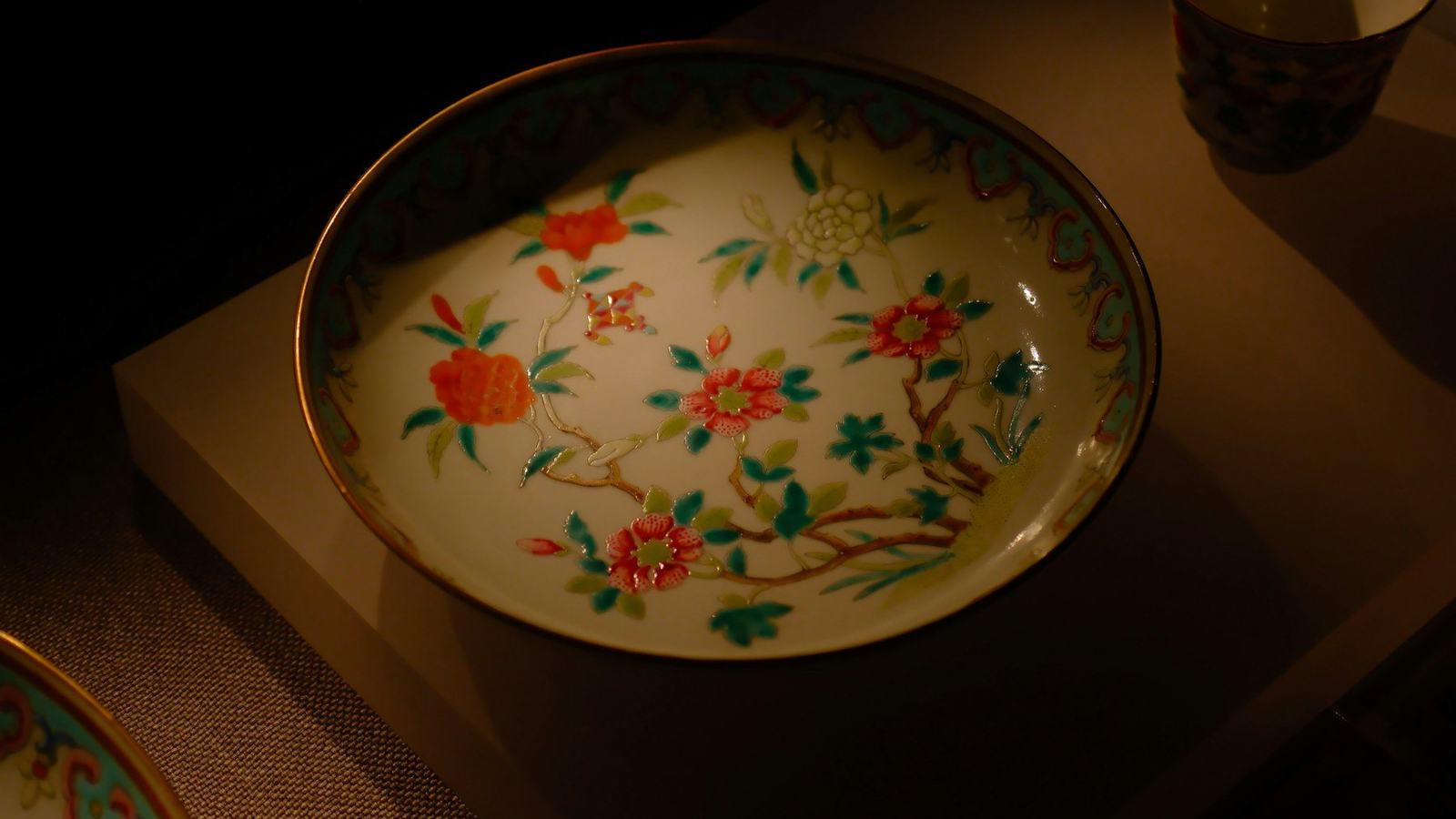
Editorial photograph: photographer and original image — Terence Zheng / Unsplash License; Qing-era porcelain plate photographed at the Summer Palace Museum, Beijing; not a verified object in the Hong Kong exhibition. Cropped and resized under the Unsplash License. Illustrative photograph only; it does not show the 2026 event or named product.
Source
www.hkpm.org.hk