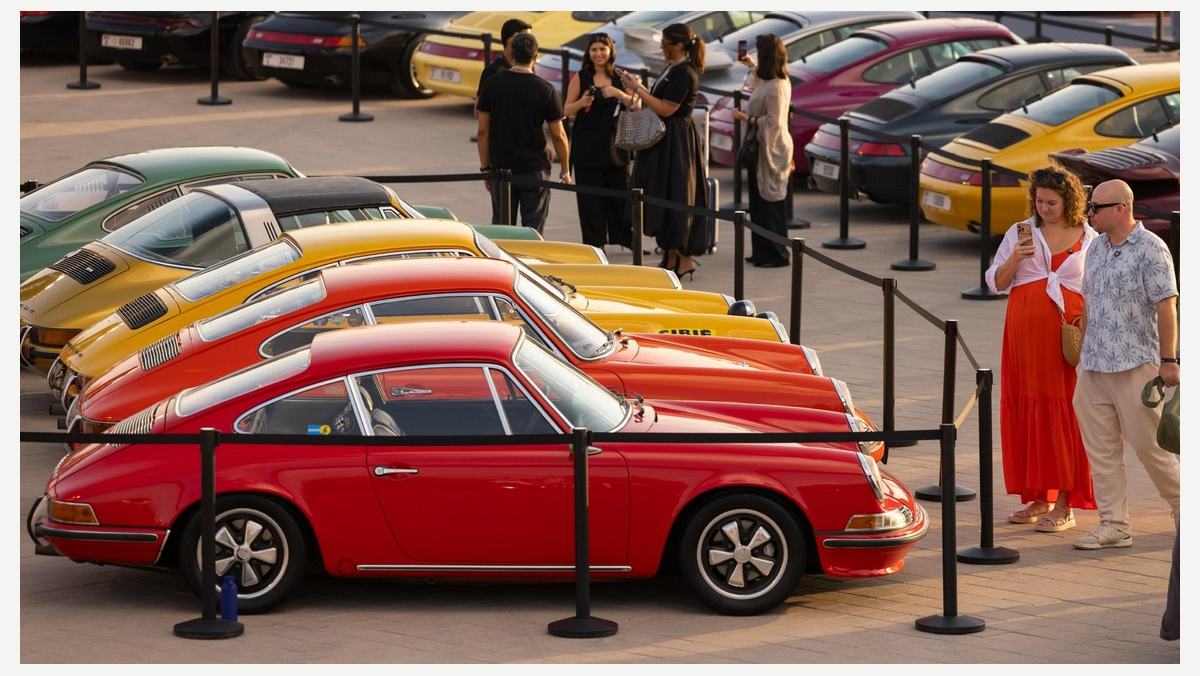
Porsche reports more than 30,000 visitors and over 1,000 cars at Dubai’s 2026 Icons festival, featuring historic racers and a restored royal-escort 924.
A larger gathering in a new setting
Porsche has reported that more than 30,000 visitors attended the sixth Icons of Porsche festival in Dubai over the weekend of 21–22 November 2026. The event moved to The Square at Nad Al Sheba and brought together more than 1,000 Porsche cars, displays from the company's motorsport past, a regional appearance by the Mission S design study and an unusual restored police vehicle with a link to the history of the United Arab Emirates.
The organiser published its results on 22 November, making this an account of a completed event rather than a preview. For superyacht owners with an interest in cars and design, the appeal lies in how an automotive gathering can connect private collections, engineering heritage and contemporary art in a setting outside the usual European concours calendar.
The sixth edition establishes its scale
Porsche describes the event as one of the largest gatherings of its marque anywhere in the world and the largest automotive festival in its region. The reported attendance and car count support the sense that the festival has become an important meeting place for owners and enthusiasts.
Those numbers are organiser-supplied figures. They should not be confused with an independently audited visitor survey, nor do they mean that every vehicle was a historic or rare example. The combination of private cars, curated displays and event parking formed the broader gathering.
Why Nad Al Sheba matters
The move to The Square at Nad Al Sheba created a new physical setting for the festival. A substantial venue is important when cars, people, exhibits and hospitality facilities must operate together. A successful event must balance the visual impact of the displays with safe movement and clear access.
Porsche says the change allowed a larger precinct with more cars, visitors, artists and food and beverage outlets than previous editions. A well-organised festival can offer reasons for visitors to remain beyond a brief viewing of one headline model.
Mission S receives its regional premiere
The Mission S vision model was presented to the Middle Eastern public after its earlier unveiling in New York in October 2026. Porsche describes it as a glimpse of a possible mid-engined super sports car positioned above the 911. The Dubai event was therefore a regional premiere, not the first worldwide introduction of the design.
A vision model is not the same as a confirmed production car. Visitors may appreciate its proportions and technical themes without assuming that a specific engine, price or delivery date has been established. The most reliable interpretation is to view it as a demonstration of design direction.
Old designs inform a new shape
Porsche placed the Mission S alongside historic models that influenced its appearance. The company identifies the 911 GT1 as a reference for the low front, the 959 for aspects of the roofline beneath the rear wing, and the 928 for a wheel design associated with its dials.
This is a particularly useful way to explain automotive design. A visitor sees not just a futuristic silhouette but the evolution of ideas across several generations. The connection may interest owners who appreciate the way classic yacht design motifs can be interpreted in new vessels without simply copying older forms.
Seventy-five years of motorsport
A major theme of the 2026 festival was the celebration of 75 years of Porsche motorsport. Four notable racing cars travelled from the Porsche Museum in Stuttgart-Zuffenhausen: the 550 A Spyder, 917 KH Coupé, 911 GT1-98 and Type 804 Formula 1 car.
The group offers a cross-section of the company's racing history, from small and light competition machines to endurance-racing designs. Their presence illustrates why a museum loan can transform an event from a display of privately owned cars into a broader historical experience.
The 550 A Spyder
The 550 A Spyder represents a period when compact dimensions and a focus on weight were central to performance. It is a useful reminder that racing innovation does not always begin with more power. Weight, balance and aerodynamics can be equally important.
Seeing a historic racer in person can reveal details that are difficult to appreciate in photographs. The proportions and simplicity of the vehicle communicate its original purpose, even when the car is presented in a carefully controlled static display.
The 917 KH and endurance racing
The 917 KH is associated with Porsche's endurance-racing heritage and an era of rapid technical development. It embodies the pursuit of sustained performance across long events rather than the short bursts typical of some other competitions.
For collectors, the historic importance of such a machine is tied to more than its appearance. The engineering, racing context and subsequent conservation all contribute to its identity. A museum car should be treated as a significant historic object, not a vehicle that visitors can handle or enter without permission.
The 911 GT1-98
The 911 GT1-98 brings another generation of endurance racing into the same display. It also creates a visual relationship with the Mission S concept, whose front design Porsche links to the 911 GT1 family.
This relationship between race and road-car design can be fascinating without being straightforward. Not every feature developed for competition becomes appropriate for ordinary road use. Designers must account for safety, regulations, reliability and the different expectations of a private owner.
The Type 804 and Formula 1
Porsche's Type 804 Formula 1 car recalled Dan Gurney's victory in the 1962 French Grand Prix. Its inclusion broadened the festival beyond the sports cars with which many modern visitors primarily associate the manufacturer.
A historic Formula 1 car can illustrate a period of mechanical and regulatory ideas very different from those of the present. Collectors should appreciate it within that historical context rather than compare its specifications directly with a contemporary road car.
A restored UAE police Porsche
One of the festival's most unusual stories involved a restored 1979 Porsche 924 that once served in the police escort for Queen Elizabeth II and Prince Philip during their first visit to the United Arab Emirates. Porsche says the car returned to public attention through a convoy from Abu Dhabi to Dubai.
This connection gives a relatively modest model a significant local story. Not every historically important vehicle is the rarest or most expensive version of a marque. Its documented role in a particular event can make it meaningful to a community.
A convoy beginning in Abu Dhabi
The restored police 924 led owners and enthusiasts towards the festival. Participants gathered for a ceremonial lap at Yas Marina Circuit before continuing to Dubai. The event connected a historic vehicle with a present-day community of collectors.
A convoy is an organised activity, not permission for unrelated motorists to drive in a police-like formation or disregard traffic rules. Professional planning and local approvals are essential when large numbers of cars move together across public roads.
The fiftieth anniversary of transaxle models
The festival also marked 50 years of Porsche transaxle cars. The 924, introduced in 1976, used a front-mounted engine and a rear-mounted transmission, distinguishing its basic layout from the more familiar rear-engined 911.
The design theme is important because it shows the manufacturer exploring different engineering arrangements over time. Owners who focus exclusively on one famous model may overlook vehicles that contributed substantially to the company's development.
Preservation as a collective effort
Porsche credits the restoration of the historic police car to Porsche Centre Abu Dhabi and Al Ain, part of Ali & Sons Holding. A project of this sort involves researching what the vehicle looked like, understanding its condition and deciding how to preserve historically important details.
The most convincing restoration is supported by documentation rather than visual approximation alone. Photographs, records and skilled work can help maintain authenticity. The same principle applies to classic yachts, where an owner's decisions can preserve or obscure the vessel's history.
The role of the owner community
The festival brought together owners and enthusiasts from different parts of the region. A large gathering may include people with relatively modern cars alongside collectors of older models. The shared interest can encourage conversations across generations and backgrounds.
For a private collector, such events may be valuable for access to expertise and the opportunity to see unusual examples. They are not necessarily marketplaces, and a vehicle appearing on display should not be assumed to be for sale.
Art, food and a wider festival atmosphere
Porsche describes art, culture, hospitality and family activity as part of the programme. This broader approach makes the festival more inclusive than an event focused solely on technical specifications or track performance.
Visitors who are not specialists can still appreciate vehicle design, creative installations and the enthusiasm of owners. A successful lifestyle festival creates several ways to participate without making every visitor feel obliged to understand motorsport history in detail.
What a two-day festival can teach designers
Bringing new and old vehicles together in a curated environment allows people to compare proportions and design languages directly. A concept car may appear dramatic on its own, while a historic reference helps explain why its shapes have been chosen.
This approach has parallels with yacht exhibitions and design shows. Owners can benefit from seeing classic and contemporary solutions side by side, provided the differences in technical requirements and intended use are respected.
Dubai's role in luxury motoring
Dubai has developed a strong community of luxury-car owners and enthusiasts. A gathering of this scale reflects local interest in collecting, design and performance. It also demonstrates that automotive culture extends far beyond traditional European and North American centres.
The presence of expensive cars does not, by itself, establish the value of the local collector market or the financial impact of the event. Those questions would require different evidence. The 2026 festival's documented achievements are its attendance, participation and exhibition programme.
Combining motoring and yachting interests
Superyacht owners sometimes develop parallel interests in cars, watches, aviation and other forms of design. A major automotive event can provide a rewarding stop during a wider journey, especially when it offers historic objects not regularly shown in public.
A yacht itinerary should not be assumed to provide direct access to Nad Al Sheba. Arrangements for arrival, transport and vehicle storage are separate matters. Visitors may find that a city-based trip offers more flexibility than trying to combine every activity with a short port call.
Valuing the diversity of a collection
The presence of a 924 with a historic police role beside much more powerful or visually dramatic cars underscores an important collecting principle. The meaning of an object depends on context, not simply its market price or performance figures.
A well-researched collection may contain examples that explain unexpected chapters of a manufacturer's history. Those stories often create conversations that a line of superficially similar high-value vehicles cannot.
Future editions and responsible expectations
Porsche's announcement describes the completed 2026 event. It does not establish all arrangements for subsequent years, nor does it guarantee that the same museum vehicles or concept cars will appear again. Prospective visitors should consult the official event programme when future dates and venues are confirmed.
Anyone taking a valuable car to a large gathering should review insurance, security and registration requirements. The pleasure of a shared event depends in part on protecting vehicles and other visitors.
What the official report establishes
Porsche's 22 November 2026 release confirms that the sixth Icons of Porsche festival took place at The Square Nad Al Sheba, attracting more than 30,000 visitors and over 1,000 cars. It identifies the regional premiere of Mission S, the four historic racing cars borrowed from the Porsche Museum, the celebrations of 75 years of motorsport and 50 years of transaxle vehicles, and the restored 1979 police 924.
For superyacht owners interested in engineering and design heritage, the festival demonstrates how a brand can bring its community together around more than the newest object. The strongest stories often arise from the relationships between people, historic vehicles and the ideas that continue to shape future design.
Primary source: Porsche Middle East original 22 November 2026 post-event report: sixth Icons of Porsche festival at The Square Nad Al Sheba Dubai.
© Porsche AG / Porsche Middle East. Original Porsche press-gallery photograph of a Porsche 911 at the sixth Icons of Porsche Dubai festival, November 2026. Official source.