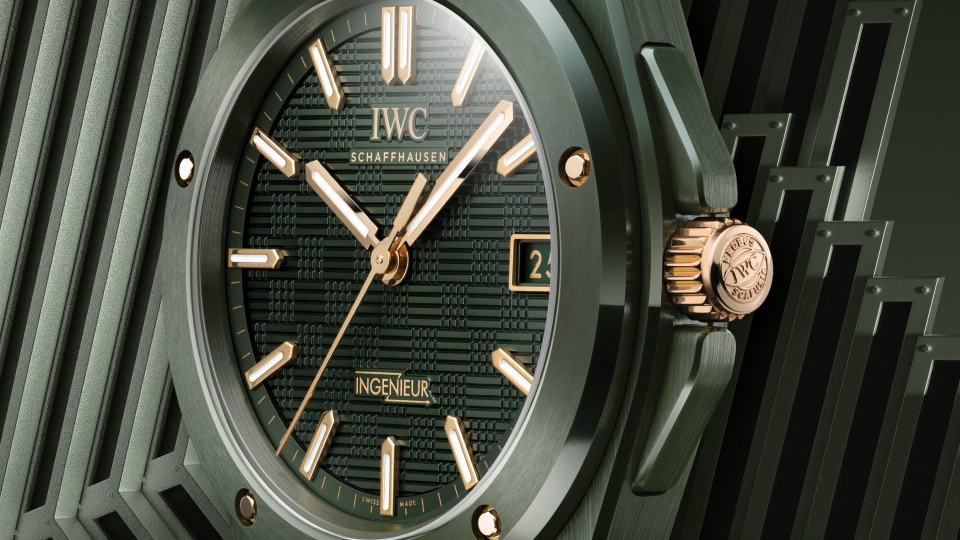
IWC's Ingenieur Automatic 42 combines olive-green ceramic, integrated bracelet design and 18-carat gold details with a 60-hour automatic movement.
A coloured ceramic interpretation of an established design
IWC Schaffhausen has introduced the Ingenieur Automatic 42 in dark olive-green ceramic, a new version of the integrated-bracelet sports watch unveiled at Watches and Wonders Geneva in April 2026. The manufacturer says it is the first coloured ceramic treatment of the design language associated with Gérald Genta's Ingenieur. Gold details bring contrast to the green case, bracelet and textured dial.
The model builds on a collection with strong links to industrial design and the continuing popularity of integrated bracelets. Its appeal is not based on a new complication but on the technical difficulty of producing ceramic parts with matching colour and precision. Those details make the manufacturing process central to the story.
Achieving consistent colour requires careful control
Coloured ceramic is produced by combining zirconium oxide with selected metallic oxides before a high-temperature sintering process. IWC explains that controlling the resulting shade is difficult because the material changes during firing. Separate case and bracelet components must appear harmonious when assembled into a single watch.
A watchmaker working with steel can apply coatings or surface finishing methods after shaping components, but ceramic introduces different constraints. The manufacturer must anticipate the behaviour of the material while it is being produced. Small differences can become especially noticeable when a case and bracelet have a continuous visual design.
A bracelet engineered for the material
The watch has a multipart ceramic construction with an integrated bracelet attached through its middle links. Ceramic is lighter than steel, potentially improving comfort in a substantial sports-watch design. The brand also uses a titanium ring inside the construction to hold the movement and assist with the mechanical fastening arrangements.
This illustrates why replacing steel with ceramic involves more than copying the shape in a new colour. The ways components join, move and transfer force can require redesign. Owners should understand that ceramic's hardness and scratch resistance do not make it immune to damage from every kind of impact.
Gold details frame the olive-green dial
The crown uses 18-carat 5N gold, while the screws holding the bezel are made from IWC's Armor Gold alloy. The green dial retains the Ingenieur's grid texture, complemented by gold-coloured hands and indices with luminous material. The result contrasts a technical case material with the warmth of precious metal.
This balance has a practical dimension as well as an aesthetic one. A strongly coloured sports watch needs clear contrast so that time indications remain easy to read. Different light conditions may change the apparent depth of the green surfaces, making in-person viewing valuable before purchase.
A sixty-hour automatic movement
Inside is IWC's 82110 manufacture calibre, using automatic winding with components in the Pellaton system made from ceramic. The movement offers a stated sixty-hour power reserve. Its engineering follows a more conventional mechanical approach than the unusual material used to make the surrounding case.
For a collector, the movement's service history and the manufacturer's maintenance recommendations matter as much as its nominal reserve. A mechanical watch will still require proper servicing and occasional regulation. An elaborate case does not remove those responsibilities, and specialist work may be preferable to general-purpose repairs.
A design study that can be worn
The April 2026 announcement places the model within IWC's broader history of using ceramic, which dates back to the company's work with the material in the 1980s. The olive-green Ingenieur demonstrates how that expertise can influence the proportions and surface character of an established design rather than create an entirely unrelated watch.
Its long-term interest for enthusiasts lies in the combination of Genta-inspired geometry, challenging material fabrication and restrained gold detailing. Anyone seeking a particular example should verify availability and reference specifications through official channels rather than interpreting a previous launch announcement as current stock information.