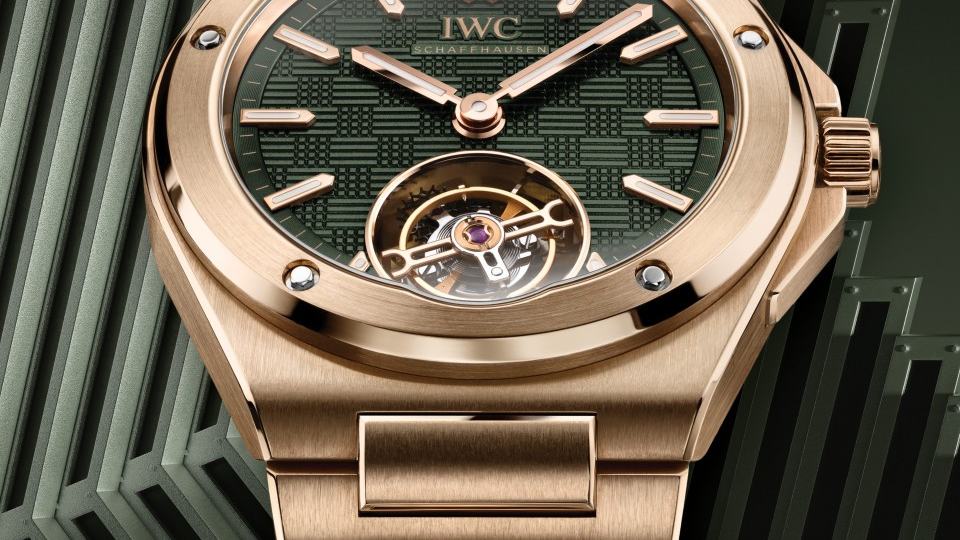
Limited to 100 examples, IWC's gold Ingenieur Tourbillon 41 combines an olive-green Grid dial, integrated bracelet and a flying minute tourbillon at six o'clock.
A celebrated sports-watch design gains a complication
IWC Schaffhausen introduced the Ingenieur Tourbillon 41 at Watches and Wonders Geneva in April 2026. The watch adds a flying minute tourbillon to the integrated-bracelet design associated with Gérald Genta's Ingenieur legacy. Its 18-carat 5N gold case and bracelet are complemented by a dark olive-green dial with the collection's characteristic grid pattern.
The result combines a familiar industrial design language with one of watchmaking's most visually recognisable complications. Rather than changing the watch into a conventional dress model, IWC retains its strong bezel, integrated bracelet and geometric proportions. The complication becomes part of the existing design rather than an unrelated ornament.
One hundred examples establish a defined edition
IWC states that the reference IW345901 is limited to 100 pieces. It uses a 41.6-millimetre case and integrated bracelet in precious metal, with five functional bezel screws formed from the manufacturer's Armor Gold alloy. The contrasting surface finishes give the watch a deliberately architectural quality.
A fixed edition size is important information for collectors, but it cannot guarantee a particular secondary-market price. The significance of an individual example depends on authenticity, case condition, documentation and the watch's complete service history. A rare reference is still a mechanical object that needs to be maintained properly.
The tourbillon takes the six-o'clock position
The flying minute tourbillon is positioned at six o'clock and rotates through a full revolution once every minute. A tourbillon brings elements of the escapement and balance into a moving cage, an arrangement developed historically to address positional effects on mechanical timekeeping.
On a modern wristwatch, the appeal is often as much the engineering and the movement's visible action as any measurable improvement in everyday accuracy. A buyer should not equate the presence of a tourbillon with a guarantee of superior timing performance. Regulation, wearing conditions and maintenance remain relevant.
Finishing gives depth to a gold watch
The case and bracelet combine satin-finished surfaces with polished edges, while the green grid dial provides a textured background. Applied gold elements and carefully treated hands add visual detail. These contrasts can become more noticeable as light moves across the case, an effect difficult to evaluate from a single promotional photograph.
The relationship between dial colour and case material is particularly important when a watch is intended to be both distinctive and wearable. Olive green changes character according to lighting and can appear subdued or intensely saturated. Viewing the watch in person is useful before making a major purchase.
A movement visible from behind
The Ingenieur uses IWC's 82905 calibre, with a Pellaton automatic winding system incorporating ceramic components. The movement is visible through a sapphire case back, allowing the wearer to appreciate elements of its finishing and construction without opening the watch.
An exhibition back also creates a responsibility to consider the movement as part of the product's aesthetic presentation. Collectors may examine the quality of finishing, the arrangement of components and the consistency of the manufacturer's work. They should also confirm the recommended service interval and any special arrangements for a high complication.
Genta's legacy in a modern limited edition
The Ingenieur owes much of its identity to Genta's 1970s interpretation of the integrated-bracelet sports watch. IWC's gold tourbillon reflects the continuing relevance of that design while showing how manufacturers use complications to extend a recognisable collection. The April launch remains a significant 2026 horology story.
For an informed collector, the balance of original design, precious material, movement architecture and documented rarity will matter more than any single feature. The watch illustrates how fine horology continues to reinterpret established shapes through contemporary engineering.