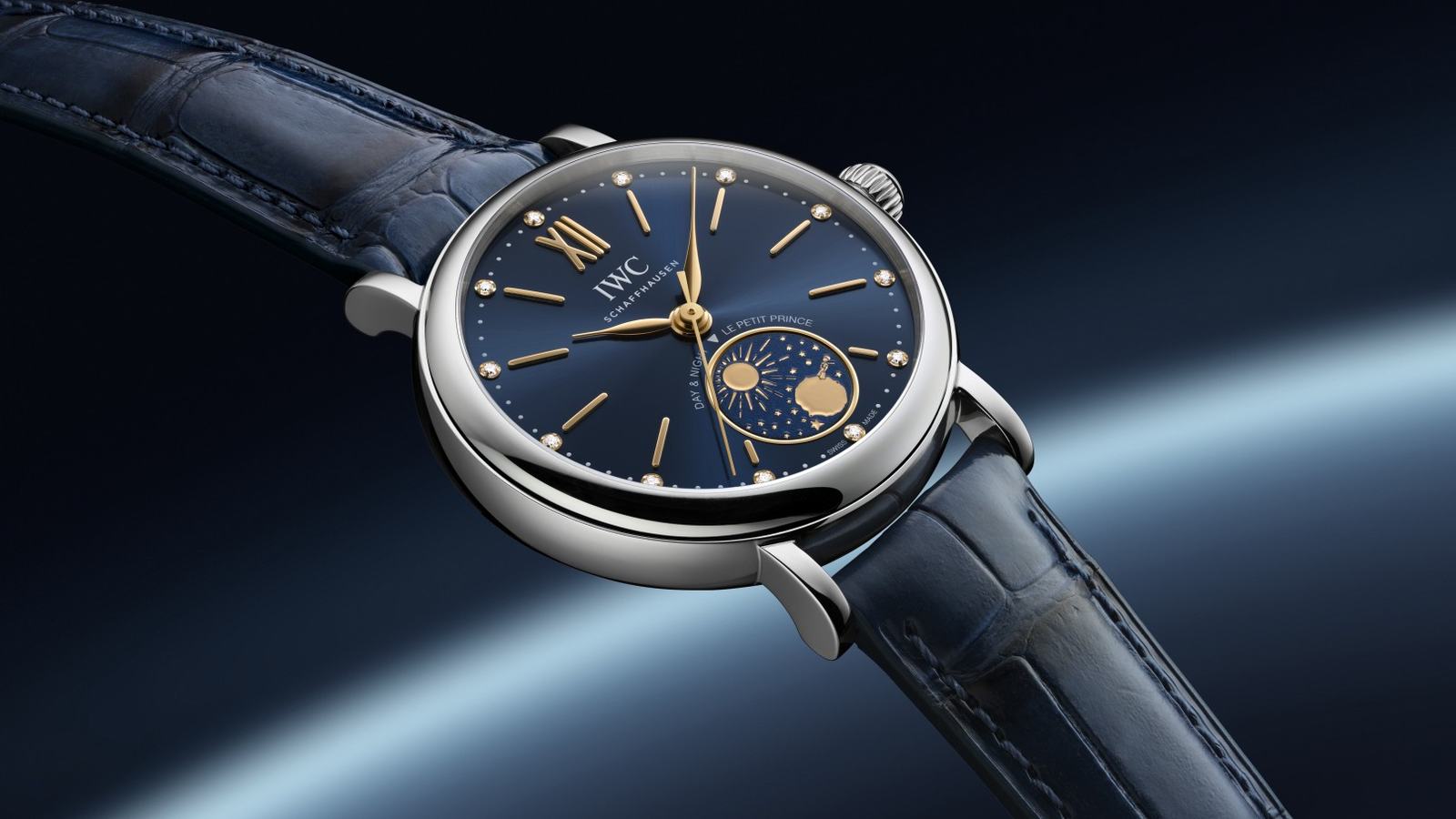
IWC's first Portofino tribute to The Little Prince uses a 34mm steel case, deep blue dial and a day-and-night display depicting the character on a golden moon.
A literary collaboration reaches the Portofino
IWC Schaffhausen introduced the Portofino Automatic Day & Night 34 Le Petit Prince at Watches and Wonders Geneva in April 2026. It is the company's first Portofino model devoted to Antoine de Saint-Exupéry's well-known story, creating a connection between a refined dress-watch line and a literary collaboration usually associated with IWC's Pilot's Watches.
The result is deliberately different from an aviation-style chronograph. The Portofino uses softer proportions and a relatively compact case, allowing the literary reference to appear as a small complication within an elegant dial rather than as a bold technical motif.
A day-and-night indication becomes an illustration
The central storytelling detail is positioned at six o'clock, where the Little Prince appears on a golden moon within the day-and-night display. As the indication changes, it references the passage of time through an image linked to the novel's imaginary universe.
Such displays are generally appreciated for their visual character as much as their practical information. The design can prompt the wearer to notice the watch throughout the day rather than treat it purely as an instrument. Its success depends on keeping the image charming without distracting from the hours and minutes.
Steel and blue establish a restrained identity
The Portofino has a thirty-four-millimetre stainless-steel case and a deep-blue dial with a sunray finish. The colour connects it with earlier Le Petit Prince watches while remaining compatible with the Portofino's formal appearance. Small applied details help give the dial depth.
A watch of this size may appeal to people who favour a lighter, less prominent timepiece. Yet comfort depends on more than diameter, including case thickness, strap configuration and the curvature of the lugs. Prospective owners should assess the watch on the wrist instead of relying entirely on numerical specifications.
Saint-Exupéry's story provides context
The Little Prince has been read internationally for many decades, with its account of a young traveller exploring different planets and encountering unfamiliar personalities. Themes of curiosity, friendship and loss give the book a broad appeal across generations. The watch translates that association into one simple visual element.
A collector can appreciate the literary reference without assuming the timepiece is meant to illustrate every part of the story. A well-chosen symbol can be more effective than numerous decorations, particularly on a small dial. This economy of design supports the Portofino's understated character.
Mechanical ownership remains important
Although the day-and-night image may attract first attention, the watch remains a mechanical timepiece with the usual requirements for operation and servicing. Owners should understand the setting procedure for its indications and avoid forcing adjustments outside the manufacturer's guidelines.
Documentation and the condition of the dial, case and movement all matter if the watch is later sold or passed to another person. A limited cultural collaboration may encourage careful preservation, but regular and appropriate use is compatible with that objective.
Why a day-and-night display should not be mistaken for a moonphase
The distinction between a day-and-night indication and a true moonphase is important when describing a watch with a celestial motif. A day-and-night disc communicates the broad division between daytime and nighttime, while a moonphase complication represents stages in the lunar cycle. The Le Petit Prince Portofino uses its storybook character on a golden moon as part of the day-and-night presentation. The symbolism is charming, but prospective owners should rely on IWC's precise explanation of the mechanism rather than assume the display follows the astronomical moon. Clear technical language protects the appeal of the design by giving it a truthful foundation. This matters particularly when a decorative indication becomes the feature most visible in advertisements and online photographs. The owner should understand both what the display conveys and how to set it using the official instructions.
The thirty-four-millimetre case also deserves consideration on its own terms. A smaller watch can provide a refined counterpoint to oversized sports models, especially when the dial is intended to feel open and balanced. However, diameter alone does not determine whether a piece looks delicate or substantial on a wrist. Lug design, thickness, strap width, colour and even the shape of the wearer’s hand affect perception. A blue sunray dial can shift from dark to luminous as it moves through the light, while polished steel contributes a separate kind of brightness. Those changes are precisely why an in-person fitting is valuable. A buyer should also examine the clasp and strap material before deciding whether the watch is best suited to daily use, formal occasions or both.
Giving a literary watch a lasting personal meaning
A watch connected to The Little Prince may be chosen as a personal object rather than as a conventional investment. The novel's international readership gives the motif recognisable cultural meaning for people with very different backgrounds. An owner might associate the design with a favourite book, a family memory or the simple pleasure of a small illustration on a dial. None of these reasons depends on an artificial claim that the watch is exceptionally rare. The restrained Portofino case allows the narrative reference to operate gently, leaving space for the piece to be appreciated as a dress watch. Its scale and comparatively uncluttered appearance may appeal to buyers who dislike a heavily branded collaboration. The most successful design is one that remains attractive even when its cultural reference is not immediately recognised by everyone around the wearer.
Long-term enjoyment still asks for familiar disciplines. The watch should be accompanied by a clear reference identity, manufacturer literature and reliable records of purchase and maintenance where possible. Owners should know how the mechanical movement behaves after a period without winding, and whether the day-and-night disc has a recommended adjustment procedure. A particularly sentimental purchase may eventually be handed down, making straightforward documentation and careful storage worthwhile. The April launch introduced this first Portofino interpretation of IWC's literary partnership, but a November feature can legitimately revisit it as an example of restrained storytelling in luxury design. Readers considering a current order should confirm stock, pricing and the available strap or bracelet choices directly with IWC rather than relying on launch-period assumptions. The enduring attraction is the combination of utility and a quietly personal visual story.
A different expression of IWC's identity
The April 2026 launch extends the Saint-Exupéry relationship into a dress-watch format. It demonstrates how a manufacturer can use a familiar literary theme without making every interpretation visually identical. The blue dial provides continuity, while the Portofino silhouette changes the emotional effect.
For buyers interested in design, literature and fine watches, this model offers a quieter interpretation than a large ceramic Pilot's Watch. Current availability should be checked directly because a manufacturer's launch release does not constitute a live stock listing.
Source: official IWC announcement. The original 2026 launch date is identified above; current availability is unverified.