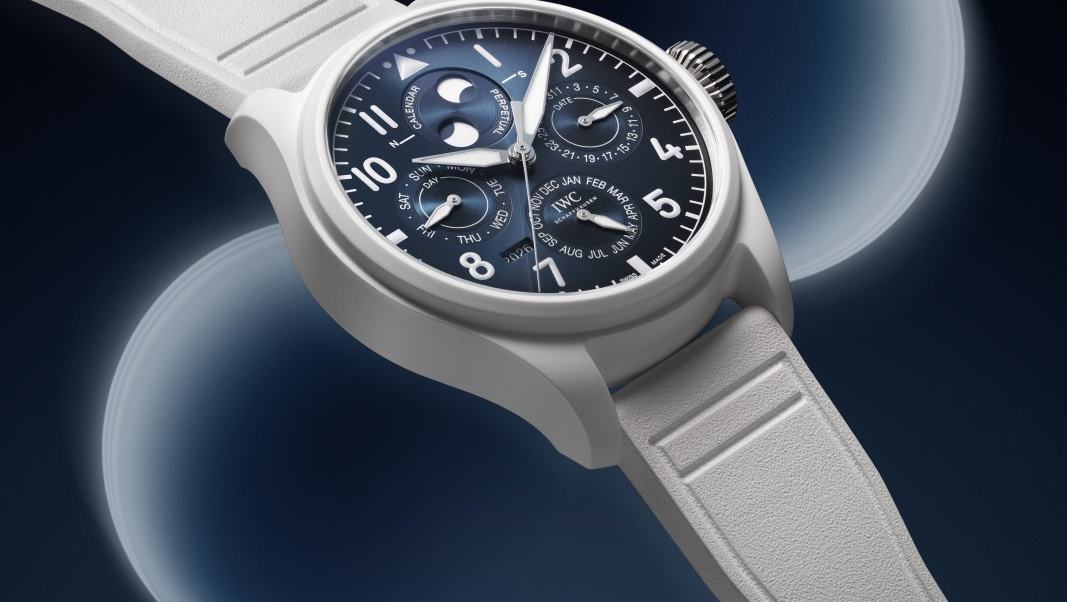
IWC's ProSet perpetual calendar introduces a synchronised gear-based adjustment system allowing both forward and backward correction, debuting across three Big Pilot models.
A longstanding complication gets a new mechanism
IWC Schaffhausen introduced IWC-ProSet at Watches and Wonders Geneva in April 2026, describing it as a substantial redesign of the mechanical perpetual calendar. The new system uses interconnected gears to coordinate calendar indications, enabling adjustment both forward and backward. That matters because many traditional perpetual calendars require particularly careful handling when the displayed date needs correcting.
A perpetual calendar is designed to recognise differences between months and leap years through a mechanical programme. It is celebrated for this complexity, but complexity can make a watch inconvenient if it has stopped for an extended period. A collector may appreciate the sophistication of a movement yet still prefer a practical method for resetting it.
Why backwards adjustment changes the experience
Traditional mechanical calendars may carry restrictions on setting times or the direction in which displays can be moved. ProSet seeks to simplify the process by keeping indications synchronised while the wearer makes corrections. IWC describes the ability to move the calendar in either direction as a fundamental improvement.
This is not only a technical achievement for engineers. A watch worn occasionally may be found displaying the wrong date when taken from a safe. The more intuitive its controls, the easier it is to enjoy a complicated timepiece without relying on a specialist for ordinary adjustment. Owners must nevertheless follow the manufacturer's own instructions.
Four decades after Kurt Klaus
IWC's modern calendar reputation is closely linked with watchmaker Kurt Klaus and the Da Vinci Perpetual Calendar Chronograph introduced in 1985. Its crown-controlled setting system became a significant milestone in simplifying a demanding complication. ProSet is presented as a continuation of that engineering tradition rather than a rejection of it.
Watchmaking develops through successive improvements, where later engineers revisit constraints accepted by earlier generations. The important question is whether a refinement creates a real benefit for the wearer. A more elegant mechanism can reduce uncertainty and turn a difficult operation into something more approachable.
A moon-phase display with ambitious precision
The new calendar includes a moon-phase indication said by IWC to deviate by just one day after 1,040 years. This numerical precision concerns the astronomical gearing of the display, not the accuracy of the watch as a timekeeper. The distinction is important because an extremely precise lunar mechanism does not eliminate the ordinary needs of mechanical regulation and maintenance.
IWC uses an 82665 manufacture calibre for the initial watches. Collectors considering a high complication should understand how the calendar mechanism is coupled to the base movement and how servicing will be managed after years of use. Technical sophistication is meaningful only when the watch remains maintainable.
Three different interpretations of the launch
ProSet arrived in three editions of the Big Pilot's Watch, including references in white ceramic, stainless steel and gold. One Le Petit Prince reference combines a white ceramic case with a deep blue gradient dial, while the stainless-steel model uses a five-link bracelet. Each creates a different visual setting for the underlying mechanism.
A collector may be drawn by the convenience of the new calendar or by a particular case material. The differences in weight, dial contrast and the feel of a bracelet can be as important in daily use as the calibre. These choices are best judged in person rather than through photographs alone.
A technically rich development for watch collecting
The April launch makes ProSet a 2026 development, not a newly announced October product. Its continuing significance is the attempt to solve a familiar problem with complicated watches: how to keep an intricate display genuinely usable for people who do not wear the same piece every day.
Perpetual calendars remain among watchmaking's most admired complications because their mechanical programme represents calendar logic through physical components. ProSet shows how the next phase of innovation may focus as much on the owner's experience as on adding yet another display.