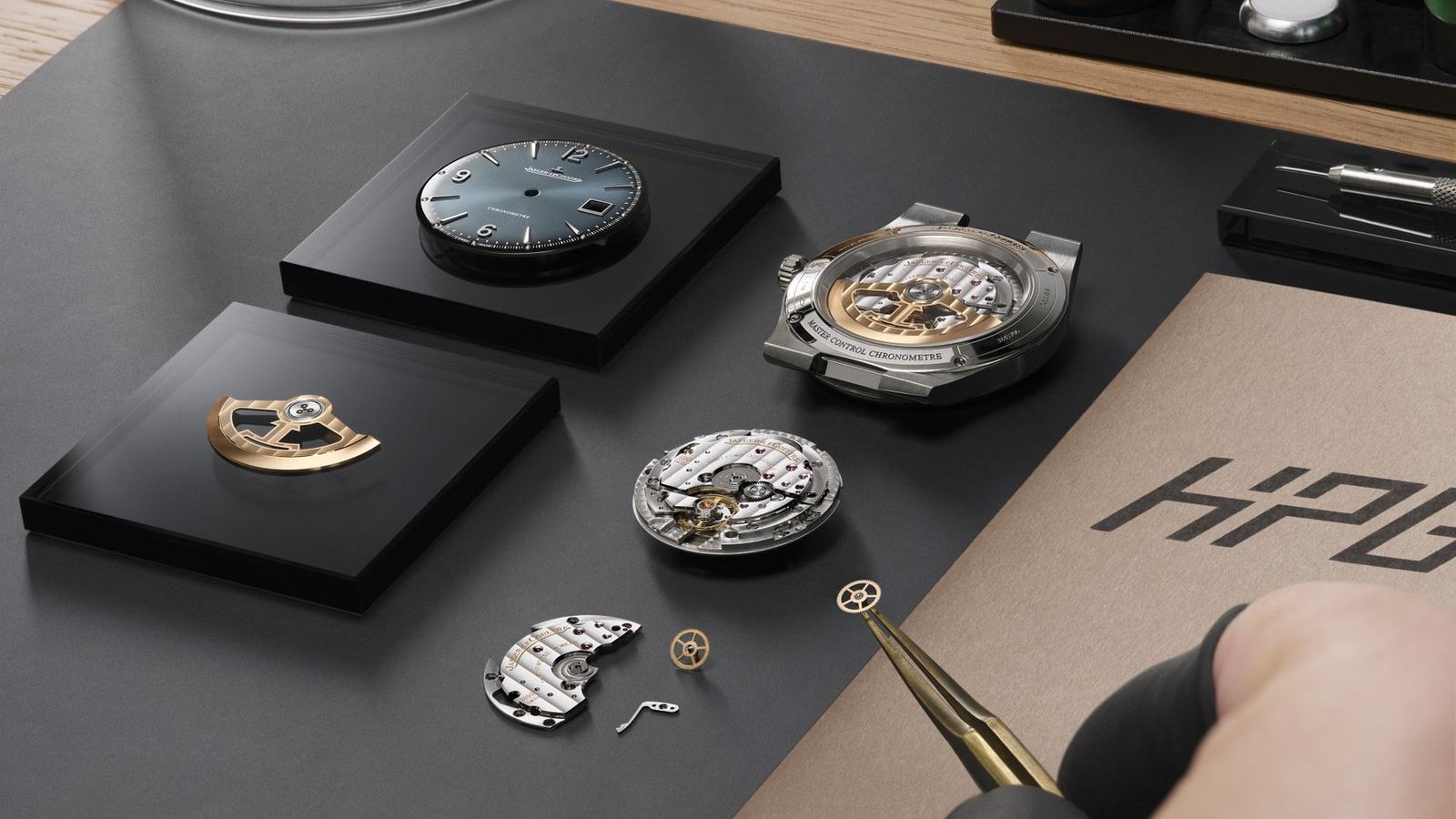
Jaeger-LeCoultre explains its HPG certification, which combines simulated wearing-condition tests with craftsmanship standards, starting with Master Control Chronometre.
Jaeger-LeCoultre defines a new house standard
Jaeger-LeCoultre has set out the details of its High Precision Guarantee, or HPG, a proprietary seal intended to assess both the timekeeping of a mechanical watch and the quality of its decorative finishing. Introduced with the Master Control Chronometre family in 2026, the programme is designed to progress across further collections from 2027. The manufacturer presents it as a broader evaluation of how watches perform in ordinary use, rather than a cosmetic badge alone.
The announcement is significant for buyers who compare certification marks on expensive mechanical timepieces. A quality seal can bring structure to claims about precision, but not all seals assess the same characteristics or come from independent organisations. Jaeger-LeCoultre's HPG is its own standard; the programme's claims should be understood as a manufacturer-led testing and finishing process, not confused with third-party approval.
Testing against conditions beyond the laboratory
The HPG approach uses a combination of controlled tests intended to reproduce stresses that occur when a watch is actually worn. These include changes of temperature, different orientations, simulated shocks and a range of atmospheric pressures. The company says the testing begins with the movement and continues after the watch has been fully cased, addressing performance at different stages.
This is an important distinction because a movement's behaviour can change after assembly and during daily activity. The finishing of a movement may look exceptional through a transparent caseback, but appearance cannot determine the accuracy of the hands. For a buyer, the value of a test depends on its stated conditions, measured tolerances and whether every watch receives the same examination.
Altitude and mechanical shocks
One element of the protocol subjects the calibre to simulated changes in atmospheric pressure between sea level and about 1,004 metres, corresponding to the altitude of the manufacture in Le Sentier. Another applies shocks in different positions, with stated values from 25G to 50G. The company uses these methods to investigate how the movement deals with stresses beyond a stationary bench test.
The figures refer to laboratory procedures, not a guarantee that the watch is suitable for impact sports or diving. Shock resistance and water resistance are different properties, and a wearer should check the specific product specifications before exposing a watch to unusual conditions. The manufacturer's seal does not remove the need for normal care, servicing or attention to the crown and case.
Movement, rest and changes in temperature
The programme also varies a watch's orientation, alternating periods of movement with fixed resting positions to replicate a more realistic wearing routine. Temperatures are changed between roughly 18 and 35 degrees Celsius, reflecting differences between a watch resting and being worn near the body. The objective is to test performance under combinations of influences rather than a single idealised condition.
Jaeger-LeCoultre describes a sequence in which two days represent more active weekday use, followed by a third day of more stable rest. This is a standardised test pattern, not a prediction of how every wearer will use a watch. Actual accuracy remains affected by conditions, maintenance and individual movements. Those evaluating a particular model should ask what performance limits the HPG process requires.
A seal that also covers finishing
Unlike certifications concerned mainly with movement rate, the HPG seal incorporates standards for decorative and functional finishing. Jaeger-LeCoultre says a qualifying watch must show at least six of eight traditional techniques. These include bevelling, burnishing, circular and linear smoothing, jewel countersinking, Côtes de Genève, perlage and polished screw heads.
Such methods take time and skill, and their effects differ. Polished bevels can make the edges of components catch light, while careful countersinking helps create precisely shaped recesses around jewels. Decoration is not simply evidence of better timekeeping, however. The manufacture is making a combined claim about craftsmanship and performance, which should be judged against the stated standards rather than inferred from photographs alone.
A long history of precision measurements
The company connects HPG with earlier advances in mechanical measurement. Its history includes the Millionomètre of 1844, an instrument developed for extremely fine dimensional measurements, and subsequent contributions to compact watch movements. Later watches such as the Geophysic and Futurematic explored distinct challenges in accuracy and reliability during the twentieth century.
Jaeger-LeCoultre also links the programme to its 1,000 Hours Control, introduced with the Master Control family in 1992. That earlier testing approach was notable for examining complete watches rather than movements in isolation. The latest seal builds on the same principle while adding a more elaborate set of simulated wearing conditions and explicit expectations for movement finishing.
How HPG relates to independent certification
The Master Control Chronometre collection that debuted with HPG was also submitted for COSC certification before the manufacture applied its own assessment. COSC is an independent Swiss chronometer testing organisation, while the new HPG seal belongs to Jaeger-LeCoultre. The two marks therefore have different identities and should not be treated as interchangeable.
Independent certification can provide a useful reference point, but buyers should still understand what has actually been tested. A caseback inscription is easier to assess when a manufacturer explains the methods and tolerances behind it. The company's published material gives an overview of the procedure and notes that a patent application has been filed for elements of the dynamic protocol.
What collectors should ask before buying
The HPG announcement adds another feature for collectors comparing contemporary watches at the upper end of the market. It combines a declared procedure for evaluating the complete watch with a stated minimum standard for traditional finishing. The initial use with Master Control Chronometre and planned gradual extension mean not every Jaeger-LeCoultre currently in circulation necessarily carries the seal.
The accompanying photograph comes from the brand's own technical material and shows watch components arranged around the HPG testing and finishing theme. It does not imply an independent third-party inspection of the equipment shown. Prospective buyers should consult the exact watch reference, its warranty and documented certification, while treating the maker's new seal as one part of a wider assessment of quality.