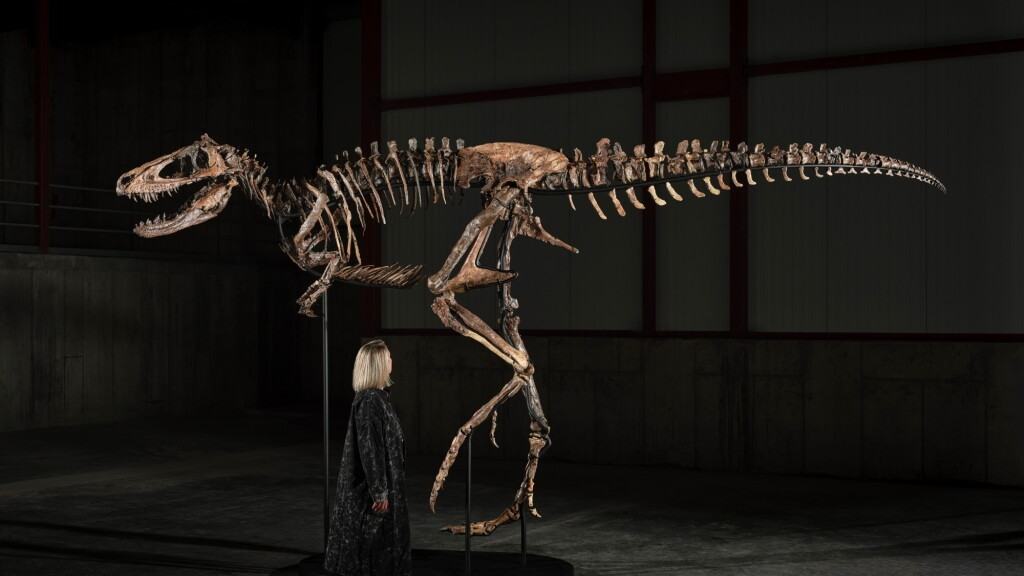
Sotheby's will offer Jodi, a mounted Nanotyrannus fossil skeleton from Montana's Hell Creek Formation, on 27 October 2026 with a $6–9m estimate.
An unusual fossil enters the top tier of collecting
Sotheby's has scheduled a New York auction of Jodi, a mounted skeleton identified as Nanotyrannus cf. lancensis, for 27 October 2026. The specimen carries an estimate of US$6 million to US$9 million, placing it within the market for major scientific and natural-history objects rather than everyday decorative collecting. Online bidding is due to begin on 13 October.
The bones come from the Hell Creek Formation in Garfield County, Montana, and date to roughly 67 million years ago in the Late Cretaceous. A prospective bidder should distinguish the pre-sale estimate from a sale price and understand that paleontological specimens have different conservation, storage and documentation needs from artworks. Physical scale and spectacle are only part of the proposition.
The species question has shaped Jodi's reputation
Nanotyrannus has long been central to debate about how to classify certain smaller tyrannosaur specimens, including whether they represented juvenile Tyrannosaurus rex. A scientific reassessment published in 2025 supported recognising Nanotyrannus as a distinct genus. That changing understanding creates additional interest in well-documented examples without making every detail of their evolutionary history indisputable.
The Sotheby's listing uses the qualified identification Nanotyrannus cf. lancensis, and that qualification is important. Fossil interpretation depends on material completeness, comparison and evolving methods. Buyers should seek access to the available technical literature and independent specialists instead of treating an auction label as a final scientific authority.
The skeleton's Montana origins matter to provenance
The specimen was discovered in 2019 on a Montana ranch associated with Jodi Pierson and subsequently excavated by commercial palaeontologist Clayton Phipps. Geological setting, excavation records and evidence of lawful ownership are all material to serious fossil collecting. Such objects cannot be valued sensibly from dimensions and photographs alone, especially where their status may change through further study.
Natural-history specimens often include preparatory or restoration work to support display. A detailed condition assessment should disclose the proportion of original material, replacement elements, conservation products and the structural frame supporting the mount. Those technical distinctions can strongly influence a collector's understanding of authenticity and its long-term preservation.
Museums and private collectors share an interest in fossils
Major dinosaur skeletons have attracted exceptional prices in recent years, with dramatic public sales bringing new attention to the category. Private ownership can provide resources for scientific work and display, but it may also create concerns if researchers lose access to important material. An informed acquisition ought to consider loan opportunities, access agreements and the suitability of the intended installation environment.
Temperature, humidity, vibration and physical security matter in displaying a large fossil, particularly in a private home or public-facing gallery. Transport and assembly require specialist teams rather than ordinary furniture movers. Anyone bidding across borders must also understand applicable fossil, heritage and import regulations before making a commitment.
The auction will provide a public market test
The sale is scheduled for 27 October, and Sotheby's has published a single-lot catalogue entry with the expected price range. The description places Jodi among a very small set of comparable Nanotyrannus specimens. The eventual result may illuminate collector interest, but it will not settle the scientific issues surrounding tyrannosaur classification.
The compelling feature is the meeting of a rare object, current research and substantial private capital. Whether the specimen joins a private collection or an institution, preservation and responsible documentation will be as consequential as its auction-room price.
Source
Sotheby's