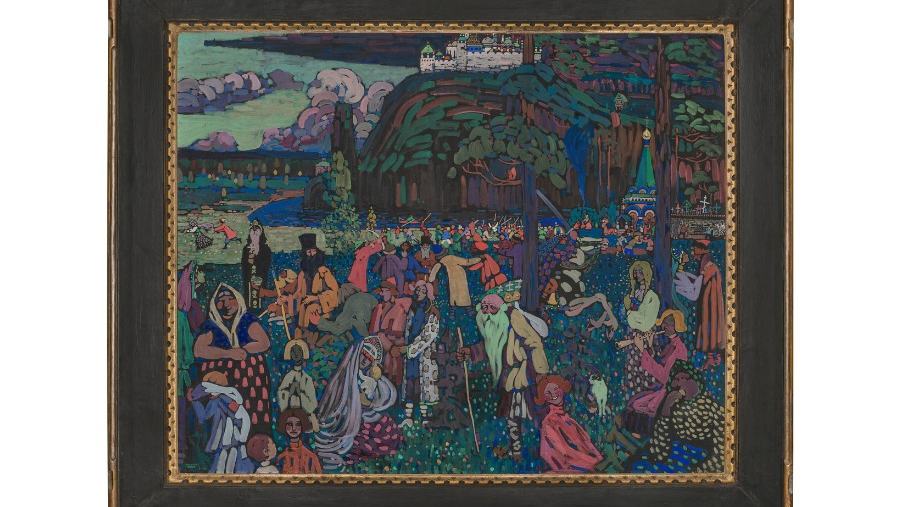
Wassily Kandinsky's monumental 1907 Das bunte Leben will be offered at Christie's London on 14 October, following restitution to heirs of Hedwig Lewenstein-Weyermann.
A painting with both artistic and legal history reappears
Christie's is bringing Wassily Kandinsky's Das bunte Leben, completed in 1907, to its London evening sale on 14 October 2026. The painting is a major example of the artist's development before fully non-objective abstraction, but its return to the auction market carries another important context: it was restituted in June 2023 to the heirs of Hedwig Lewenstein-Weyermann.
Restitution is not a decorative footnote in the object's story. It concerns ownership and the circumstances in which artworks passed through collections during an era of displacement and injustice. A prospective buyer should read the documented history with care and avoid treating a completed restitution as a reason to overlook the original loss and the work required to reach an agreed outcome.
Paris influenced Kandinsky's changing palette
Kandinsky worked through a period of intense experimentation between 1904 and 1908, encountering artistic developments in Paris associated with Pointillism, Fauvism and post-Impressionist colour. Rather than copy one movement, he drew on several approaches to develop a painting language in which colour could carry emotional meaning beyond describing visible objects.
Das bunte Leben belongs to that formative period and was shown at the Paris Salon d'Automne in 1907. Its large dimensions, approximately 130 by 163 centimetres, made it an ambitious public statement. The scale allows the viewer to move among crowded figures and scenes, discovering relationships that are much less apparent in a reproduction seen on a screen.
The subject bridges figuration and later abstraction
The canvas includes pilgrims and figures gathered within an elaborate landscape, arranged through small, vivid passages of colour. Its motifs remain linked to Kandinsky's cultural background, yet their treatment points towards a less literal understanding of space and storytelling. The subject matters because it shows how abstraction developed rather than simply appearing as a sudden decision by the artist.
Close examination can reveal the painting's material complexity: density of pigment, relationships between adjacent colours and the way elements are balanced across the surface. An established title and a celebrated painter do not relieve collectors of the responsibility to study conservation reports, framing and how the work has been handled during earlier exhibitions or loans.
The Lewenstein history forms part of the scholarship
Amsterdam collectors Emanuel Albert Lewenstein and Hedwig Lewenstein-Weyermann acquired the painting in 1927. Its subsequent history became the subject of a significant restitution process, and Christie's reports that it returned to Hedwig's heirs in June 2023. The work had also spent more than fifty years on long-term loan at the Lenbachhaus in Munich, making it familiar to generations of museum visitors.
The painting's return illustrates how collection research can reshape the story of a masterpiece many decades after its creation. Provenance may involve private archives, institutional records and legal agreements, so careful presentation is essential. The new offering follows a specific restitution agreement; it should not be taken as a general statement about the status of every Kandinsky in circulation.
London provides a new chapter, not an ending
Christie's has arranged an international programme of viewings before the London auction, with the painting appearing in European, American and Asian centres. These presentations give prospective bidders time to study the work and consult independent specialists. A major painting can attract intense attention during Frieze Week, but the hammer result cannot be known before the sale.
The broader significance lies in bringing a pivotal early Kandinsky into public discussion alongside the history of its ownership. Whether it enters a private collection or one ultimately accessible to institutions, the work will continue to invite questions about modern painting, cultural memory and the responsibilities of collecting at the highest level.
Source
Christie's Press Office