A carefully sourced guide to Alaska's Kenai Fjords for superyacht owners and captains, centred on Aialik Glacier, glacier-wave hazards, protected wildlife and well-planned cold-water exploration.
The fjord coast that rewards a serious voyage
Kenai Fjords National Park presents Alaska at a scale that changes the atmosphere of a superyacht voyage. Glaciers descend between steep mountain walls, ice fragments drift across cold inlets and wildlife moves through a coastline shaped by the Gulf of Alaska. For owners who normally cruise highly serviced Mediterranean waters, this is an altogether different form of luxury: wide horizons, extraordinary quiet and the privilege of exploring with a capable expedition crew.
A private vessel makes it possible to spend time contemplating the coast rather than moving through it on a fixed sightseeing circuit. Yet greater independence must be matched by greater preparation. The National Park Service emphasises that these waters are exposed to ocean swell from the Gulf of Alaska, with relatively few truly protected coves, changeable winds and shore landings that can turn difficult after an afternoon breeze.
Seward and Resurrection Bay provide the usual geographical starting point for appreciating the wider park coast. Beyond them lie Aialik Bay and more remote fjords where mountains, ice and water dominate. The itinerary should be designed around weather windows and suitable working positions, not around the assumption that a yacht can remain close to every glacier for as long as guests wish.
Aialik Glacier: the view is better from safe water
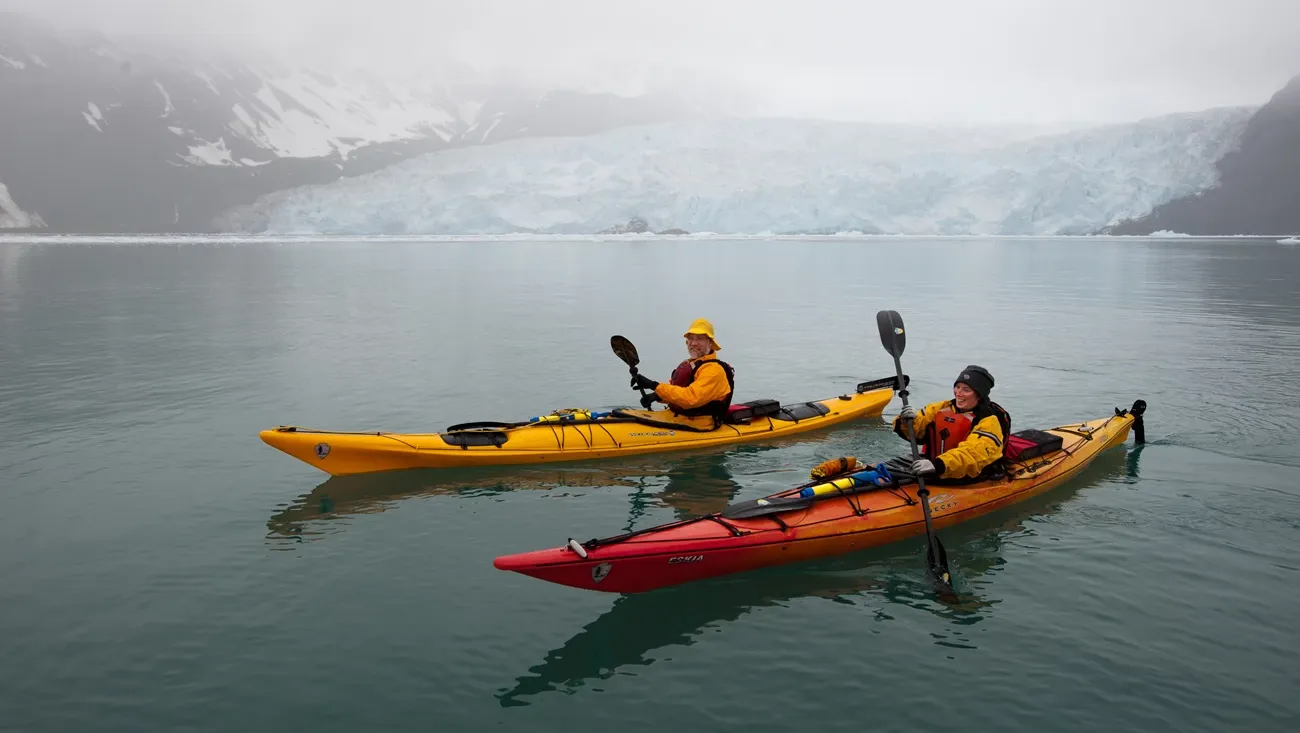
Aialik Glacier descends from the Harding Icefield into the sea at the head of Aialik Bay, making it one of the park's most memorable marine sights. The blue and white face appears almost architectural from a distance, while floating fragments remind visitors that this landscape is continuously changing. The official National Park Service photograph accompanying this guide shows paddlers near a tidewater glacier and records a real location rather than a generic or generated wilderness scene.
The dramatic moment most guests hope to see is calving, when a section of glacier breaks away into the water. The event can produce substantial waves and dangerous ice movement far from the face itself, which is why the park's boat-safety information recommends that kayakers remain at least half a mile from tidewater glacier termini. A yacht's professional bridge team must make its own conservative assessments with local knowledge, current conditions and the vessel's characteristics.
Trying to achieve an unusually close photograph is an especially poor trade-off at a glacier front. Viewing from a sensible position lets guests use binoculars and long lenses while reducing the risk of sudden movements in ice-filled water. A responsible captain should treat changing ice, confined manoeuvring room and potential surge as reasons to increase distance, not as elements of an exciting attraction.
Why glacier-side beaches deserve caution
The park's guidance warns that waves from ice calving can reach beaches with surprising force, lifting or sweeping away kayaks and equipment even when they appear to be stored beyond the obvious waterline. For shore landings it recommends avoiding beaches within two miles of tidewater glaciers. That advice is particularly relevant when a superyacht party proposes an apparently tranquil picnic or photography stop beneath a spectacular wall of ice.
Landing assessments are not limited to how a beach looks at arrival. Wind against tide, swell direction, surf, uneven cobbles and the expected position of the tide a few hours later affect whether a tender can safely recover its passengers. A place that looks inviting in photographs may be entirely unsuitable for a guest transfer, especially for less mobile guests or when ice and wind complicate the return.
An experienced expedition crew will plan alternatives before anyone leaves the yacht. A scenic passage, a different sheltered viewpoint or a guided activity in a more suitable location can be a richer experience than persevering with an awkward landing. In this environment, discretion and restraint are signs of competence and the foundation of a genuinely comfortable private voyage.
Glacial lagoons are not casual tender playgrounds
The National Park Service identifies the entrances to Northwestern, James, McCarty and Bear Glacier lagoons as locations where tidal currents can create standing waves, boils and confusing eddies. Its paddling guidance generally favours high slack tide for certain lagoon entries and imposes particular precautions at Pedersen Lagoon, where a submerged bar affects the approach. Those are specialist warnings, not invitations for larger yachts or inexperienced visitors to follow a kayak itinerary.
A guest may reasonably see an iceberg-filled lagoon as the ultimate location for a small-boat excursion, but the entrance can be the most consequential part of the trip. Some icebergs turn or move unpredictably, and the park advises keeping at least twice an iceberg's height or width away from it. The crew must also account for rapidly changing weather and cold-water exposure while weighing whether the outing should be attempted at all.
Luxury expedition travel is at its best when the transfer vessel is properly chosen and handled by people with real local experience. Where conditions are uncertain, a guided shore-based activity or a quiet observation from the parent yacht may be the preferable alternative. The point is to design a journey in which extraordinary scenery does not create pressure for an unnecessary risk.
Marine mammals and the ethics of approaching wildlife
Whales, sea otters, seals and sea lions are among the attractions of the Kenai coast, although sightings should never be guaranteed. For marine mammals, park guidance recommends keeping at least 100 yards away and directs skippers to NOAA's more specific codes of conduct. Alaska wildlife encounters may also be subject to species-specific rules, so yacht crews should check official guidance for the animals they expect to encounter.
A large yacht should not use its tenders to surround whales, intercept their course or manoeuvre repeatedly for a preferred photograph. If animals change behaviour in response to the vessel, the observation is already too intrusive. Quiet engines, good lookout discipline, distance and patience often produce a more meaningful encounter than an aggressive attempt to close the gap.
For any bears observed ashore, the National Park Service recommends a much larger distance of 300 yards, while discouraging feeding, following or approaching all wildlife. Guests may be tempted to walk toward an animal on a beach, but a capable guide will resist that impulse and move the party to a safer viewpoint. Wildlife remains wild precisely because the visitors' comfort is not allowed to override its welfare.
Reading the glaciers as a changing landscape
The Harding Icefield feeds several glaciers in the park, but the faces visible to visitors are not static monuments. National Park Service repeat-photography projects show substantial change to some glaciers over time, including retreat and thinning. A yacht itinerary can therefore be an unusual opportunity to discuss environmental change in front of the landscape itself, provided the crew distinguishes direct observations from claims that require scientific measurement.
Bear Glacier and the waters around its lagoon demonstrate how strikingly a coastline can transform as the ice retreats and new water and sediment features develop. Aialik Glacier has also changed over decades, though its tidewater face and adjacent glacier margins do not all respond in the same way. The scientific story is more nuanced than a single dramatic headline, and it merits thoughtful interpretation.
Owners interested in conservation can ask a qualified local naturalist to explain the relationship among snowfall, ocean temperatures, ice movement and the habitats of the fjords. A short illustrated briefing before the day's passage can make the quiet hours aboard more rewarding. There is no need to turn the voyage into a lecture, but accurate context gives unusual depth to the experience.
Designing the guest programme
A rewarding day often begins with an early weather review and a route chosen for both the main yacht and any small craft. Aialik Bay can anchor the day's visual narrative, but arrival timing should allow for safe navigation, glacier observation from a suitable distance and a relaxed return. Guests may prefer to spend the longest period where the view is most compelling rather than move continually to the next landmark.
Photography is especially effective when the crew creates time and space for it. Long lenses, stable decks, prepared waterproof cases and warm clothing are more useful here than a hurried attempt to get as close to ice as possible. Soft light over dark water can reveal intricate details in the glacier face that are less obvious in harsh midday sun.
Cold water demands honest preparation even during the summer visitor season. Anyone using a kayak or exposed tender should have suitable flotation and insulation, understand the recovery procedure and be supervised by trained crew. The park explicitly warns that the conditions are not for inexperienced boaters and recommends guided tours when appropriate, a principle that is entirely compatible with a private-yacht programme.
Seward logistics and the role of local expertise
A well-equipped yacht should plan fuel, provisions, repairs, communications, medical contingencies and weather alternatives before committing to remote passages. Being able to reach a scenic bay does not imply that it offers a secure overnight anchorage, an authorised landing or reliable support services. The master remains responsible for choosing positions that are appropriate for the specific vessel, including its draft, windage and manoeuvring characteristics.
Seward's harbour and regional marine operators are natural contacts when arranging local advice, tender support or specialist guides. Captains should verify present-day berthing capacity, services and any regulatory permissions directly rather than treating older cruising descriptions as guarantees. The vessel's insurance conditions, commercial charter status and any local operating requirements also deserve attention during the planning stage.
Satellite communications, suitable navigation charts and independent contingency plans are important on this coast. A realistic programme may set out two possible fjords for the same day, selecting between them when forecasts are reviewed. Guests rarely mind a change when the alternative is explained as part of a considered expedition rather than an improvised cancellation.
A three-day perspective, without a rigid checklist
Begin with a comfortable arrival and familiarisation day around Seward and Resurrection Bay, allowing the captain to assess conditions and guests to adapt to the Alaskan environment. Use this time for a wildlife and glacier-safety briefing, to confirm local support and to assemble the warm clothing and camera equipment needed for the main excursion. A calm first day can transform the mood of the journey.
Reserve the central day for a carefully timed exploration toward Aialik Bay if the forecast and vessel's operating plan support it. The objective is to experience the wider fjord landscape and the glacier from a prudent distance, while leaving sufficient daylight and fuel margin for the return or another authorised plan. Nature will decide whether there is wildlife or calving to observe.
Keep a third day flexible for a different coastline, a locally guided wildlife programme or a restful time aboard watching weather move across the mountains. The best expedition schedules make room for the unexpected without treating risk as entertainment. Kenai Fjords offers a profound private-yacht experience to owners who value judgement, patience and the power of a landscape that cannot be controlled.