A practical, premium shore excursion for superyacht guests based at Port Canaveral, exploring Kennedy Space Center Visitor Complex, the Apollo/Saturn V Center, Space Shuttle Atlantis, The Gantry, Rocket Garden and launch-viewing expectations.
A different kind of Space Coast shore day
Cape Canaveral is familiar to mariners for its busy port and Atlantic approaches, but a short journey inland reveals an experience unlike the usual luxury-yacht excursion. Kennedy Space Center Visitor Complex invites guests into the history of American spaceflight, with preserved spacecraft, stories of engineers and astronauts, and bus access to selected areas of the working launch centre. For superyacht guests interested in technology, design and exploration, this is one of Florida's richest cultural outings.
The attraction has particular resonance for a yacht party because spaceflight and sophisticated seafaring share a vocabulary of navigation, systems engineering, weather, life support and disciplined teamwork. A visit need not be timed to a launch to be memorable. An encounter with the scale of a Saturn V rocket or the original shuttle Atlantis can reward an entire day, with enough material to inspire conversations long after guests return aboard.
Begin with the berth, not the launch pad
A yacht-based visit starts by confirming an appropriate berth or approved guest landing arrangement in the Port Canaveral area. The visitor complex is not accessible by simply mooring at NASA's launch facilities, and the working spaceport has tightly controlled land and waterside boundaries. Captains should confirm the vessel's berthing suitability with the relevant operator and organise private ground transportation independently of the public visitor experience.
Port Canaveral is a commercial and cruise-port environment with operational traffic and security requirements. A scenic view of distant facilities from the water never justifies departing marked channels or approaching restricted areas. The day's plan should separate professional navigation decisions from passenger sightseeing: secure the vessel, allow a comfortable transfer window and let the guests experience Kennedy Space Center through its authorised visitor routes.
The bus tour opens the wider site
The Kennedy Space Center Bus Tour is one of the principal reasons to allocate a substantial part of the day to the visitor complex. According to the operator, it is included with general admission and provides an interpreted journey through selected parts of the working facility. The tour links the main complex with The Gantry at Launch Complex 39 and the Apollo/Saturn V Center, bringing guests closer to the infrastructure behind famous missions.
Access is managed, however, and should not be confused with a private tour of every launch pad. The operator advises that the last departing bus leaves well before the visitor complex closes, and that route changes can occur when NASA or its commercial partners need operational access. Check the current day's boarding procedures, any virtual-queue arrangements and the official timetable as soon as guests arrive.
The Gantry at Launch Complex 39
The Gantry at LC-39 is a newer attraction within the bus-tour circuit, designed to interpret the landscape of launch operations and the wider coastal environment. Its elevated viewing position provides context for the immense launch pads and support facilities around Kennedy Space Center. Exhibits also explore the relationship between engineering and the surrounding natural habitat, a theme that gives the visit breadth beyond rockets alone.
The operator opened the attraction in 2025 and describes it as a place to see the active spaceport from a purpose-built visitor viewpoint. The distinction matters to photography-minded guests: views will depend on weather, operational restrictions and the day's route, and the presence of a launch vehicle is never guaranteed. Even without a rocket on a pad, the infrastructure reveals the scale of the ambitions that shaped this stretch of Florida's coast.
Under the Saturn V moon rocket
The Apollo/Saturn V Center is an essential stop for anyone interested in the engineering achievements of the Moon missions. A preserved Saturn V rocket gives visitors a physical sense of the machines that powered human beings beyond Earth orbit. Its dimensions are difficult to communicate through photographs alone. Standing beneath the rocket's stages changes the perspective from familiar media images to the reality of valves, structures, engines and complex systems.
The experience is as much about people as about hardware. Exhibits connect the launch programme to mission control, crews and the enormous industrial effort needed to reach the Moon. Yacht guests with a professional interest in propulsion, reliability or operational planning may particularly appreciate the discipline of testing and coordinating many interdependent systems. That technical story becomes more meaningful when seen against the era's broader political and social context.
Space Shuttle Atlantis and a new generation of flight
Back at the main complex, the Space Shuttle Atlantis exhibition brings the story forward into the reusable spacecraft era. The operator confirms that the genuine orbiter is displayed at Kennedy Space Center, supported by films and interactive exhibits. Visitors can examine a vehicle that has actually operated in orbit rather than a simple replica. It is one of the clearest reasons for reserving time for the permanent galleries.
The exhibition also encourages comparison between the shuttle and today's spaceflight ambitions. The challenges of launch, re-entry, crew safety and repeated operations influenced each generation of designers. Rather than racing from one simulator to another, guests can take time to understand why a vehicle is built in a certain way and how mission planners balanced innovation against reliability. An informed guide can help connect those ideas to wider advances in materials and engineering.
Rocket Garden and the early American space programme
The Rocket Garden places representative vehicles and related displays into an outdoor setting, making the history of early space exploration accessible at a glance. Families can move from the scale of small early launchers to the immense machines displayed elsewhere at the complex. Guided interpretation, when offered, gives visitors the opportunity to ask about the difference between unmanned launch vehicles, crewed capsules and later reusable spacecraft.
A rocket garden is also a reminder that space exploration evolved through many steps and experiments. Visitors see the products of different engineering philosophies rather than a single uninterrupted march toward larger machines. For a yacht party spanning different generations, the exhibits can prompt rewarding conversations about the Apollo era, satellite navigation and the technologies that have quietly transformed modern marine operations.
Why the Vehicle Assembly Building matters
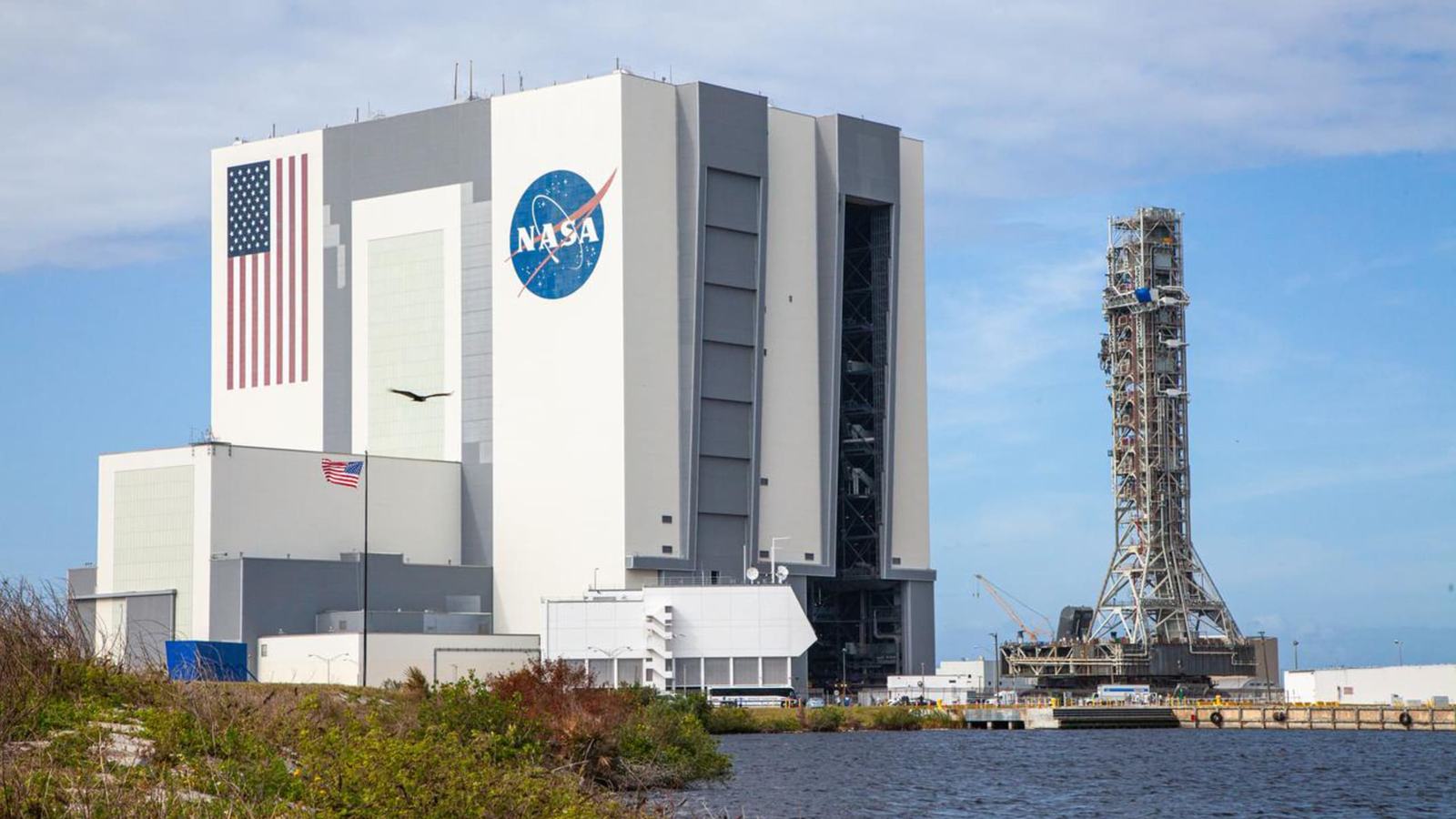
The colossal Vehicle Assembly Building is one of Kennedy Space Center's most recognisable landmarks. It was created to support the assembly and integration of launch vehicles, and its external scale signals the logistical difficulty of preparing large rockets for flight. The official visitor-complex photograph accompanying this guide shows the building as seen from the water, connecting the aerospace complex visually to the surrounding coastal setting.
The image does not imply that yachts may approach the facility by water. It instead provides a useful geographical reminder that Cape Canaveral is both a sophisticated spaceport and an active maritime region. On the authorised bus route, visitors may be able to see parts of the operational landscape, subject to restrictions. Reading the building's purpose before the visit makes a distant view far more rewarding.
Space Coast wildlife beside launch infrastructure
Kennedy Space Center occupies an unusual coastal landscape that also supports important natural habitats. The visitor complex's newer Gantry experience highlights the connection between spaceport operations and the local environment, while the wider region is known for waterways, wetlands and bird life. For guests spending much of their cruising season at sea, the juxtaposition of protected nature and immense engineering projects can be especially thought-provoking.
An excursion focused on scientific discovery should include respect for the landscape itself. Keep to authorised visitor paths and routes, avoid disturbing wildlife and understand that some areas are closed for environmental as well as operational reasons. The most successful itineraries do not attempt to turn every part of the spaceport into a photo stop, but give guests the context to appreciate how people and nature coexist in the area.
Launch-viewing expectations and the moving schedule
The possibility of seeing a rocket launch is exciting, but it should remain a bonus rather than the sole justification for a private-yacht call. Launch dates, windows and public viewing arrangements change with mission requirements, weather, technical readiness and security. A ticket to the visitor complex does not itself guarantee that guests will see a launch, nor does an advertised launch window guarantee liftoff.
Consult the operator's official daily calendar and NASA's mission information close to the intended visit, and confirm whether a viewing package or reserved position is required. Avoid shaping an entire yacht passage around a schedule that can move by hours or days. A rewarding backup plan is already built into the visitor complex: its museums, historic spacecraft and bus tour deliver substantial value when the sky is quiet.
A private approach to a public attraction
Luxury in this context comes from preparation and time, not necessarily from purchasing a special access product. Reserve transport to and from the port, obtain admission in advance where appropriate, identify the group's most important exhibits and consider whether official guided experiences are available for the desired date. Guests interested in detailed aerospace history may favour longer museum time over simulation attractions and souvenir stops.
The experience should be tailored to the party. For families, interactive galleries and the Rocket Garden can balance the demanding technical material. For owners, engineers and experienced captains, the Saturn V Center and launch infrastructure may be the highlights. Allow for walking distances, Florida heat and the possibility of afternoon storms, and keep a flexible return deadline so that the yacht's sailing programme is not compromised.
A full-day plan that respects both worlds
A sensible itinerary departs the yacht after a relaxed breakfast, uses prearranged ground transport and begins with orientation at the visitor complex. If the bus tour is operating, prioritise its boarding arrangements early and give the Gantry and Apollo/Saturn V Center adequate time. Return to the main exhibits for Atlantis, the Rocket Garden and selected galleries according to the group’s interests and the current schedule.
Before guests disembark in the morning, the captain should already have an agreed return time and contingency arrangement if the visitor schedule changes. A cultural day does not need an exhausting checklist to succeed. For superyacht visitors, Kennedy Space Center is memorable because it connects the precision of modern engineering with the extraordinary ambition of exploration—and reveals how much human effort lies behind a machine designed to travel far beyond the sea.