Koenigsegg's Sadair's Spear is a 30-car road-legal track machine. We examine its two fuel-dependent power ratings, active aerodynamics and exceptional collector appeal.
Thirty cars, one uncompromising purpose
Koenigsegg's Sadair's Spear occupies an extreme corner of the collector-car world: a road-legal machine developed with track performance as its overriding purpose and restricted to just 30 examples. The Swedish manufacturer introduced the model in 2025, drawing its name from a racehorse connected with Christian von Koenigsegg's family history. That story gives the car a personal identity, but the substance lies in engineering choices intended to make high performance more accessible on a circuit rather than simply more impressive on a specification sheet.
The model builds on Koenigsegg's expertise in carbon construction, active aerodynamics and lightweight engineering. The manufacturer describes a recalibrated balance between front and rear downforce, with aerodynamic devices designed to generate useful forces at track speeds. The result is a car whose shape is inseparable from the airflow it must manage. For collectors accustomed to beautifully designed road cars, the Sadair's Spear presents a different idea of luxury: mechanical and aerodynamic purpose expressed without apology.
Exclusivity is unavoidable when production is limited to 30 vehicles, but rarity alone does not explain the appeal. Owners must be genuinely interested in the way a car drives and the discipline required to enjoy performance responsibly. The engineering becomes most meaningful in a suitable environment, with training and appropriate maintenance. A beautiful garage photograph can capture its drama, yet it cannot demonstrate the forces, feedback or concentration that define a serious track-focused car.
A V8 with two very different power figures
At the centre of the car is Koenigsegg's twin-turbocharged five-litre V8 engine, paired with the marque's nine-speed Light Speed Transmission. The official technical specification quotes 1,300 horsepower when running on petrol and up to 1,625 horsepower with E85 fuel. Those figures must not be merged into a single claim. The higher output is associated with a particular fuel type and operating conditions, while the car's actual performance remains subject to calibration, weather and other variables.
The manufacturer lists a maximum torque figure of 1,500 newton-metres and an 8,500-rpm engine redline. It also describes an unusually light power unit with materials and systems designed to support a demanding performance application. Engineering of this kind increases the responsibilities of ownership. Correct fuel, servicing procedures, cooling performance and inspection routines are essential, particularly after sustained high-load use on a circuit.
Koenigsegg's transmission is intended to manage the immense power delivery, but its technical sophistication does not change the need for a thoughtful driver. Fast changes of gear and huge acceleration can be rewarding only when the person behind the wheel has a safe environment in which to experience them. Road legality is not an invitation to explore the car's limits in public traffic. For many owners, expert instruction and organised track access will be a more important part of the experience than any optional trim choice.
A carbon-fibre monocoque forms the basis of the structure. Koenigsegg gives the Sadair's Spear a dry weight of approximately 1,320 kilograms and a kerb weight of around 1,385 kilograms in its technical data. These figures illustrate the emphasis on keeping mass low, but comparisons with other cars should use the same weight definition. The real engineering achievement is combining lightness with substantial power, necessary safety systems and enough structural stiffness for precise handling.
Downforce that matters before ultimate speed
The Sadair's Spear uses an active, top-mounted twin-profile rear wing, a larger front splitter and several carefully managed airflow paths around the body. Koenigsegg says its aerodynamic work focuses partly on making downforce effective at speeds typical of circuit driving, rather than optimising solely for a theoretical maximum. That is an important distinction, because drivers need stable handling through braking zones and corners as well as on the longest straight.
According to the manufacturer's specification, the package can produce about 850 kilograms of downforce at 250 kilometres per hour, with a stated maximum significantly above that figure under its test conditions. Such measurements depend on aerodynamic setup and speed, and they should be interpreted as engineering data rather than an endorsement of public-road driving at extreme velocities. What matters is the relationship between the downforce, suspension, tyres and the confidence of an experienced driver.
The suspension incorporates electronically adjustable ride height and sophisticated dampers, including Koenigsegg's Triplex arrangements. Carbon-fibre components and lightweight wheels are part of the wider effort to improve response. Ceramic brakes and carefully chosen tyres complete the track-focused package. All these systems need to work together, because greater engine output without equally capable steering, braking and chassis control would make a very different and less coherent machine.
The Swedish marque also maintains a degree of usability. The technical equipment list includes climate control, an audio system, parking assistance and adjustable driving controls. These features do not turn Sadair's Spear into a conventional grand tourer, but they can make its occasional road use more manageable. A collector should distinguish such convenience from genuine everyday practicality, which is limited by the car's dimensions, ride height and specialised mechanical character.
A cabin that leaves the driving in focus
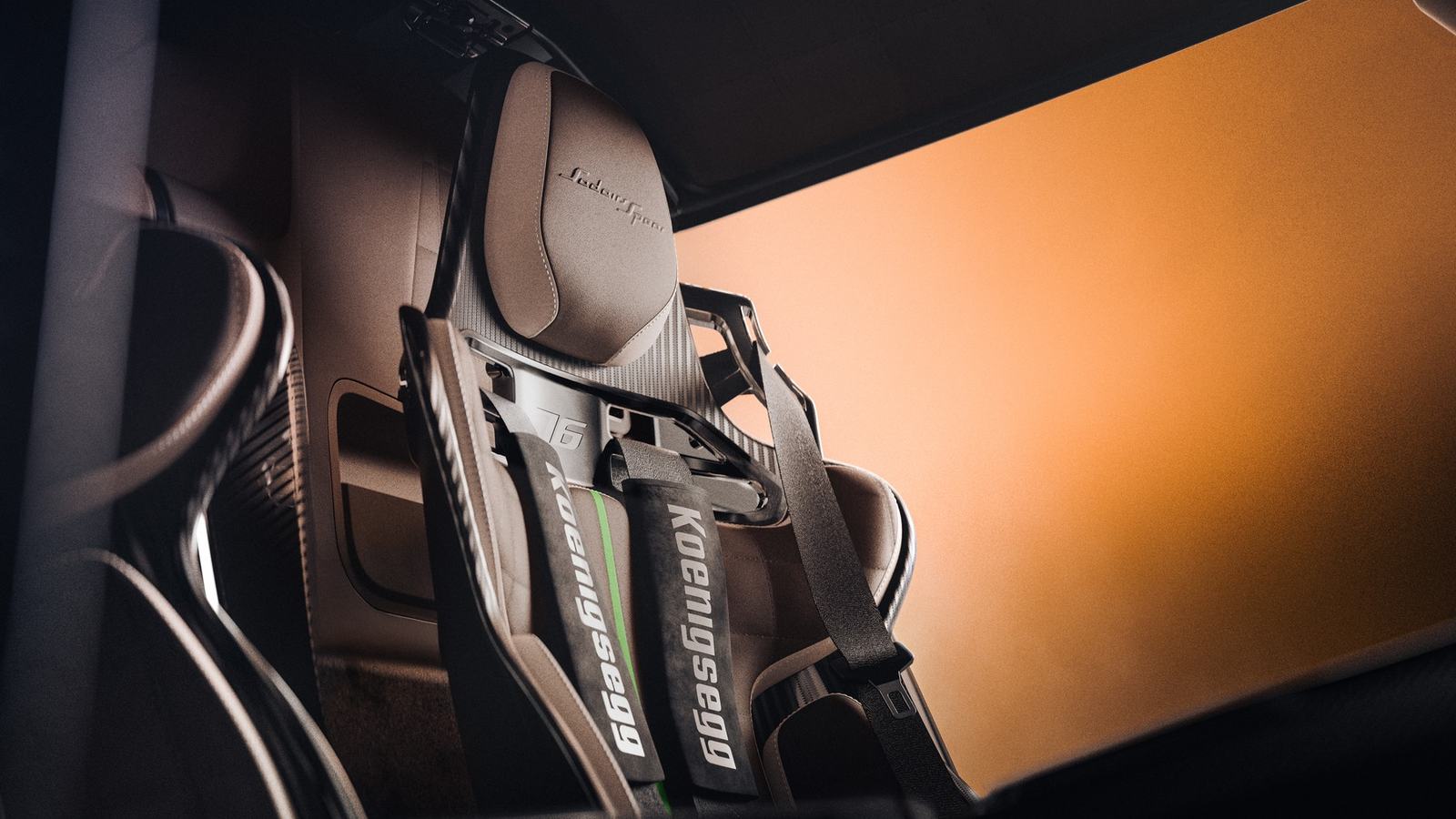
Inside, Koenigsegg describes a bespoke minimalist centre console and carbon-fibre seats, with options intended to suit more demanding track use. The design seeks to reduce distractions while retaining the sense of an individually crafted machine. For an owner, the most important cabin qualities may be driving position, visibility and secure support under acceleration and braking. Luxury here is less about soft furnishings than about careful ergonomics and the intelligent use of expensive materials.
The car's two-seat layout and lightweight construction also impose practical limits. Luggage capacity is modest compared with a grand touring coupé, and the manufacturer's detachable hardtop is not intended to be stored within the car. Such details may be unimportant to an enthusiast who transports the vehicle to selected events, but they are central to honest ownership planning. A collector should consider transportation, secure storage and access to specialist service facilities at the outset.
The value of a specialised car can be enhanced by an informed relationship with its maker and a disciplined maintenance record. Tyres, brakes and other consumables may experience unusual demands during circuit sessions, and even road use requires care around low ground clearance and unfamiliar surfaces. Responsible ownership is part of preserving a complex machine for the future. Rarity is meaningful only when the car remains mechanically and cosmetically well supported.
An uncompromising addition to a serious collection
For collectors who already own luxury sports cars, the appeal of Sadair's Spear is the clarity of its purpose. It represents a focused interpretation of Koenigsegg engineering in which active aerodynamics, light mass and substantial engine power are aimed at a coherent dynamic result. The 30-car production limit adds scarcity, but the engineering gives that scarcity a reason to matter. It is a machine created for an informed enthusiast rather than for effortless everyday commuting.
The model's significance should also be understood in time. Introduced in 2025, it is not being presented as an October 2026 product launch; this feature examines its established technical specifications and collector appeal. Its performance claims are conditional on fuel and test settings, and its extreme capabilities belong in appropriate, professionally managed environments. A well-informed owner will treat those distinctions as part of the attraction rather than an inconvenience.
Sadair's Spear demonstrates how contemporary ultra-luxury can take the form of engineering intensity. For the right collector, owning one of 30 is less about publicly displaying wealth than about understanding a particular mechanical achievement and using it with care. It is a car whose most compelling story begins after the garage door opens and the driver prepares for a circuit.