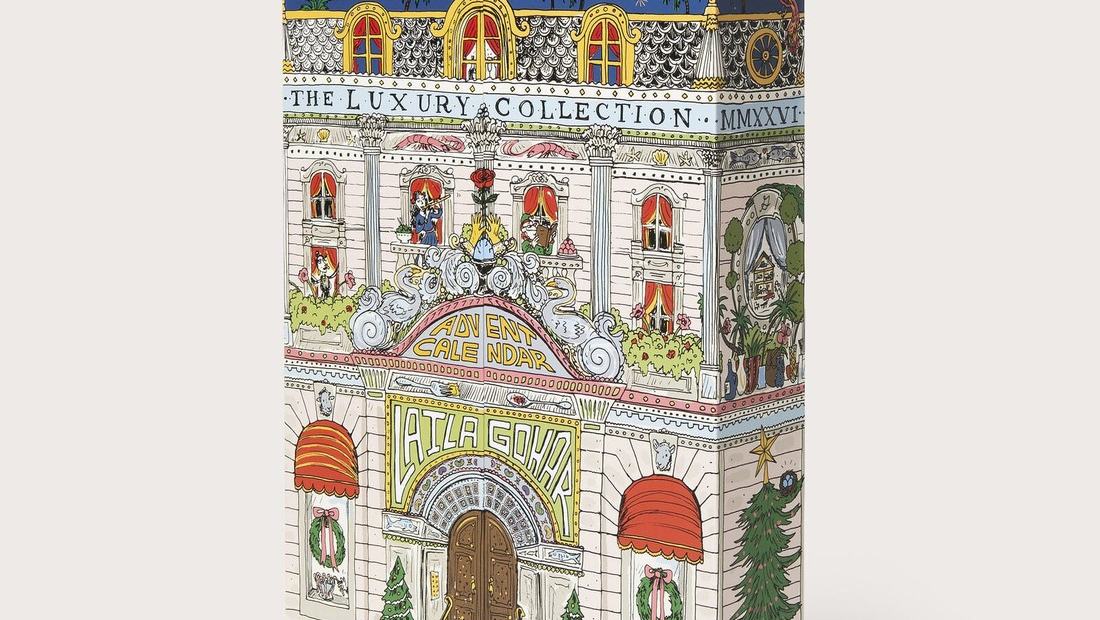
The Luxury Collection's Laila Gohar advent calendar offers 24 destination-inspired Casa Bosques chocolates behind Joana Avillez illustrations, with festive hotel pop-ups.
A festive calendar that travels the world
The Luxury Collection has introduced a limited-edition advent calendar designed with artist Laila Gohar, turning the familiar ritual of opening a numbered drawer into a tour of 24 hotel destinations. The collaboration, announced by Marriott International on 3 November 2026, brings together Gohar's approach to food and design, illustrations by Joana Avillez and chocolates developed by Casa Bosques. Each sweet is associated with a place in the hotel portfolio, making the calendar as much an exercise in destination storytelling as a seasonal gift.
An advent calendar usually measures anticipation in small daily increments. This one asks its owner to consider travel as part of the experience: a flavour recalls a coast, city or regional ingredient, while the packaging takes the form of an imaginary grand hotel. There is a distinction between a culinary idea inspired by a place and the actual food culture of that destination. The Luxury Collection is offering an interpretation, not claiming to reproduce every local recipe or tradition in a single chocolate.
Laila Gohar gives the project its character
Gohar is the hotel brand's Epicurean Global Explorer, a role that connects her work in food, art and design with the destinations represented by The Luxury Collection. In this project, she has shaped both a product and the surrounding presentation, including pop-up retail settings. Her involvement gives the concept a visual and culinary through-line. The calendar does not need to resemble a conventional gift box when it can borrow from the architecture and theatrical atmosphere of an imagined hotel.
The artistic approach is important because many premium seasonal gifts rely on elaborate packaging without giving the contents an equally specific identity. Here, the chocolates have named flavour connections and the box has original artwork. That does not establish the quality of every chocolate before it is tasted, but it makes the concept more considered. The project invites a recipient to open a different part of the fictional hotel every day, with the details encouraging curiosity about a real destination.
Illustrations by Joana Avillez
Joana Avillez has supplied the original illustrations for the grand hotel-inspired façade, giving the calendar its playful characters and architectural detail. The 24 numbered compartments sit behind this scene, so the object can be displayed as well as opened. The design aims for something closer to a miniature illustrated building than a row of plain cardboard doors. For those interested in decorative objects, the packaging is a substantial part of the gift, although its ultimate appeal is necessarily subjective.
Avillez's contribution also makes the calendar a collaboration across disciplines. Gohar brings an artistic and culinary vision; the illustrator creates a visual setting; the chocolatiers work with flavours informed by individual destinations. Those roles should not be conflated. The official announcement credits Casa Bosques founder Rafael Prieto and collaborating hotel culinary teams for the chocolate creations. It is that combination of creative responsibilities that turns a straightforward seasonal purchase into a more ambitious design proposition.
Twenty-four chocolates and their origins
Casa Bosques founder Rafael Prieto developed the chocolates with culinary contributors from The Luxury Collection hotels. The official product listing identifies 24 flavours, each mapped to a property, offering more detail than the general announcement. South Caicos is represented by toasted coconut flakes and sea salt, while Waikiki pairs banana and sea salt. Solaz in Los Cabos contributes a combination of smoked mesquite, dates and salt; Las Alcobas in Mexico City suggests candied orange peel and ancho chilli. These are deliberately specific choices.
Elsewhere in the selection, the Palace Hotel in San Francisco is linked to almonds and Meyer lemons, and The Phoenician in Scottsdale to jalapeños. Nashville's The Joseph appears through pecan praline; Savannah's Perry Lane uses milk-chocolate pecan praline. The flavours do not constitute a formal ranking of regional cuisines. Instead, they are small edible cues, intended to evoke aspects of a hotel's location through familiar ingredients or unexpected combinations. Whether each association feels convincing is a question for the person opening that particular drawer.
A route through Asia and Europe
The Asian portion of the calendar includes golden sesame paste for The Prince Gallery Tokyo Kioicho, black sesame with cacao shell and nibs for Kyoto's Suiran, pineapple for The Laurus in Singapore and roasted cashew for TA'AKTANA in Labuan Bajo. Indian destinations receive cardamom for ITC Grand Bharat and coconut-sugar candied ginger for ITC Grand Chola. Together, those selections create a sequence of contrasts, from fruit and nuts to spice and toasted flavours, without reducing the region to one recurring note.
European properties offer another set of combinations. Munich's Koenigshof appears through pistachios and raspberries, while Prince de Galles in Paris uses hazelnut praline. The Gritti Palace in Venice is represented by hazelnut butter and roasted hazelnuts; Madrid's The Palace combines dried strawberries with violet flowers. Vienna's Hotel Imperial has almond marzipan, and Hotel Marqués de Riscal in Elciego brings together black cherry, liquorice, cinnamon and black pepper. The list reads like an itinerary that moves according to taste rather than geography.
From Dubai saffron to a Peruvian valley
The calendar extends beyond the more obvious luxury-travel capitals. Al Maha, a Luxury Collection desert resort near Dubai, is associated with saffron. Tambo del Inka in Peru's Sacred Valley is linked to cacao nibs and puffed quinoa. Isla Mujeres appears through Almare's hibiscus and pink peppercorn. Dalian's Castle Hotel uses dried black cherries. Every flavour is set against a named hotel, a useful device for turning product information into destination discovery rather than treating the sweets as a collection of unidentified indulgences.
The destination connections also illustrate the limits and possibilities of culinary storytelling. A single spice cannot explain an entire culture, and the calendar does not pretend to be a scholarly guide. It may nevertheless prompt someone to look more closely at a region or property they had not previously considered. For an audience that travels frequently, the interest may be recognition. For someone who has never visited the places involved, the experience can begin as curiosity about a map encountered through a small box of chocolates.
Pop-up shops add a theatrical setting
The collaboration includes retail pop-ups at selected Luxury Collection hotels, conceived by Gohar with references to old-world Parisian chocolate shops and Milanese apothecaries. The installations present the calendar within display windows and banks of drawers, making the shopping experience more theatrical than a standard checkout counter. The Prince de Galles display in Paris includes scenography devised by artist and set designer Alix Bortoli, who uses the chocolates' ingredients as part of an imaginative visual landscape.
Announced pop-up locations include Prince de Galles in Paris, The Joseph in Nashville, Solaz in Los Cabos and The Laurus in Singapore. The hotel group also describes selected festive programming associated with its wider World In Season approach. Specific participation, hours and merchandise may change, so travellers should confirm details with the individual property before planning a visit around a display. The important idea is that the retail presentation is meant to connect the box with an actual hospitality space.
Price, availability and practical details
The limited-edition calendar is listed at $218 through The Luxury Collection's official online boutique in the United States, with additional availability through Gohar World in selected countries and at participating hotel pop-ups. This makes it a premium seasonal item rather than a mass-market chocolate assortment. The official product page also states that the item is final sale and cannot be returned after purchase. Those terms matter, especially for anyone ordering a fragile or food-based gift across a significant distance.
The product information identifies milk, nuts and seeds among the allergens, which should be checked carefully before gifting. Because the flavours range across different ingredients, it would be unwise to treat the calendar as suitable for someone with an allergy without checking the complete current label and seller guidance. International buyers should establish whether their market is covered and how the chocolates will be transported. The announcement does not provide a comprehensive delivery guarantee for every destination, and seasonal availability can change.
World In Season as a hospitality idea
The Luxury Collection describes the project as part of its World In Season platform, which looks at places through the celebrations, tastes and traditions that shape particular times of year. The advent calendar is a small, portable expression of that approach. At a hotel, a guest can experience an environment through food, architecture and service. In the calendar, those strands have been compressed into illustration, a short flavour idea and the physical act of opening a numbered compartment.
That compression is both the charm and the constraint of the concept. A hotel destination is not something that can be fully reproduced by a sweet, no matter how thoughtfully designed. Nevertheless, a calendar can offer a memorable starting point for conversation about places. The strongest feature of the collaboration is the way the product provides concrete destinations and ingredients rather than a vague promise of global inspiration.
A gift at the intersection of travel and design
The Luxury Collection's 2026 calendar sits between confectionery, decorative design and luxury travel merchandising. Its purpose is not to replace a journey but to use the idea of journeys to make a holiday ritual more distinctive. Original illustrations, a specific list of flavours and pop-ups in real hotels give the project several points of engagement. People who value collectible packaging may be drawn to the illustrated façade, while others may find the appeal in discovering different sweet and savoury notes.
At $218, the decision should rest on the design, contents, recipient and suitability of the gift, not on an assumption that a luxury hotel name guarantees universal appeal. The collaboration is most persuasive when considered on its stated terms: a playful, curated journey through 24 destinations created by artists and chocolatiers. For travellers, it offers one more example of how hospitality companies are taking their sense of place beyond accommodation and into objects meant to be enjoyed at home.
Editorial source: Marriott International / The Luxury Collection official news release, 3 November 2026. This original lifestyle feature is based on information from the named source; confirm current availability, specifications, travel dates and booking conditions with the relevant provider.