Tomorrow's Cologne auction brings together signed jewellery, historic tiaras, twentieth-century goldsmithing and watches from Cartier and Patek Philippe.
A November sale spanning four collecting traditions
Tomorrow, 19 November 2026, Cologne auction house Lempertz will offer 280 lots of jewellery and watches from a number of private collections. The official announcement for auction 1298 identifies signed Parisian jewellery, Belle Époque tiaras, the work of twentieth-century German goldsmiths, and collectible wristwatches among the principal attractions. The sale is scheduled for 2 pm local time after a series of previews in Brussels, Munich and Cologne. Its significance is not simply the presence of internationally recognised jewellery houses. It offers a comparison between objects valued for their signature, historical association, gemstones or highly individual artistic construction. For yacht-owning households with established collections of jewellery and decorative arts, the event illustrates the diversity of the European secondary market. All figures quoted here are presale estimates published by Lempertz. They are neither achieved prices nor independent valuations of individual objects.
Cartier and the distinctive vocabulary of the panther
Several works consigned from one private collection represent different manifestations of Cartier's familiar feline designs. Lot 133, a Mahango Panthère demi-parure, carries an estimate of €30,000 to €50,000. The catalogue also identifies a Grand Modèle Maillon Panthère necklace, lot 128, at €20,000 to €30,000, and a corresponding bracelet, lot 129, at €30,000 to €50,000. The latter two are set with pavé diamonds. Collectors considering the group should distinguish between the visual identity of a particular collection and the documentation establishing each piece's manufacture, age and history. A matching design need not mean that two individual objects were first sold together. The current condition of articulated links and fastening mechanisms is another consideration, especially for a piece intended to be worn frequently rather than kept exclusively in a collection. Measurements, signatures, identification marks and any evidence of alterations should be assessed through the individual catalogue entries and direct inspection.
Rubies and the language of floral jewellery
The auction announcement highlights a pair of Camélia ear clips by Van Cleef & Arpels from the 1970s, lot 149, estimated at €50,000 to €70,000. Their composition incorporates rubies and diamonds within gold and platinum. A floral motif provides an alternative to the repeated geometric arrangements often associated with twentieth-century formal jewellery. The effect depends on the relationship between the stones, the proportions of the setting and the way in which the piece appears when worn. An auction photograph can help establish the overall composition, but may not convey colour accurately under the varying conditions in which the owner will use the earrings. Those considering a gemstone-led acquisition should establish which gemmological reports are available and what conclusions those documents actually support. The maker's signature, artistic interest and gem quality are related dimensions of value, not interchangeable measures. The published estimate does not itself establish the origin, treatment history or individual value of every ruby.
An aristocratic tiara with literary associations
Lot 39 is a Belle Époque tiara in white gold with diamonds, attributed in the catalogue to Georges Carpentier in Paris around 1910. Lempertz traces it by descent from the family of the French Romantic writer Alphonse de Lamartine. That is a family provenance, not a claim that the nineteenth-century poet personally commissioned or wore a piece made several decades after his death. Its accompanying original case bears the name of the jeweller Hubert Martincourt. With a presale estimate of €30,000 to €50,000, the object offers a combination of historical setting, period design and surviving associated material that can be of particular interest to a private collector. Lot 16 provides another approach to the same category, using dog-rose forms with rose-cut diamonds and a central emerald. It is estimated at €15,000 to €20,000. The suitability of either tiara for contemporary wear should be assessed separately from its historical appeal, especially where changes to fit could affect significant original elements.
Hemmerle and jewellery conceived as an individual object
Lempertz identifies a naturalistic mushroom brooch by Munich jeweller Hemmerle, lot 121, as a notable example of the house's distinctive approach. The piece represents a saffron parasol mushroom and uses diamonds to convey its form. Its estimate is €20,000 to €30,000. Lot 125, also by Hemmerle, is a cocktail ring set with an approximately 8.84-carat emerald-cut diamond and is estimated at €30,000 to €50,000. The contrast between the two objects illustrates why a collection might distinguish a gem-centred acquisition from a work in which the entire sculptural idea is important. A comparatively unusual subject can make a piece particularly meaningful to a collector interested in the creative history of jewellery. Conversely, a large diamond may invite a detailed assessment of the individual stone alongside the setting. Both categories still require close examination of condition and the available documentation before a purchaser makes a commitment at auction.
Cologne goldsmiths provide a different collecting perspective
The sale includes works associated with Elisabeth Treskow and members of her artistic circle. A laurel-wreath necklace by Wilhelm Nagel, incorporating a star ruby, appears as lot 167 with an estimate of €12,000 to €15,000. Falko Marx's work is represented by a water ring and related bangle, lots 86 and 87, each estimated at €7,000 to €9,000, and by an elaborate brooch from 1979 combining gold, sheet iron, diamonds and coloured stones, lot 89, at €8,000 to €10,000. These works invite consideration of the individual maker's development and the artistic use of materials rather than an evaluation based only on precious-metal weight. Further reflecting the breadth of the sale, lot 107 is an Art Deco silver cuff with onyx by Jean Després, estimated at €10,000 to €15,000. Collectors may find connections between such jewellery and the decorative or sculptural objects they already collect. The individual documentation and authenticity assessment remain important even where the intended acquisition is primarily artistic rather than financial.
The wristwatch selection
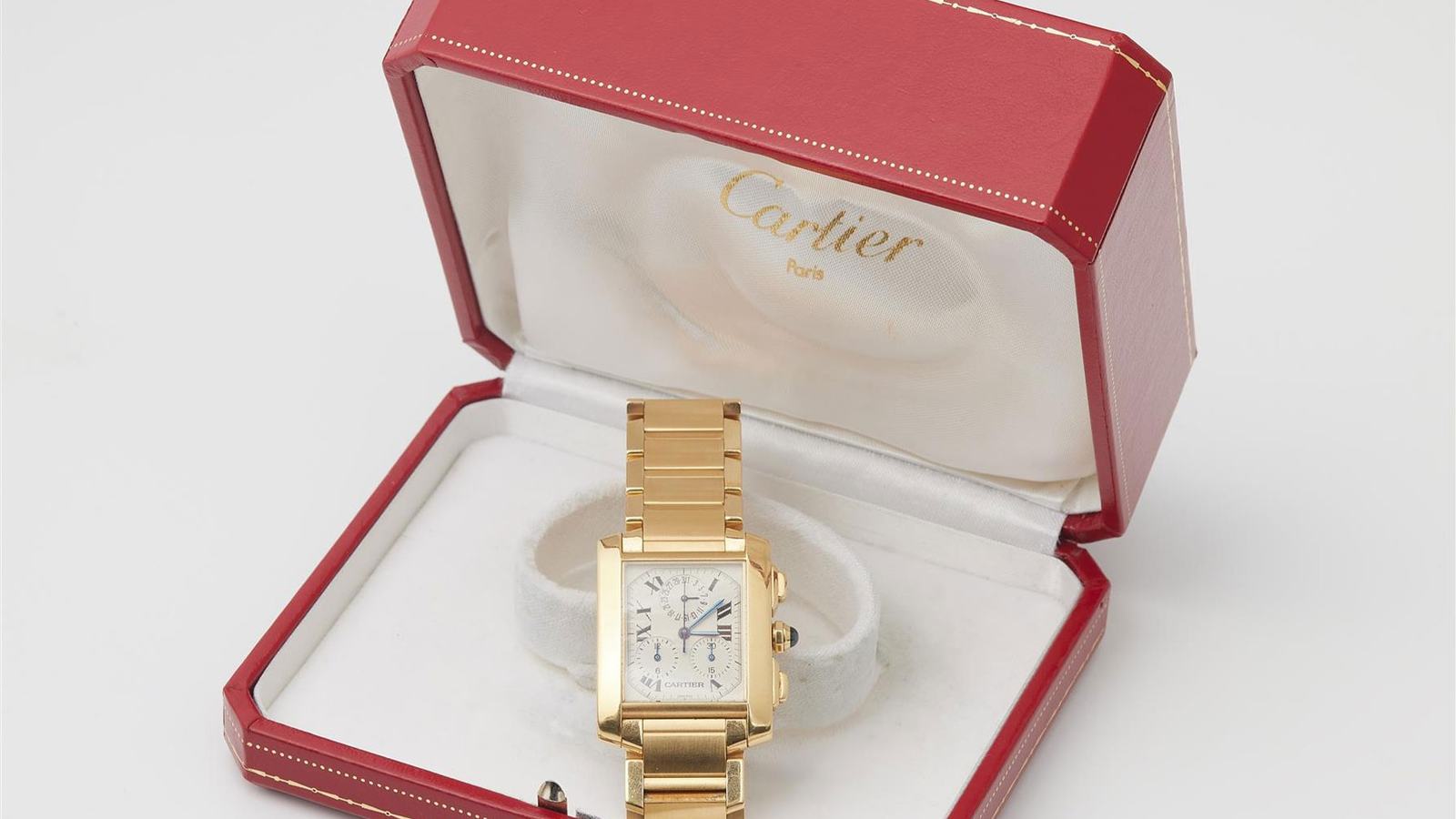
A Cartier Tank Française XL, reference 1830, appears as lot 264 with a yellow-gold case and a presale estimate of €15,000 to €20,000. The accompanying detail photograph is from the auction house's press material for this lot. The selection also includes a ladies' Patek Philippe Nautilus, reference 4700/51, and an Ellipse d'Or wristwatch in white gold, lot 274, estimated at €12,000 to €14,000. These watches offer different interpretations of a precious-metal wristwatch and different considerations for collectors. A wristwatch can contain mechanically or electronically operated components requiring specialised inspection and ongoing maintenance. Its reference identifies a particular model, but does not by itself establish the originality or condition of every component of an individual example. An interested bidder should examine the full description, accompanying documents, movement condition and any information about servicing or replacements. The suitability of a valuable vintage watch for everyday use at sea should also be assessed separately from its aesthetic or historical character.
Acquiring and managing jewellery in an international household
The catalogue extends to loose gemstone-led pieces and a vintage Hermès Kelly bag from 1968. These objects present different responsibilities after acquisition. A collector who transfers valuable jewellery between a residence, yacht and other destinations should consider secure custody and the territorial conditions of insurance. Items containing particular natural materials may also be subject to movement restrictions; a historical date or an auction purchase does not automatically establish permission to import or export them. The sale's circa-1890 brooch made with coral, lot 15, makes that distinction especially pertinent. An independent specialist can identify the relevant material and any documentary requirements before cross-border movement. Significant stones and antique settings should be inspected by an appropriately qualified professional before regular wear. In a family collection, a detailed inventory can help trustees, heirs or insurers distinguish an individual object from superficially similar examples and retain information relating to provenance, acquisition and condition.
Tomorrow's sale and the limits of the estimates
The auction house's published schedule provides a final Cologne preview today until 5:30 pm, with tomorrow's auction beginning at 2 pm. Interested collectors should consult the current catalogue and the conditions of sale to establish registration, payment, buyer's charges and arrangements for collecting or transporting purchases. An auction estimate does not include every possible acquisition expense and does not predict what a competing bidder will be prepared to pay. The breadth of the selection makes the sale particularly useful for comparing collecting approaches at different price levels. Whether a bidder is attracted by a Cartier signature, the historical association of a tiara or the particular artistic vocabulary of a modern goldsmith, the assessment ultimately concerns the individual piece. The forthcoming sale therefore provides a timely view of the European jewellery market without yet establishing any sale results.
Primary source: Lempertz official press announcement and auction 1298 programme, checked 18 November 2026.
Photography: Lempertz, official press photograph accompanying auction 1298, Cartier Tank Française XL reference 1830. Official source.
