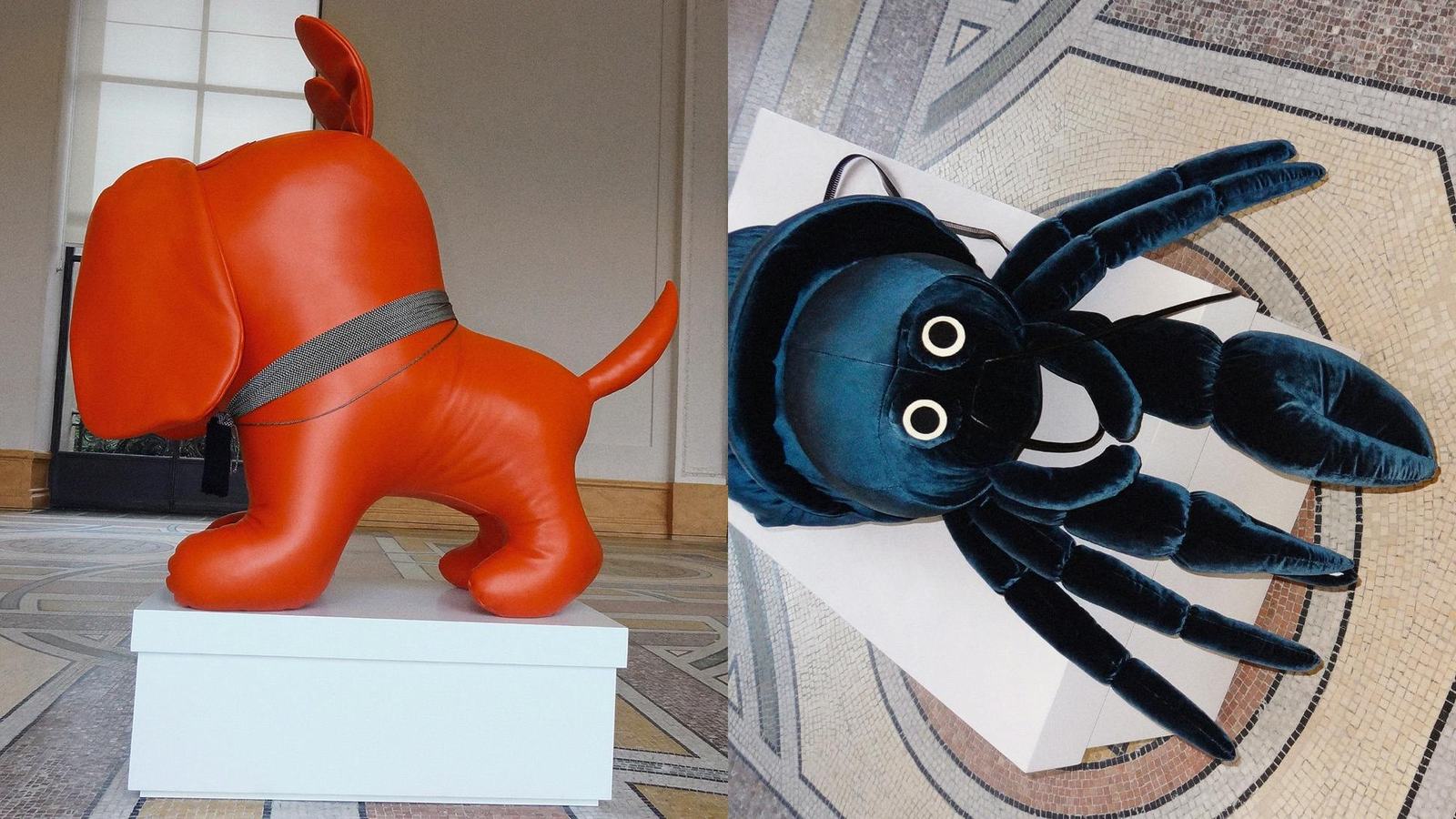
A review of Loewe's collaboration with Cosima von Bonin explores how textile sculpture moved from the fashion runway into the Petit Palais during Art Basel Paris.
The relationship between high fashion and contemporary art was given an unusually tangible expression at Art Basel Paris this autumn, when a group of oversized textile sculptures by German artist Cosima von Bonin appeared at the Petit Palais. The works had originally been commissioned for Loewe's autumn-winter 2026 presentation under the creative direction of Jack McCollough and Lazaro Hernandez. Their subsequent appearance in the historic museum formed part of the art fair's public programme, according to an account published by Loewe's parent company LVMH on 28 October 2026.
The installation, entitled Dollys & Beaux, was organised by the Gaga, Neu and Petzel galleries. Among the creatures associated with the project were a leather octopus, a whale made with mohair and a velvet Saint Bernard. Their journey from a fashion presentation in March to an art setting in October provides a useful illustration of the increasingly interconnected interests of collectors of contemporary art, fashion and objects of design. For this November lifestyle review, the interest lies in those relationships rather than in suggesting that the temporary installation is still open.
The migration of an object between settings
An object does not necessarily communicate the same ideas in every setting in which it appears. At a runway presentation its relationship with the garments, movements of the models, lighting and staging can influence the way an audience perceives it. In a museum it may be viewed at a different pace and in relation to the surrounding collection, architecture and other visitors.
Loewe's March presentation placed von Bonin's creatures in a setting in which clothing was the principal commercial subject. Their October installation gave the public an opportunity to encounter the art in a different environment. The museum's existing sculptures provided a contrasting backdrop to the textile forms, while fabrics and accessories incorporated into the contemporary objects added further layers of reference to fashion.
LVMH describes several of the runway pieces as having inspired elements of Loewe's collection, including a version of the Amazona 180 bag. This is an identifiable link between the two creative disciplines. It does not establish that purchasing a related fashion accessory is equivalent to owning one of von Bonin's artworks. The objects occupy different markets and should be evaluated on their individual qualities and provenance.
Textile materials in contemporary sculpture
The choice of a soft material to represent a creature affects both the appearance and the interpretation of the work. A viewer may associate velvet with upholstery and clothing, mohair with tactile warmth and leather with the craft of fashion accessories. In a larger sculptural form, these familiar materials can produce a different reaction because they are no longer being used in an ordinary utilitarian way.
Textile sculpture also presents particular practical challenges. Its structure may depend on supports or internal materials that are not immediately visible. Its surface may be vulnerable to pressure, dust, light or changes in humidity. The technical construction of any individual artwork is a matter for its creator or the professionals who care for it, and cannot be inferred solely from photographs.
For collectors who are accustomed to considering paintings or metal sculptures, work made from textile materials may demand a different approach to acquisition and display. A conservator can advise on the conditions appropriate to a particular object, including the implications of repeated handling or relocation. The visual accessibility of a playful object does not make its conservation requirements less significant than those of a more traditional sculpture.
Why the Petit Palais provided a distinctive context
A historic museum establishes architectural expectations even before the visitor encounters a work of art. Formal stairs, decorated surfaces and permanent sculpture may encourage associations with established traditions of display. An oversized animal with an exaggerated shape can interrupt those expectations and draw attention to the conventions of the setting itself.
In the October installation, the contemporary creatures appeared within the Petit Palais alongside historic sculpture. The contrast offered viewers a way to consider the different roles that materials, scale and subject matter play in the production of an artwork. A fabric creature can be immediately recognisable without being intended as a naturalistic representation. Its exaggerated character may invite amusement while simultaneously encouraging reflection on the objects traditionally treated as worthy of formal exhibition.
The galleries' participation in Art Basel Paris also places the installation within the context of contemporary art presentation rather than exclusively fashion promotion. It brought a project that had been experienced by the runway audience into a public-facing cultural environment. The published account does not provide individual sale terms or a list of the works available to acquire.
Creative collaboration beyond conventional licensing
Collaborations between artists and fashion houses can take various forms. In some cases a designer incorporates a graphic motif from an existing work into a product. In others the artist contributes directly to the development of a setting, a performance or a collection. The significance of a collaboration is best considered through the actual work produced rather than through the prominence of the names attached to it.
In this instance the sculptures were commissioned for a presentation and subsequently shown in a different context. This demonstrates a connection that extends beyond the application of a recognisable image to a product. The artist's work was a visible part of a larger creative environment, and elements associated with it in turn informed some of the fashion pieces.
For the fashion collector, it can be worthwhile to document those connections. The date of a collection, its creative direction and the relationship between a particular item and its associated presentation may give a piece an interesting place within the history of a house. That interest should not be confused with an assurance that an object will appreciate in monetary value.
Collecting fashion and contemporary art
There are important differences between acquiring fashion and acquiring a unique artwork or an edition. A collector of bags may be concerned with the condition of the exterior, completeness of associated accessories, manufacturing details and authenticity. A contemporary art collector may also need to establish the artist's intended presentation, the status of an edition, the ownership history and any installation requirements.
Provenance and documentation
The documentation associated with an acquisition should therefore reflect the nature of the object. For an artwork made of unconventional materials, the condition report and any instructions provided by the studio may be particularly important. The documentation needed when acquiring a related fashion product will be different. The fact that both objects share a creative origin does not erase those distinctions.
At the luxury end of both markets, scarcity can attract considerable attention. It is nonetheless necessary to establish whether an object is genuinely unique, an officially numbered edition or simply a product available for a specified period. A public brand announcement that describes a collaboration may not disclose all the information required to evaluate the status of an individual item.
Thinking about art within a private yacht
Collectors furnishing a private residence or superyacht often face decisions about how contemporary artworks relate to the wider interior. The scale and visual character of a sculpture can have a substantial impact on a space, particularly when it departs from the palette or forms of the surrounding furnishings. The example of the Petit Palais suggests one possible approach: deliberate contrast rather than the repetition of a uniform decorative language.
A yacht also introduces practical constraints that do not ordinarily arise in a static gallery. Movement, vibration, changing climatic conditions, restricted access and the need for secure installation must be considered. A large textile sculpture may require specialist advice on fixing arrangements, protection and the conditions within its intended display area. The owner should also consider the implications of moving the work between the yacht and residences over time.
There is no indication in the October announcement that the works were commissioned for yachts or that any of them are available for marine installation. The relevance of the exhibition for yacht owners is its demonstration of an aesthetic relationship between fashion, sculpture and interior context, not a specific yacht furnishing proposal.
Looking back at a particular cultural moment
The autumn installation belongs to a particular sequence of events in 2026. It followed the March Loewe presentation and was shown during the October gathering of the international contemporary art market in Paris. No current visitor availability is implied by this retrospective. Further details of future exhibitions or the availability of the artist's work should be obtained from the relevant galleries.
Its broader interest endures beyond the dates of the fair. The project shows how a fashion presentation can provide a space for contemporary art while a public installation can reveal new aspects of objects first encountered in a commercial creative setting. For collectors whose interests encompass fashion, design and fine art, the value of such a collaboration is not confined to the resulting products. It also lies in the new contexts in which the creative work can be experienced and understood.
Primary source: LVMH official Loewe feature, 28 October 2026.
Photo: Loewe / LVMH official editorial gallery accompanying the October retrospective. Official source.
