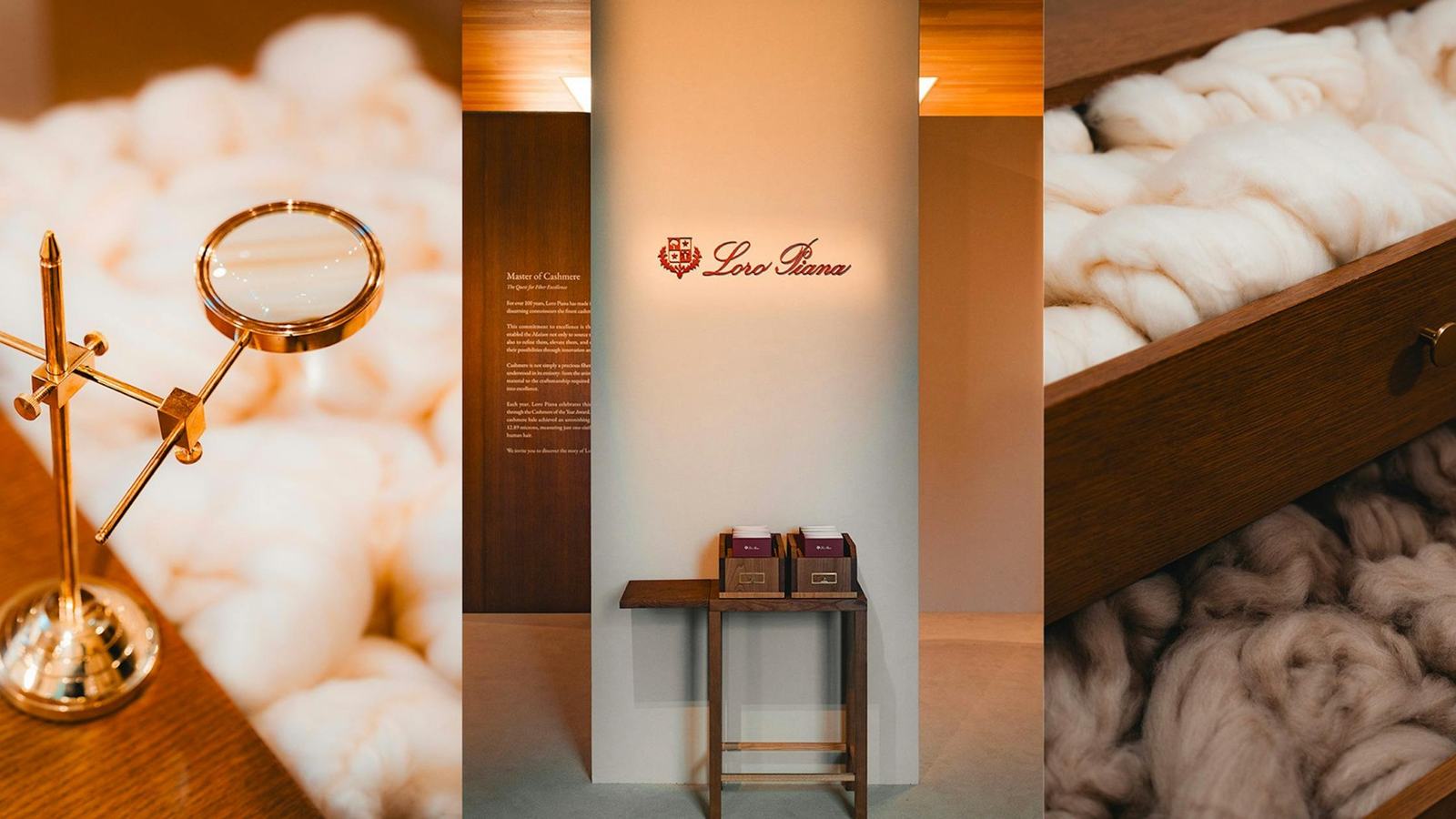
Loro Piana’s 11th Cashmere of the Year Award recognises Inner Mongolian herders and their 2025 production, celebrated alongside a New York exhibition.
The eleventh award recognises the people behind the fibre
On 10 November 2026, Loro Piana presented the eleventh edition of its Cashmere of the Year Award at the Brant Foundation in New York. The results, announced by parent group LVMH on 12 November, recognise three couples of herders from Inner Mongolia, China, for cashmere produced in 2025. The winning submission comprised 135.8 kilograms of washed cashmere with a reported fibre diameter of 12.89 microns. An accompanying exhibition, Master of Cashmere: The Quest for Fibre Excellence, examines the connection between the source of the material and the work undertaken to transform it.
For clients accustomed to selecting exceptional textiles, the award is interesting precisely because its attention is directed toward the earliest stage of production. A finished garment or furnishing can conceal the amount of work involved before a fibre reaches a spinning or weaving operation. The award recognises producers through a measurement of the material they supply, while the exhibition explains a broader sequence of craftsmanship. It offers an opportunity to consider the relationship between measurable fibre characteristics, the management of natural resources and the qualities experienced in a completed textile.
What the 12.89-micron result describes
A micron is one millionth of a metre. Fibre diameter is a particularly useful measurement in considering cashmere because the fineness of individual fibres contributes to the way a textile feels against the skin. The number published for the winning submission is a measurement of the fibre, not the thickness of a finished piece of fabric. Nor does it establish that every fibre in a particular finished product has that precise diameter.
Other properties also matter to textile quality. The length and consistency of fibres, their strength and the way they are selected and processed can influence the resulting yarn. Spinning, weaving or knitting, finishing and garment construction introduce further variables. A very fine material may be selected for qualities of softness and delicacy, but the suitability of a textile depends on its intended use. A garment designed to be worn next to the skin involves different considerations from a heavy throw intended for occasional use in an interior. The award is therefore best understood as recognition of one significant property at a defined stage of production, rather than a comprehensive ranking of every textile that might ultimately be manufactured from the fibre.
Three awards and the quantities of the recognised material
LVMH identifies the first-prize recipients as Mr. Siqingbilige and Mrs. Hasiqiqige. Their 135.8-kilogram washed submission was measured at 12.89 microns. Second prize went to Mr. Jiyatu and Mrs. Gegentuya for 87.1 kilograms at 13.01 microns, and third prize to Mr. Lifuqiang and Mrs. Qiqi for 116 kilograms at 13.04 microns. The results relate to the herders' 2025 production.
The presence of a quantity alongside each diameter measurement is important. The recognition concerns actual production rather than merely the examination of a single exceptionally fine fibre. The result identifies the washed quantities that were recognised by Loro Piana, but the release does not describe the complete sampling methodology, variation within each submission or distribution of other characteristics such as fibre length. Readers should therefore avoid drawing conclusions that extend beyond the published measurements. The three results demonstrate the closeness of the reported diameters while also recording differences in the quantities submitted. Credit for this material belongs to the identified producers, whose work precedes the processes carried out by the Maison.
Financial recognition and the silver comb
The Cashmere of the Year Award was established in 2015. According to LVMH, the winning producers receive a financial reward per kilogram of the fibre recognised by the award. The first-prize recipients also receive a crafted silver comb representing the traditional combing associated with cashmere collection. The group says the fineness of winning fibres has improved since the initiative began.
Rewarding suppliers directly for the characteristics of a raw material establishes a connection between the desired product quality and the work needed to produce it. The significance of such an arrangement depends on its precise terms and on the economic circumstances in which producers operate. The November release does not give the size of the payment per kilogram or establish how the award affects the income of herders who do not receive a prize. It therefore provides evidence of the award mechanism rather than a comprehensive account of the economic effects of Loro Piana's sourcing programme. The silver comb adds a symbolic element by drawing attention to the collection process. Its significance lies in the acknowledgement of a skill associated with the source of the material, rather than simply the use of a precious metal in a presentation object.
The Brant Foundation exhibition and the textile journey
The exhibition at the Brant Foundation in New York is described as an immersive presentation of the journey from the Mongolian steppes to the Maison's creations. Its focus is on the processes through which a raw natural material becomes a completed textile. The programme accompanies the awards ceremony and offers viewers an opportunity to consider the relationship between the people who supply fibres and those who subsequently work with them.
For someone familiar with finished luxury garments, the sequence of production is worth examining in its own right. The selection and preparation of fibre precedes the creation of yarn, which in turn must be transformed into a fabric or knitted structure appropriate to a particular use. The desired feel of a textile needs to be considered alongside its behaviour during manufacture and its properties during use. The appearance of the completed object is consequently the result of decisions made at multiple stages. An exhibition devoted to the material can provide a different understanding from a retail presentation that concentrates on the finished collection. The announcement does not give complete visitor arrangements or the closing date of the exhibition; anyone planning to attend should check those details directly with the venue.
The Alashan goat and the management of natural resources
The group identifies the Loro Piana Method, introduced in 2009, as a programme intended to improve cashmere quality while contributing to the preservation of the Alashan goat. This places the quality of the fibre within the context of the animals and the environment from which it originates. The award is presented as one component of a longer relationship with producers rather than a single annual encounter with an anonymous supply chain.
For purchasers concerned with provenance, fibre traceability and environmental performance are related but distinct questions. The existence of a programme to improve a material does not itself establish the sustainability of every item sold under the associated brand. A meaningful assessment requires information about the source of the material, the relevant production practices and the environmental conditions in which those practices take place. In the case of a natural animal fibre, animal care and the management of grazing resources are among the important considerations. LVMH's description identifies the scope and intended contribution of the Maison's method but does not supply independently verified measurements of every environmental outcome.
Resilient Threads and the landscape of production
In 2025, Loro Piana launched Resilient Threads in partnership with the United Nations Convention to Combat Desertification. LVMH describes the programme as supporting herding communities and biodiversity in the Mongolian steppes. The initiative connects the issue of fibre production to wider questions concerning the resilience of landscapes and the people whose livelihoods depend on them.
That relationship matters because the environmental characteristics of a grazing region influence the conditions in which high-quality natural fibres can be produced over time. A focus on the material alone can obscure the dependence of production on the health of the surrounding landscape. It is also important to distinguish Inner Mongolia in China, the location identified for the annual award winners, from Mongolia when considering the geography of regional initiatives. They are not interchangeable jurisdictions. The November release does not establish that the winning producers are individual beneficiaries of Resilient Threads. The programme and the award should be understood as distinct initiatives described together by the group. Their longer-term results would require examination of project reports and other relevant evidence.
Selecting cashmere for a private wardrobe or yacht interior
For owners choosing exceptional textiles, the awards highlight the value of asking questions that go beyond a brand name or a description of softness. The intended use of a fabric should guide its selection. A fine garment may benefit from delicacy, whereas a textile intended for frequent handling in a yacht interior may require a different balance of feel, durability and maintenance characteristics. Appropriate storage and care are particularly important in environments where humidity and exposure to sunlight can vary.
The award results do not establish that the recognised material is available in particular garments or interior textiles, nor do they identify prices for finished products made with the winning fibre. A purchaser interested in tracing a specified fabric to a source should obtain documentation from the Maison rather than assuming that the annual result applies across an entire collection. Loro Piana's New York presentation is valuable as an example of recognition given to the producers and to the quality of a natural material before its transformation into a luxury object. The figures and names reported here derive from LVMH's 12 November 2026 announcement of the awards and accompanying exhibition.
Primary source: LVMH official 12 November announcement.
Cashmere of the Year Award — LVMH official Loro Piana photograph. Official source.
