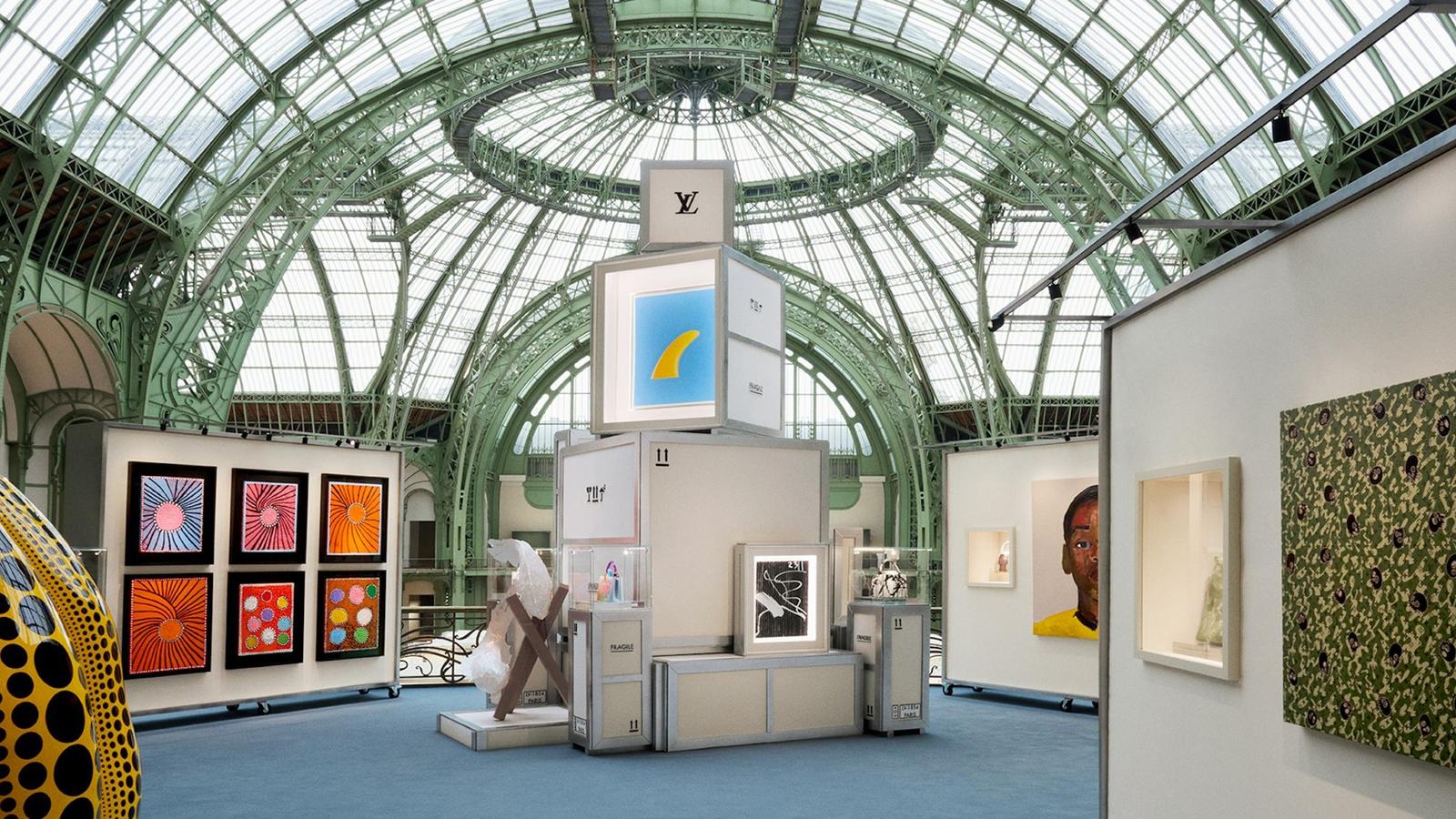
Louis Vuitton reunites work by 14 artists at the Grand Palais, exploring seven years of Artycapucines collaborations and a collection devoted to Keith Haring.
Louis Vuitton's presentation at Art Basel Paris in October 2026 offered visitors an opportunity to examine seven years of collaborations between contemporary artists and the French luxury house. The retrospective, which opened to the public on 23 October at the Grand Palais, brought together work by 14 artists and was documented in an official LVMH announcement three days later. Its focus was Artycapucines, the initiative through which selected artists have reinterpreted the Capucines handbag since 2019.
The exhibition is of interest to collectors because it reveals a form of creative commissioning distinct from the conventional release of a seasonal luxury accessory. Artists brought individual visual practices to an object with an established shape, working with specialist artisans to translate ideas about texture, colour, assemblage and sculpture into leather goods. The presentation also included an Artycapucines collection devoted to Keith Haring and a historical trunk associated with the artist. It was a retrospective of an exhibition already held, rather than an announcement of a new auction or a current offer of every object on display.
An established object becomes an artistic medium
One challenge inherent in an artist collaboration is that the object already has a function, proportion and identity. A handbag must accommodate the needs of the person using it, while retaining structural integrity and a relationship between its handle, closure and body. An artist approaching the Capucines may instead be accustomed to working on a flat picture surface, in sculptural volumes or with materials selected without reference to the stresses of repeated handling. Combining these disciplines requires negotiation between artistic intention and the constraints of fabrication.
The Artycapucines initiative makes this negotiation part of the object itself. Rather than simply placing a decorative motif on a neutral surface, some collaborations can explore how a material behaves when it is shaped, layered or assembled. The specific methods differ between the artists and the creations. The retrospective's value was in making a number of approaches available for comparison. It allowed viewers to consider how recognisable features of the original design remained visible while different artists interpreted its surfaces and form.
Craftsmanship as the intermediary
Translating a work conceived in one medium into another can involve detailed technical research. A painter's desired colour may have to be reconciled with the characteristics of leather and the way a finish responds to light. An artist interested in relief or assemblage may require consideration of the weight and attachment of elements as well as their appearance. Embroidery introduces another set of decisions about thread, tension, placement and the underlying support.
The final appearance of a luxury accessory can consequently obscure much of the work needed to make it. A successful translation is not necessarily a literal reproduction of the source artwork. It may depend on making choices that preserve the qualities the artist considers essential while responding to the physical possibilities of the new medium. For collectors who commission decorative objects, furniture or bespoke textiles for private homes or yachts, that relationship between artistic ambition and workshop expertise is familiar. The collaboration is evidence of a process, rather than simply a label linking two prominent names.
Viewing the source artwork and the finished creation together
Louis Vuitton describes the Grand Palais presentation as bringing the bags together with the artworks that informed them. This arrangement is an important aspect of the retrospective because it invites viewers to compare objects rather than consider each bag exclusively within the context of fashion. The two works may make different use of scale, space or material. What appears subtle in a larger composition may become unusually prominent on the surface of a handheld object.
Collectors can learn something from examining the distance between an original artistic idea and the final work. A close formal resemblance might reflect a deliberate choice, but an interpretation may equally have value because it transforms an idea into something distinct. Neither approach should be assumed superior without consideration of the artist's intentions and the resulting quality of the piece. The exhibition illustrates why documentation of a collaboration can be as interesting as the object to someone building a collection around relationships between creative disciplines.
The exhibition architecture and Louis Vuitton's origins
The display incorporated open crates, plinths, brushed aluminium and cotton canvas, according to the house's announcement. The visual references were associated with the transport and preservation of art, while also drawing attention to Louis Vuitton's history of producing trunks. The exhibition thereby treated the presentation infrastructure as an extension of the subject, rather than simply providing an unrelated decorative setting.
For an art collector, transport and protection are practical questions that remain important long after a purchase. The movement of an unusual object between properties or into a yacht's interior can require appropriate packing, environmental assessment and coordination with insurers or specialist handlers. The historical role of the trunk offers a useful connection between a luxury maker's technical origins and its contemporary interest in art. The crates and supporting structures in the exhibition evoked that relationship without suggesting the displayed pieces all had identical transport or storage requirements.
Keith Haring and the historical trunk
The retrospective also showcased the latest Artycapucines collection, devoted to Keith Haring. LVMH describes Haring's recognisable figures and graphic language appearing on the new creations. Of particular historical interest was a Louis Vuitton trunk dating from the 1930s that Haring had signed in the 1980s. Its inclusion associated the contemporary collection with a material object from an earlier period of the relationship between the artist and the house.
An historical object and a contemporary artist-inspired accessory occupy different positions in a collection. The trunk's importance may derive from its age, physical history and documented association with Haring. A newly made accessory interpreting his visual language has a different history of manufacture and authorisation. A collector should distinguish those categories rather than assume that they offer equivalent ownership of an original artwork. The retrospective addressed both through their visual and institutional connections, but the announcement did not establish market values or offer the historical trunk for sale.
Provenance and the responsibilities of a collector
Objects involving identifiable artists and luxury manufacturers can enter several secondary markets. A person considering an acquisition should seek the relevant documents establishing its identity, the collaboration under which it was created and, where applicable, its position within an edition. Original packaging, invoices, correspondence and condition reports may assist in establishing continuity between the initial acquisition and later ownership.
Descriptions of artist collaborations can sometimes be ambiguous in secondary sales. A bag personalised after purchase is not necessarily part of an officially commissioned collaboration, and a design drawing or exhibition photograph is not the same as an example manufactured for the collection. Those distinctions can have practical implications for authentication, insurance and the way an object is described when sold. LVMH's retrospective provides institutional context but is not itself an authentication service for examples offered elsewhere. Nor does the announcement establish that every exhibited design is obtainable from the house today.
Displaying an accessory as part of an art collection
An object intended to be carried can also be kept primarily for exhibition. The choice affects the way a collector approaches wear, storage and presentation. Leather, decorative finishes, embroidered surfaces and assembled components may have different sensitivities to light, heat, humidity and mechanical pressure. A collector should seek handling guidance appropriate to the materials of a specific piece instead of treating every bag as if it were made solely from an identical leather.
For a yacht interior, the environmental considerations can be especially nuanced because the object may experience a different pattern of humidity, sunlight and vibration from one retained in a permanent land-based collection. Display choices should be reviewed with the crew and appropriate conservation specialists. Collecting need not entail removing an object permanently from use, but it is useful to establish whether the object is held principally for its function, its artistic interest or a combination of both.
Seven years of experimentation in context
The significance of the Grand Palais retrospective lies in the possibility of assessing a programme over time. Since 2019, the Artycapucines initiative has allowed artists and artisans to investigate how an established luxury object can accommodate widely different visual practices. Seeing several collaborations together can provide a more informative perspective on the programme than encountering an individual piece in isolation.
The October presentation is now part of the history of Art Basel Paris 2026. The official announcement describes the works of 14 artists and the Keith Haring collection but does not specify future release schedules, remaining availability or anticipated auction results. Collectors interested in the individual creations should consult the house and appropriately qualified specialists about their documentation and conditions of acquisition. For the wider world of bespoke luxury, the retrospective is a reminder that an enduring form can be the starting point for new artistic approaches without losing its connection to the craft tradition in which it originated.
Primary source: LVMH official announcement, 26 October 2026.
Louis Vuitton Artycapucines retrospective at the Grand Palais — official press photograph. Official source.
