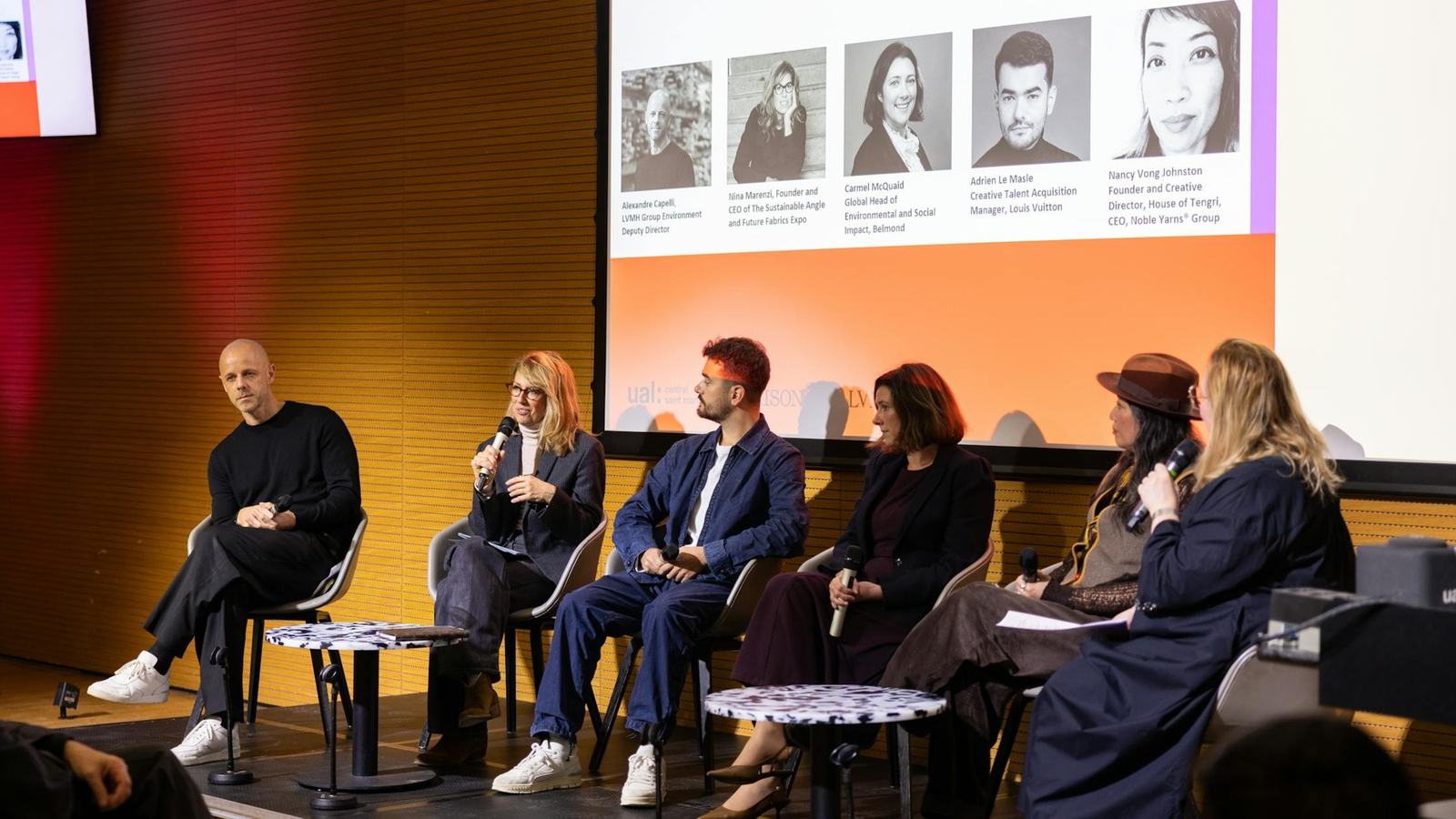
The renewed Central Saint Martins partnership expands LVMH's Maison/0 educational work, linking creative research, scholarships and regenerative design practice.
LVMH and Central Saint Martins, part of University of the Arts London, have renewed the educational relationship they established in 2011. The luxury group announced the new stage of the partnership on 10 November 2026, following a programme at the London art and design school on 4 November that brought students, academics and industry representatives together. The announcement describes plans to expand educational programmes and projects concerned with regenerative design, strengthen scholarship support and build closer relationships between students and the group's individual luxury houses.
At the centre of the existing partnership is Maison/0, a multidisciplinary platform launched in 2021 as a five-year initiative connecting scholarships, collaborative projects and research with questions of climate change and biodiversity. The renewal is significant for collectors and clients who take an interest in the origins of contemporary luxury goods, from specialist fashion and textiles to the materials specified in bespoke interiors. It provides an institutional context in which future designers can investigate the consequences of material decisions before they enter professional practice.
The distinction between sustainability and regeneration
Regenerative design is not a precisely uniform description of all creative practices. In the context of environmental design, it often expresses an ambition to consider whether a process can support the restoration or improved functioning of ecological systems, rather than merely diminish harm relative to an existing method. The idea requires attention to what those systems are, how an intervention affects them and over what period an outcome can be observed.
A design may have a comparatively low environmental impact without necessarily regenerating anything. Conversely, an individual activity that supports habitat restoration can have other environmental consequences elsewhere in its supply chain. It is therefore important to distinguish a stated regenerative ambition from an independently established outcome. LVMH and Central Saint Martins describe their renewed programme as an educational and research commitment. The announcement does not offer evidence that every resulting student project or commercial product delivers a net positive environmental effect.
Developing material literacy before entering professional practice
A creative education concerned with materials can give students the opportunity to examine characteristics that are not immediately visible in a finished object. A textile's handle and appearance are important, but its fibres, processing requirements, construction method and anticipated service life also influence the design decisions made during development. A material appropriate for one application may be unsuitable for another where different performance or maintenance requirements apply.
Understanding this distinction can benefit designers working with bespoke clients. Instead of presenting a client with only a collection of finishes chosen on visual grounds, a designer can explain why an individual sample is being considered, what alternatives exist and what its use would require in practice. Such reasoning is particularly valuable where a commissioned object is expected to remain in service for many years. It encourages the designer to assess a material in relation to its application rather than treat a particular material description as sufficient evidence of its suitability.
The relationship between scholarships and specialist training
LVMH's announcement identifies scholarship support as one of the elements that will be strengthened through the renewed collaboration. A scholarship can widen access to educational experiences that require time, specialist facilities or exposure to professional practitioners. It can also assist students in continuing research rather than choosing projects solely because they can be undertaken at comparatively low personal financial cost.
The value of such assistance depends on its structure and accessibility. When evaluating educational patronage, prospective supporters should establish how recipients are selected, what resources the award covers and what opportunities exist for students whose interests lie outside a particular sponsor's commercial activities. The announcement does not specify new individual scholarship amounts or eligibility conditions. Those would need to be established from subsequent programme information. The significance of the renewal is the stated continuity and expansion of the relationship between education and industry.
Translating an exploratory project into a manufactured object
An academic design project can investigate questions without necessarily resolving all the constraints associated with commercial manufacture. Students may create samples or prototypes that make an unfamiliar process comprehensible, even when the cost, supply arrangements and durability of that process are not yet suitable for production. This freedom is useful because it allows a concept to be examined before its value is judged solely by a market.
The development of a manufactured product requires additional steps. Material availability, production tolerances, repairability, the skills of the people making the object and the quality assurance of repeated processes all become relevant. An experimental result should not therefore be represented automatically as an established manufacturing alternative. Collaborative research between educational institutions and practitioners can help identify which ideas warrant further investigation and what testing would be needed before they are introduced into a finished product.
Environmental claims and the expectations of private clients
A collector choosing an expensive item has an opportunity to ask questions that extend beyond its appearance or scarcity. A commissioned garment, piece of furniture or interior finish can come with information about its material origins, fabrication and appropriate care. Such information enables the purchaser to consider longevity, the practicality of maintaining the object and the extent to which claims about its environmental properties have been substantiated.
The appropriate evidence varies with the claim. A statement about the origin of a raw material is not equivalent to a comprehensive assessment of its environmental implications. Similarly, a supplier's commitment to reducing impacts is different from measured performance on a specific project. Clients need not be specialists in every aspect of production to recognise that distinction. They can request sufficient information to understand what is established, what is being researched and what remains uncertain. Education directed towards these issues may make such conversations more productive as graduating designers enter the profession.
The November industry event at Central Saint Martins
The renewed relationship was marked by an INSIDE LVMH Day on 4 November. The announcement identifies panel discussions on sustainable development, regenerative practices in creative industries and the impact of artificial intelligence. Speakers included Alexandre Capelli, LVMH's deputy environmental director; Adrien Le Masle from Louis Vuitton talent acquisition; and Carmel McQuaid, Belmond's global head of environmental and social impact. Aisling Halleman also introduced the LVMH Prize to students on fashion pathways.
The participation of representatives from different areas of the group illustrates why environmental design questions cannot always be confined to a single department. Designers, procurement professionals, environmental specialists and people responsible for developing future talent encounter different aspects of the problem. For students, exposure to those perspectives can help reveal the practical decisions that follow a creative proposal. The event is not evidence, by itself, of particular commercial partnerships between individual students and the houses represented.
Relevance to bespoke superyacht interiors
The design of a private yacht's interior can involve the selection of numerous materials with different technical and aesthetic functions. Textiles, wall finishes, cabinetry, furnishings and decorative objects may need to satisfy constraints relating to weight, maintenance, marine environmental conditions and applicable safety requirements. An approach that gives close attention to material origins and their service life can be useful alongside those considerations.
A material promoted for a particular environmental quality should not be assumed suitable for marine use without the necessary assessment. The yacht's design team must take account of the requirements applicable to the individual installation, including any relevant fire performance or technical certification. Where bespoke material research is involved, collaboration among the designer, manufacturer and responsible engineering professionals is particularly important. The renewed educational programme does not establish that its projects have been developed specifically for yachting, but the analytical habits it encourages can be relevant to commissions in that sector.
Looking beyond the announcement
The continuation of the LVMH and Central Saint Martins partnership provides a framework for a new period of collaboration following the initial Maison/0 programme. The group says it intends to strengthen scholarship opportunities, expand the programmes involved and develop additional projects. The particular results will become clearer as new research, designs and educational activities are disclosed.
For collectors and patrons, one of the potentially useful aspects of the initiative is the opportunity to examine how creative education responds to questions about the materials used to make luxury objects. A meaningful assessment will depend on the nature of the projects, the quality of the resulting work and the evidence supporting any environmental claims. The November announcement establishes a renewed commitment to that educational relationship. It should be read as an investment in the development of skills and critical practice, not as a declaration that all the environmental challenges of the luxury industry have been resolved.
Primary source: LVMH official announcement, 10 November 2026.
LVMH and Central Saint Martins creative education partnership — official press photograph. Official source.
