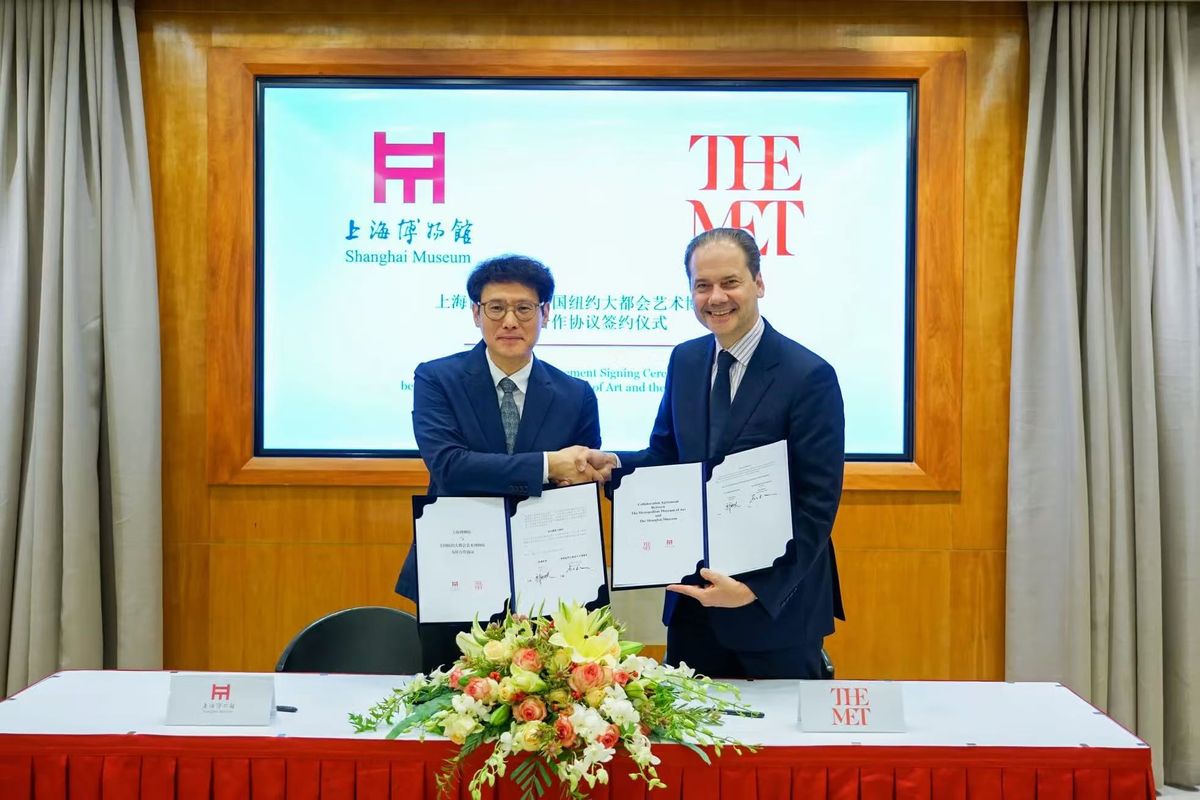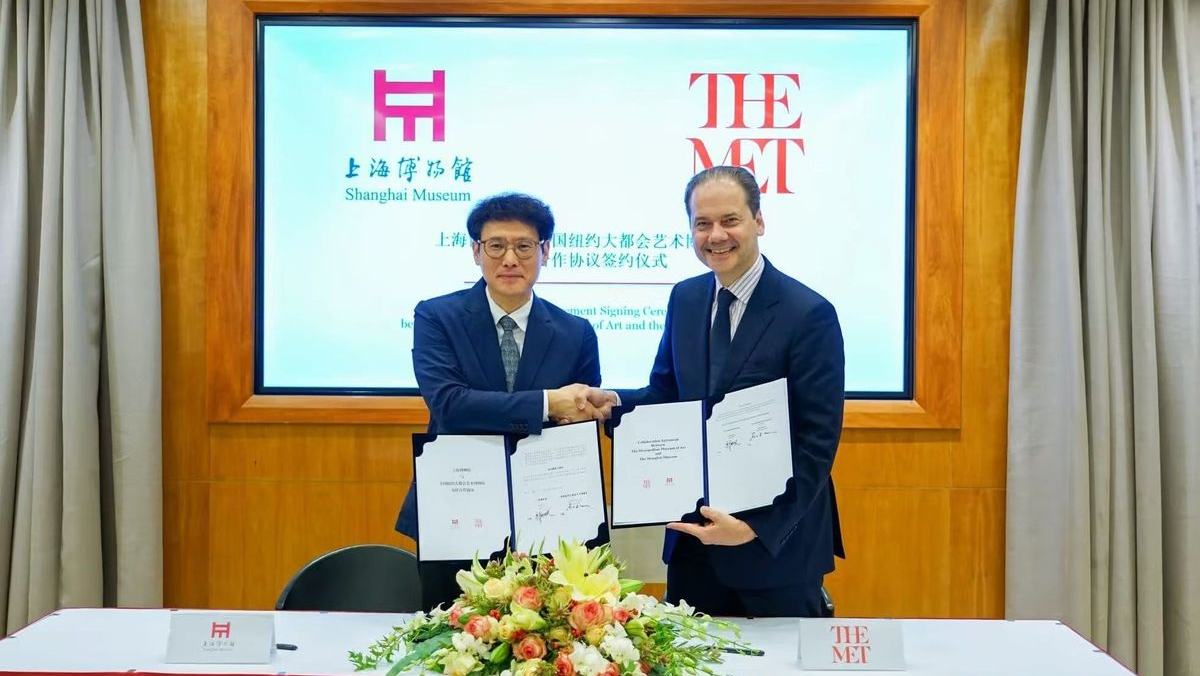
New York’s Met and the Shanghai Museum formalise decades of collaboration as a major exhibition of jewellery opens at Shanghai Museum East.
The opening of an international jewellery exhibition
Jewelry: The Body Transformed, Treasures from The Metropolitan Museum of Art opens at Shanghai Museum East on 18 November 2026. The exhibition, scheduled to continue through 5 May 2027, draws extensively on the collection of The Metropolitan Museum of Art in New York, with additional works from the Shanghai Museum. Two days before the opening, museum directors Max Hollein and Chu Xiaobo signed a memorandum of understanding at the Shanghai Museum's People's Square institution. The Met announced that the agreement formalises cooperation extending across exhibitions, research and curatorial exchange. The timing of the two events brings jewellery into focus as a field in which institutions can jointly investigate objects from different cultural traditions. For collectors interested in historic jewellery, the opportunity is to consider material, workmanship and cultural meaning outside the immediate circumstances of an auction or commercial presentation. The museums have not identified the individual exhibition objects as being offered for private sale.
Jewellery as an object made in relation to the body
The exhibition's title identifies a relationship that is easy to overlook when an object is examined chiefly through its precious materials. Jewellery acquires a particular meaning through the manner in which it is worn and through the circumstances in which it is seen. An item placed upon the head, around the neck or at the wrist may have been conceived with distinct formal or ceremonial purposes. The spatial behaviour of a pendant, for example, differs from that of a piece made to surround a finger. Across historical societies, jewellery could signal relationships, social obligations, religious commitments or access to resources as well as an individual's aesthetic preferences. Those meanings need to be established in relation to the object and its own documented context rather than attributed automatically according to a modern observer's impression. The exhibition's shared institutional setting gives visitors an opportunity to examine relationships between different collections, without implying that every tradition treats adornment in the same way.
Scholarship beyond the commercial description
A collector may ordinarily encounter historic jewellery through descriptions that foreground a gemstone's identity, its dimensions, a maker's signature or an estimated price. Those details can be important, but a museum exhibition provides an alternative framework for understanding the object. Information about its intended use, construction techniques, historical ownership and the artistic conventions of its period may contribute substantially to an assessment of what makes it unusual. The distinction between material and workmanship is especially worth considering. A relatively small object made with materials that are familiar to a jeweller may embody a technically accomplished form of construction. Another item with a valuable gemstone may be significant for entirely different reasons. The Met's collection-based presentation in Shanghai offers a context for considering such questions independently of the availability of particular objects for purchase. Museum attribution should likewise not be applied to a visually similar piece without examining the evidence relating to that piece.
Four decades of exchanges provide the foundation
The November memorandum is not the beginning of the relationship between the two museums. The Metropolitan Museum of Art's announcement dates their exhibition collaboration to 1980, when the Shanghai Museum participated in The Great Bronze Age of China. Subsequent exchanges included works connected with the painting of Wang Hui and the artistic culture of the Yuan dynasty, as well as exhibitions of early ceramics, jades and ritual bronzes. The institutions have also undertaken projects concerning a number of later Chinese artists. In 2024 the Shanghai Museum presented Wallace Chan: Half a Century, another point of interest for those following the creative history of art and jewellery. The series of projects illustrates the differing forms an institutional exchange may take. A loan of individual works to an exhibition organised by another institution is not necessarily the same arrangement as the joint organisation of an exhibition. The announcement does not suggest that all the works previously involved in such exchanges belong to one particular collection.
Recasting the Past and the move towards joint organisation
In 2025, the two museums collaborated as co-organisers for the first time on Recasting the Past: The Art of Chinese Bronzes, 1100–1900. The Met identifies approximately 200 works from international collections as having been brought together for the presentation, which took place at both institutions. The project examined the continuing use and significance of bronze rather than confine attention to the earliest period associated with the material in China. For a collector of decorative arts, that breadth of chronology is especially useful because forms can acquire new meanings as they are recreated, adapted and interpreted in later periods. A reference to an early prototype does not necessarily establish the date of the object derived from it. The institutional collaboration enables the examination of a wider body of material than might be available at either museum on its own. The November memorandum provides a formal basis for continuing such work, without identifying every project that will be undertaken in future years.
The importance of conservation when works travel
The movement of works between institutions involves an important set of responsibilities distinct from the scholarly aims of an exhibition. Loan arrangements need to address the ability of an object to withstand transport, the conditions in which it is exhibited and the treatment of particularly sensitive components. Historic jewellery can incorporate several materials whose environmental requirements differ. A metal body may provide support for textiles, enamel, organic substances or stones, for example. Each object requires assessment by qualified personnel rather than a general assumption that its scale makes it straightforward to move. These matters are also relevant to a household that maintains a collection across several residences or aboard a yacht. A piece intended for display in a cabinet may need a carefully designed support, while a piece still intended to be worn may be subject to additional considerations. The November announcement does not disclose the detailed conservation and insurance arrangements for the Shanghai exhibition, which should not be inferred from the existence of the institutional partnership.
A further exhibition dedicated to Bada Shanren
The Met has also confirmed that it will lend five works to Sonorous Silence: The Painting and Calligraphy of Bada Shanren on the 400th Anniversary of His Birth. The exhibition at the Shanghai Museum is scheduled from 19 December 2026 to 22 March 2027. This is a separate initiative from the jewellery exhibition, involving works on a different scale and in other artistic media. For collectors with interests that extend between decorative art and painting, the overlap in the two programmes provides a reason to follow the museum's winter exhibition calendar. The announced loan count concerns works being lent by The Met, not necessarily the total inventory of the forthcoming exhibition. It also does not establish that the five works will be available for examination outside the exhibition's arrangements. Detailed gallery schedules, admission conditions and any arrangements for special educational visits should be confirmed with the museum before planning a visit.
Implications for private collection stewardship
The agreement raises an important broader question for those who own significant historic objects: how knowledge about the collection is developed and retained. When an individual work is acquired, the invoice alone is seldom sufficient to preserve all the information potentially relevant to its subsequent study. Earlier descriptions, published references, condition documentation and records of restoration can be important to researchers and future custodians. Where a collector considers lending a piece to an institution, the purpose of the proposed loan should be discussed together with its transport, display and safeguarding arrangements. The owner may be particularly interested in whether research relating to the piece will form part of a larger publication or exhibition. Any contractual decision requires independent consideration. The partnership between The Met and Shanghai Museum demonstrates the value the institutions place on scholarly exchange; it does not establish an obligation or invitation for individual private owners to lend objects to either museum.
An exhibition for the coming winter and spring
The confirmed public programme at Shanghai Museum East extends from 18 November into May 2027. The separate Bada Shanren exhibition reaches into March. International travellers should establish admission, any advance booking requirements and the locations of the individual exhibitions before organising their itineraries. The official publicity photograph accompanying this report records the signing of the memorandum on 16 November; it is not a photograph of an individual jewellery object or of the completed exhibition galleries. The significance of the announcement is the combination of a substantial collection-based jewellery presentation with a formal commitment to continuing exhibitions, scholarship and institutional exchange. For private collectors, the opportunity offered by such a presentation is to examine adornment as an artistic and cultural practice whose significance cannot be understood solely through its material or commercial value.
Primary source: The Metropolitan Museum of Art official press release, 16 November 2026.
Further official information: Independent report, 17 November 2026, containing the Met's attributed official photograph.
Photography courtesy of The Metropolitan Museum of Art, official signing photograph reproduced with attribution in Hyperallergic's report of 17 November. Official source.