A superyacht guest guide to Monaco's Oceanographic Museum, combining the Mediterranean 2050 exhibition, rooftop terrace, current renovation advice and private-event enquiries.
A more considered Monaco shore excursion
Monaco offers more to visiting superyacht guests than the familiar spectacle of grand hotels, designer boutiques and cars moving through the Principality. The Oceanographic Museum, set above the Mediterranean, provides a very different kind of shore programme: architecture, marine history, living collections and an interactive look at the future of the sea that makes cruising possible.
For an owner, charter guest or family arriving by yacht, the attraction is not simply filling two hours between engagements. A thoughtful visit can connect the experience of living beside the sea with the scientific and conservation questions that shape its future, and it can be fitted into a Monaco day without suggesting that the museum operates as an exclusive yacht facility.
The institution's current highlight is the Mediterranean 2050 experience, a sequence of spaces through which visitors move from maritime history toward possible futures. It is immersive cultural programming rather than a scientific prediction, and that distinction makes it particularly suitable for conversation among adults and older children alike.
Mediterranean 2050, from Oceanomania to a future sea
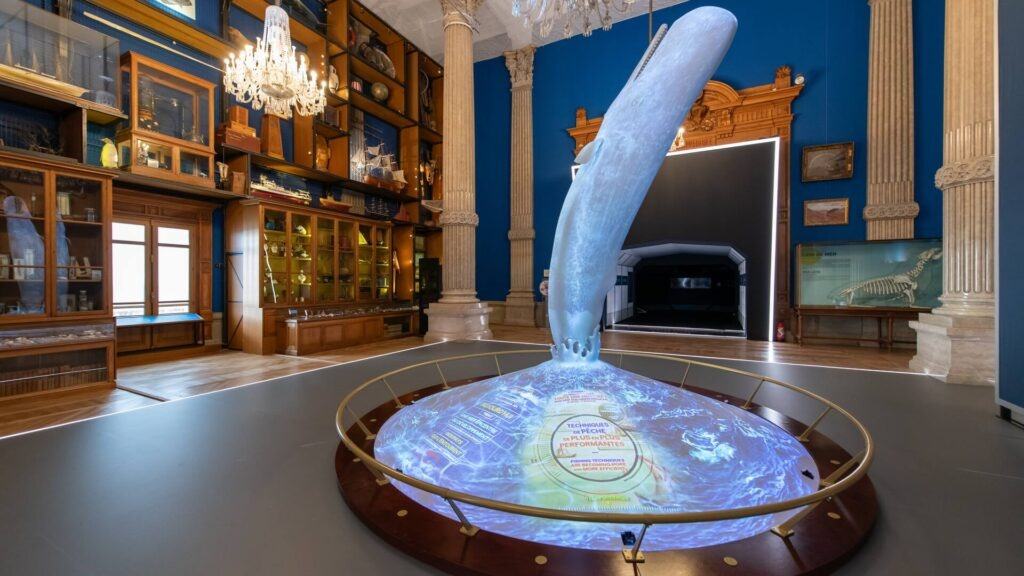
The first section, Oceanomania, is organised around the museum's collections of marine curiosities and a four-metre sculpture of a sperm whale. Its presentation introduces the long history of the Mediterranean before guests progress toward the ways people have navigated, explored and tried to protect the sea over generations.
The second section, Oceano Monaco, follows the Principality's relationship with maritime exploration and protection, including the roles of Prince Albert I, Prince Rainier III and Prince Albert II. For yacht guests it supplies a useful historical counterpoint to the modern marina, showing that Monaco's connection with the sea reaches beyond today's fleet.
Oceano Odyssey turns toward an imagined Mediterranean in 2050 and the Pelagos marine sanctuary, using an immersive fictional mission to introduce marine mammals and protected areas. The final My Oceano Med section invites choices in an interactive conservation environment, encouraging visitors to think about the cumulative impact of ordinary decisions.
These stages offer an accessible way to bring an onboard discussion about the environment into a public cultural setting. They also create a gentle framework for a family shore visit: explore the past first, consider the present at leisure, and leave space for younger visitors to interact without rushing from one gallery to another.
A rooftop pause and the living collections
The museum's terrace remains part of the visitor experience and is one of the reasons to avoid treating the destination as a quick indoor stop. Its position high above the shoreline creates a setting for looking back over the Mediterranean after a gallery visit, with the landscape outside giving additional meaning to the exhibition's focus on the sea.
Visitors should pay particular attention to the institution's current renovation advice. The Mediterranean Aquarium is being completely redesigned, but the museum says Mediterranean 2050, the Tropical Aquarium, Great Shark Lagoon, Turtle Odyssey and rooftop terrace continue to be available during the work.
For guests who are especially interested in wildlife, the living displays and Turtle Odyssey provide a different encounter from the projections and objects of the main exhibition. However, opening arrangements and the areas accessible on any particular date can change, so a yacht concierge should confirm the live visitor notices before presenting a fixed sequence to guests.
The private-event possibility for yacht owners
The Oceanographic Museum also offers a separate private-events programme, which makes it relevant beyond a conventional daytime admission ticket. Its official events page describes possibilities including receptions, dinners, conferences and other functions in spaces such as the first-floor galleries, terrace and dedicated indoor rooms, subject to direct enquiry and the venue's conditions.
That opens an attractive conceptual alternative for a Monaco gathering linked to a visiting yacht: an event with a maritime cultural setting rather than another reception built entirely around the vessel itself. It does not mean that guests can simply request exclusive use of the museum on arrival, because availability, access, catering, staffing and any permissions must be negotiated with the institution.
A terrace reception offers views of the Mediterranean, while indoor spaces can make the maritime collections part of the atmosphere. Organisers should ask the museum's event team for current capacity limits, technical details and accessibility provisions rather than relying on older published room figures or photographs as proof of what can be booked.
Practical timing for a guest itinerary
For October, November and December, the museum currently lists opening hours of 10:00 to 18:00, apart from specified closures. The institution recommends budgeting roughly two hours to explore the galleries at a relaxed pace. Final admission is earlier than closing time, so a guest programme should leave a margin for the journey, tickets and unhurried time in the exhibition.
Ashore transport and mobility requirements should be planned according to where the yacht is actually berthed or anchored, not assumed from an attractive photograph of Port Hercule. The captain or shore-side concierge should confirm the tender or berth arrangements, identify the best authorised land transfer and allow additional time for security, weather and passenger comfort.
The museum welcomes visitors of different ages, but not every space is identical from an accessibility perspective. Anyone travelling with a pushchair or reduced mobility should check the museum's current access guidance and discuss the intended route before setting departure times from the vessel.
Why the visit belongs in a luxury cruising programme
Luxury travel increasingly allows room for encounters that are meaningful without requiring a private label or an exclusive purchase. Monaco's Oceanographic Museum answers that need with a strong sense of place, because its history, setting and ocean-focused exhibitions make it a destination that would be difficult to transpose to an unrelated city.
The best visit might be a morning of exploration followed by lunch elsewhere in the Principality, or the cultural centrepiece of a fuller shore programme arranged by the guest's own team. Either way, the value lies in tailoring the pace and questions to the group, with flexibility for children, enthusiasts and anyone who simply wants to take in the view.
For superyacht owners and charter parties, Mediterranean 2050 also offers a reminder that enjoying the sea and protecting it are not separate subjects. The visitor leaves with a richer picture of Monaco's maritime identity and a useful prompt for the decisions that accompany life aboard, while the yacht remains where it belongs: a base for discovering what lies beyond the quay.