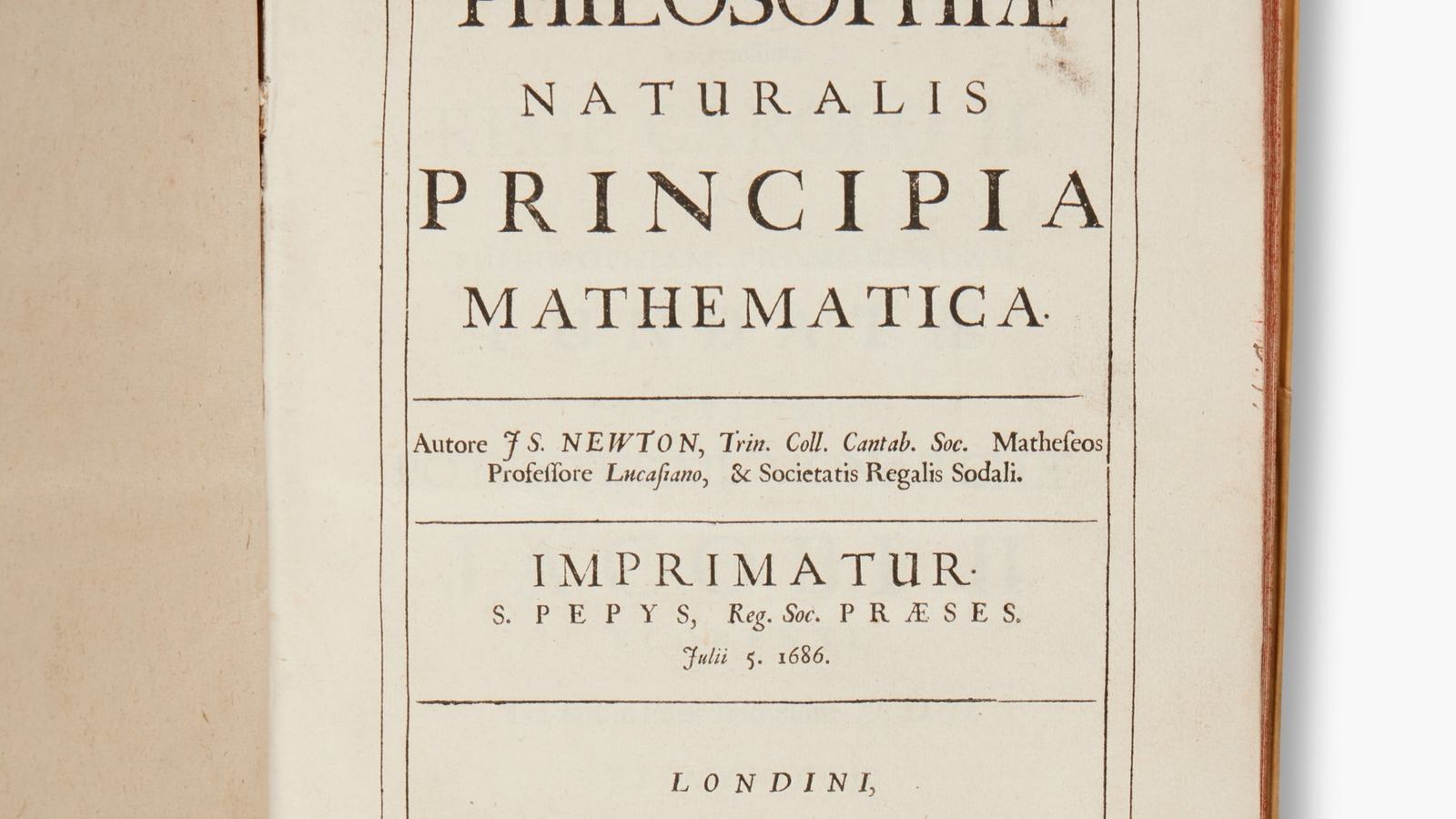
A remarkable single-owner library on the history of science reaches Sotheby's on 20 October, bringing books by Copernicus, Galileo, Kepler and Newton alongside a Newton manuscript.
The history of science enters the saleroom
Sotheby's has announced Reason and Revolution: Extraordinary Works from a Distinguished Private Collection, with its first auction scheduled in New York on 20 October 2026. The offering traces the evolution of scientific thought through important early editions by Nicolaus Copernicus, Galileo Galilei, Johannes Kepler and Isaac Newton. Among the highlights is a rare manuscript written in Newton's own hand, placing an irreplaceable historical document alongside printed milestones.
Such collecting sits at the intersection of science, cultural history and the rare-book market. The objects matter not only because famous people wrote them, but because they preserve the means by which ideas were tested and communicated. A serious buyer should understand a book's precise edition, textual state, binding and provenance rather than treating a title as a uniform commodity.
Copernicus helped change the scale of the universe
Copernicus's heliocentric model challenged the inherited picture of the heavens, providing a framework through which later astronomers could test the movement of planets. An early copy of his work can embody an extraordinary moment in intellectual history, but the significance of a particular volume depends on its completeness and bibliographic characteristics. Misbound leaves or later replacements may materially alter its scholarly value.
Private libraries at the highest level commonly need specialist cataloguing that goes far beyond decorative shelving. Detailed condition reports should identify paper repairs, annotations, ownership inscriptions and the authenticity of old bindings. Researchers may also need access to works without unnecessary handling risks, making digitisation and conservation planning part of responsible ownership.
Galileo, Kepler and Newton form a sequence of inquiry
The catalogue brings together authors whose discoveries built on one another while often developing through different methods and historical pressures. Kepler's mathematical study of planetary motion and Galileo's observations helped establish new ways of interrogating nature. Newton later developed a powerful synthesis of motion and gravitation, changing the conceptual foundations of physics.
A Newton manuscript raises a separate set of questions from a printed edition. Handwriting attribution, paper composition, dating, historical custody and textual comparison all matter, and the existence of other manuscript witnesses can change how a document is understood. A signed-looking leaf should never be valued solely on the basis of a famous name without rigorous authentication.
Two sales explore distinct historical chapters
The first part of Reason and Revolution is devoted to scientific thought and takes place on 20 October. Sotheby's has scheduled a second part for 15 December, turning toward the founding of the United States. The company says some objects have not appeared publicly on the market for more than three decades, increasing the importance of informed previews and specialist research.
That structure gives collectors a chance to understand a long-term intellectual project rather than a collection of unrelated curiosities. A bidder interested in one particular scientific work should examine the complete catalogue description and any legal or cultural export considerations. Rare-book ownership may also carry responsibilities toward scholars whose research depends on access to significant material.
The rare-book library as a living institution
For collectors capable of creating an important private library, the physical home is only one element. Stable humidity, protection from light, fire risk management, safe reading procedures and inventory control are fundamental. Even exceptionally bound books can be damaged by poor storage or inappropriate display. A conservation specialist should assess an acquisition before it is placed on a permanent open shelf.
An important manuscript or early edition can anchor exhibitions, loans or scholarly partnerships, giving it a public life beyond a private library. Sotheby's announcement establishes the dates and broad contents of the upcoming sales, not their results. The most enduring value of such a collection is the survival of original evidence for future generations, supported by thoughtful stewardship.
Source
Sotheby's