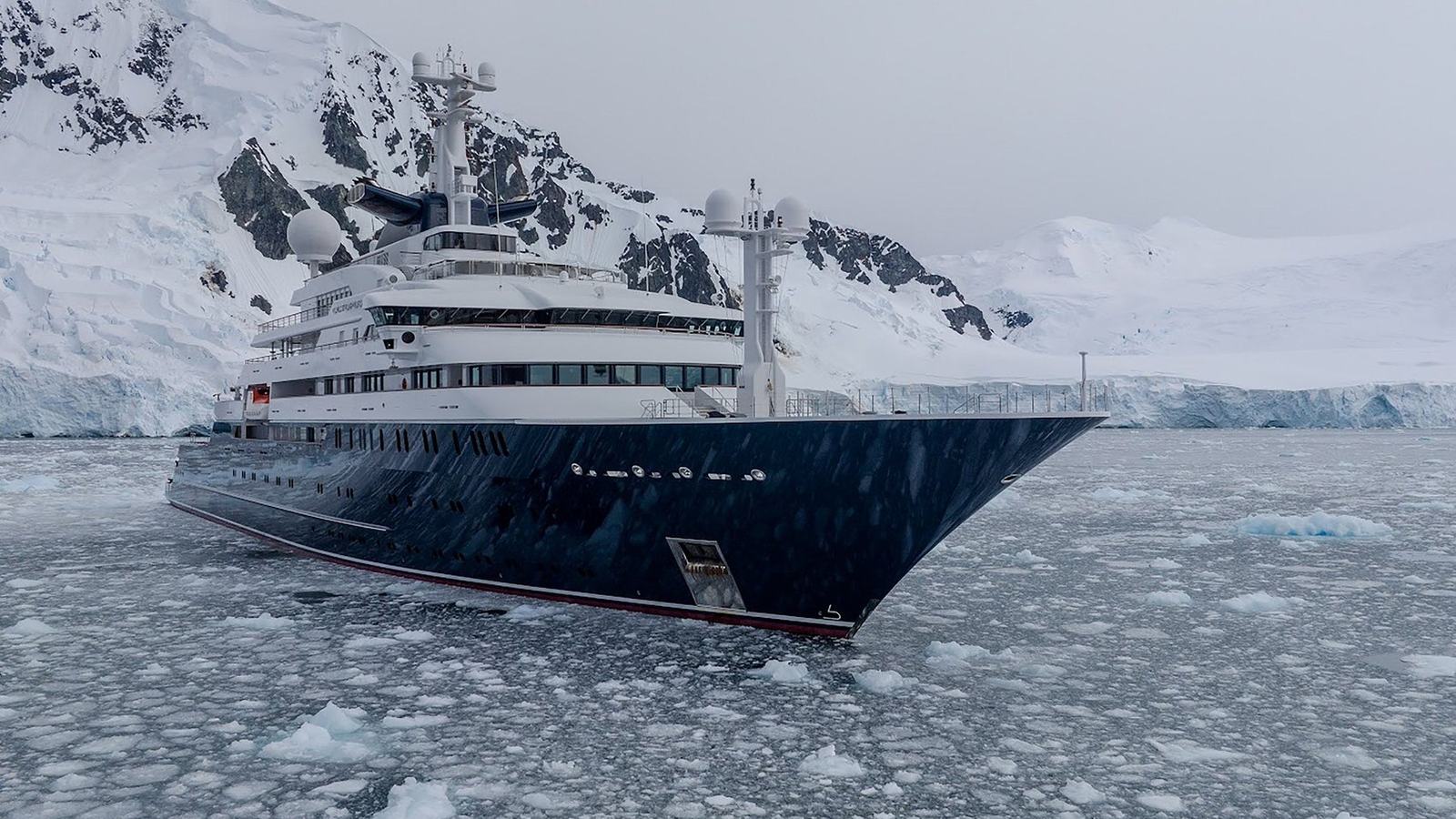
Few large charter yachts make exploration as central to their identity as the 126.2-metre Lürssen OCTOPUS. Built in 2003 and listed by Burgess following a 2024 refit, the yacht combines a substantial expedition platform with facilities for diving, tender excursions and extended time aboard. Its appeal lies in the possibility of treating a remote voyage as a carefully supported private expedition rather than a conventional resort-style cruise.
A yacht conceived for a wider horizon
At 126.2 metres, OCTOPUS is a very different proposition from a superyacht whose principal purpose is to move between familiar Mediterranean anchorages. Burgess presents the Lürssen-built vessel as a proven world traveller with a history of reaching demanding destinations. That background helps explain the scale and variety of her support facilities.
The yacht was delivered in 2003 and the charter listing records a 2024 refit, reinforcing her position in the contemporary expedition market. Those dates are useful context but do not describe any particular future voyage. Charter itineraries still depend on permissions, seasons, weather and the capabilities of the specific operation.
Accommodation is listed for twelve charter guests across thirteen cabins, an unusually generous cabin count relative to the normal guest group. That arrangement can provide flexibility, although cabin allocation should always be confirmed during enquiry. A published crew complement of forty-four indicates the scale of services needed to operate such a complex vessel.
Remote cruising is rarely a matter of simply drawing a line on a chart and sailing toward it. Port clearance, environmental procedures, specialist guides and shoreside logistics may shape the entire itinerary. A vessel of this scale can support ambition, but careful planning remains as important as the engineering.
Exploration begins with what the yacht carries
Burgess lists OCTOPUS with a dedicated dive centre and equipment for underwater activities, which places exploration close to the heart of the guest experience. For qualified divers, the opportunity is not merely to swim beside an impressive yacht. It is to make water-based discovery part of the structure of each day.
Several tenders and additional smaller craft widen the kinds of excursions a charter group might discuss with its crew. Kayaks, paddleboards and a substantial selection of watersports equipment are included in the published inventory. The equipment list is subject to change, and safe use depends on local rules and sea conditions.
In unfamiliar waters, a tender is often the key to seeing a coastline at a more intimate scale. The main yacht may remain at an approved anchorage while guests take a professionally managed excursion to a suitable landing or observation area. This separation of roles allows the larger vessel to function as a comfortable base.
Exploration should never be confused with unlimited access to wildlife or protected landscapes. A responsible itinerary may forbid approaching certain animals or landing on sensitive shores. Guests who value the destination as much as the experience should welcome the crew's guidance about distance, noise and seasonal restrictions.
Life aboard between ambitious days
The extraordinary range of activities invites an equally considered approach to rest. OCTOPUS is marketed as providing substantial entertainment and leisure spaces, including a pool and multiple deck jacuzzis. After a day exploring a remote coastline, the ability to return to warm, sheltered surroundings may be central to the appeal.
On a yacht of this size, different generations can pursue quite different holiday rhythms. Some may want early departures and energetic activities, while others are content to spend a morning reading or watching a changing sea. A thoughtfully planned charter accommodates both without making the guest group feel divided.
Formal dining need not be the only memorable meal during an expedition itinerary. Breakfast before a tender outing, a late lunch after diving or an intimate gathering on a quiet deck can become the occasions guests remember. The yacht's crew can help align hospitality with what the day actually allows.
Because an expedition may include longer passages, comfort underway deserves more attention than it does on a short coastal hop. Prospective guests should ask about the proposed route, sea conditions, medical support and the balance between travelling and stopping. A remarkable destination is worthwhile only when the journey is managed realistically.
Making the most of an expedition charter
Antarctica and parts of South America appear among the cruising regions on Burgess's charter information, illustrating OCTOPUS's ambitious geographic scope. Such locations involve specialist requirements and may not be available at every time of year. The published itinerary and the vessel's actual permissions must be checked rather than assumed.
Charterers should discuss their interests in detail before fixing a route: diving, landscape photography, wildlife observation and quiet time all place different demands on daily planning. A clear priority list helps the captain and charter team build a coherent programme. It also creates space for contingencies when conditions change.
The yacht's scale is part of its fascination, but the most memorable expedition days may happen from a far smaller craft. Watching sea ice, a distant mountain or a seal from a suitable position can be more affecting than any technical specification. Respectful observation should remain the measure of success.
OCTOPUS demonstrates how the private superyacht can become a vehicle for ambitious travel while retaining hospitality and privacy. The Burgess listing provides a starting point for understanding the layout and equipment. The final voyage, however, must always be shaped by current operational advice, careful logistics and the realities of the destination.