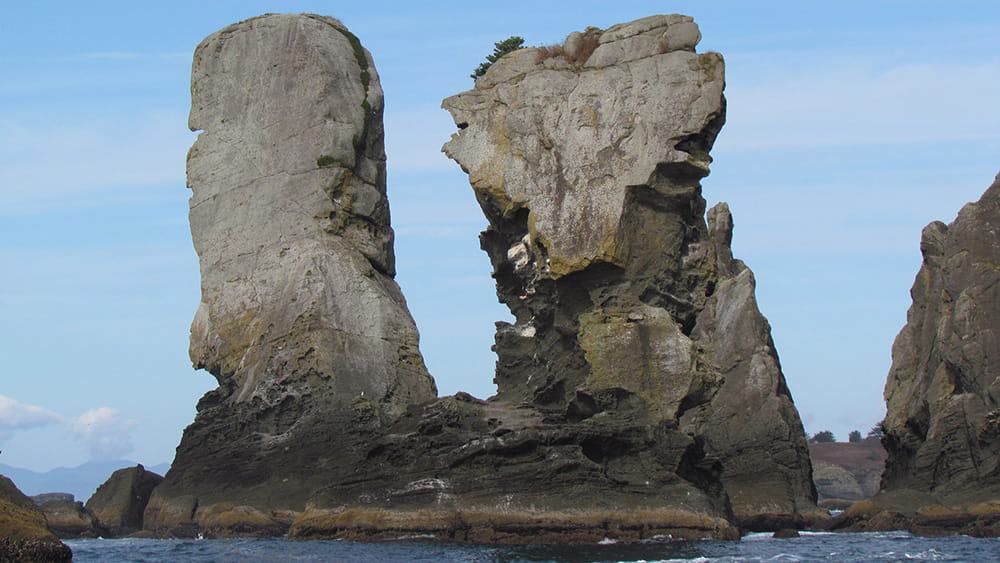
A high-value expedition guide to the Olympic Coast National Marine Sanctuary: striking Pacific sea stacks, protected wildlife, sovereign coastal nations, navigational caution, lawful shore excursions and the status of NOAA's 2026 management review.
A sanctuary unlike a conventional cruising ground
Olympic Coast National Marine Sanctuary protects a sweep of Washington's outer Olympic Peninsula where densely forested cliffs meet the Pacific and offshore sea stacks rise through surf. NOAA describes a 3,188-square-mile protected marine area reaching roughly 25 to 45 miles seaward, including productive shelf waters and submarine canyons rather than merely a narrow band beside the beach.
For a superyacht, the principal attraction is the scale of the seascape: storm-carved headlands, open ocean and a wildlife-rich horizon that has avoided the intensive waterfront development familiar in established cruising centres. The appropriate itinerary is an expedition-style passage planned around weather and regulation, not a succession of sheltered anchorages beneath every photographed rock formation.
NOAA designated the sanctuary in 1994, and its protected waters support seabirds, marine mammals, kelp habitats, corals and sponges at depth. The richness owes much to oceanic upwelling, so an informed voyage can connect observations at the surface with the less visible food web beneath the hull.
The sea stacks belong to a living landscape
From offshore, the coast may appear almost cinematic, with isolated stone columns, dark beaches and rainforest descending toward the tide line. Those features should be appreciated from safe navigational distances because breaking surf, submerged rock and changes in swell make proximity a practical hazard rather than a badge of adventurous seamanship.
Ruby Beach and Kalaloch are particularly useful reference points for understanding this terrain, although the National Park Service describes them as road-access coastal destinations. The sensible luxury itinerary pairs a well-managed passage at sea with prearranged land transport and guided access from public routes where permitted, instead of assuming a yacht's tender can put guests ashore on an exposed beach.
At low tide, the southern Olympic shore offers tidepools, intertidal animals and opportunities to observe seabirds in their habitat. National Park Service guidance specifically warns that some walking routes become impassable as the tide rises, making the timing of an onshore excursion as important as a vessel's passage plan.
Wildlife observation without disturbance
Seabirds gather on offshore rocks and nesting colonies occupy islands that seem, at first glance, inviting as close-up photographic subjects. The National Park Service notes that the coastal islands visible above high water are managed as national wildlife refuges, making their habitat function far more important than any visitor's wish to land.
A yacht's naturalist can frame a watch around distant blows, bird movement and changes in the colour and texture of the sea, without promising specific wildlife sightings. Long lenses, stable observation positions and a patient vessel schedule deliver more responsible results than repeated close approaches or attempts to manoeuvre for an intrusive photograph.
Guests should treat all marine wildlife as wild animals whose movements cannot be choreographed for an itinerary. The captain must keep current with applicable federal protection rules and sanctuary guidance, and the programme should change whenever wildlife presence makes an activity unsuitable.
Four coastal nations and their enduring ocean relationship
The Olympic coast is not empty wilderness awaiting discovery by passing visitors. NOAA identifies the Hoh Tribe, Makah Tribe, Quileute Tribe and Quinault Indian Nation as four sovereign Coastal Treaty Tribes with longstanding cultural, economic and present-day relationships to these waters.
An editorially serious itinerary recognises those communities as contemporary governments, rather than presenting cultural heritage as a decorative addition to wildlife tourism. Any cultural visit, interpretation or tribal-area access should be arranged through appropriate official channels with permission and with the community setting the terms of participation.
The sanctuary's own management process involves government-to-government relationships and an intergovernmental policy framework. That governance is a reminder that responsible luxury travel is measured partly by how carefully it understands who belongs to a place and who has authority there.
Operating a large yacht in the outer Pacific
This is a coast for captains who are comfortable treating weather forecasts, sea state, charts, notices and shore plans as the first elements of the guest experience. The region's exposed Pacific conditions can undermine tender operations, and guests should not confuse a smooth morning farther offshore with safe conditions at a narrow beach or rocky headland.
Pre-voyage planning needs verified charts, route-specific vessel restrictions, suitable arrival and departure options, and contingency harbours chosen with professional local guidance. We do not recommend assuming that an unmarked cove offers legal anchoring, that a picturesque beach provides a safe tender landing, or that every destination has facilities for a large yacht.
Washington's ocean coast is less about conspicuous waterfront dining than about the quality of the expedition team, thoughtful provisioning and quiet onboard comfort after a day of interpretation. The highest-value charter programme would budget generous weather flexibility and allow a day ashore to be cancelled without turning an otherwise remarkable voyage into a disappointment.
Regulations and the 2026 management review
NOAA says sanctuary regulation prohibits discharges of matter subject to specified exemptions, with additional provisions relating to vessel activities. A responsible superyacht programme therefore requires the bridge and engineering teams to check the current sanctuary regulations directly, control waste streams, manage fuel carefully and document vessel-specific compliance rather than rely on generic cruising assumptions.
NOAA released a draft Olympic Coast management plan and environmental assessment in May 2026, with the public comment window running from 12 May to 13 July. The draft is part of a management review, so any proposals within it must not be presented as regulations already in force; the operational standard remains the currently applicable rules and notices.
That distinction matters because a beautifully researched itinerary can still be wrong if it treats an emerging policy idea as law or overlooks an existing restriction. Before arrival, agents and captains should verify the sanctuary's latest management pages alongside National Park Service guidance and the relevant tribal, wildlife and maritime authorities.
A quieter definition of Pacific-coast luxury
The memorable moments are likely to be simple: a long view of sea stacks through the bridge windows, a guided discussion of coastal ecology, or a guest returning from an authorised coastal walk with a changed understanding of the landscape. The yacht provides safety, privacy, hospitality and scientific curiosity, but the sanctuary itself remains the centre of attention.
An ideal closing day could be reserved for a naturalist's presentation, a review of the images taken from permitted viewpoints and an unhurried conversation about ocean stewardship. This is a destination where restraint enhances the experience: a vessel that leaves wildlife and shorelines undisturbed has delivered a deeper form of luxury than one that tries to conquer every view.
Official planning sources include NOAA's Olympic Coast sanctuary overview and water-quality guidance, its management-plan review, and Olympic National Park's current Kalaloch, Ruby Beach and coastal safety information. Together they form a practical starting point for designing an itinerary, but they do not replace a captain's voyage-specific passage plan or professional legal and navigational checks.