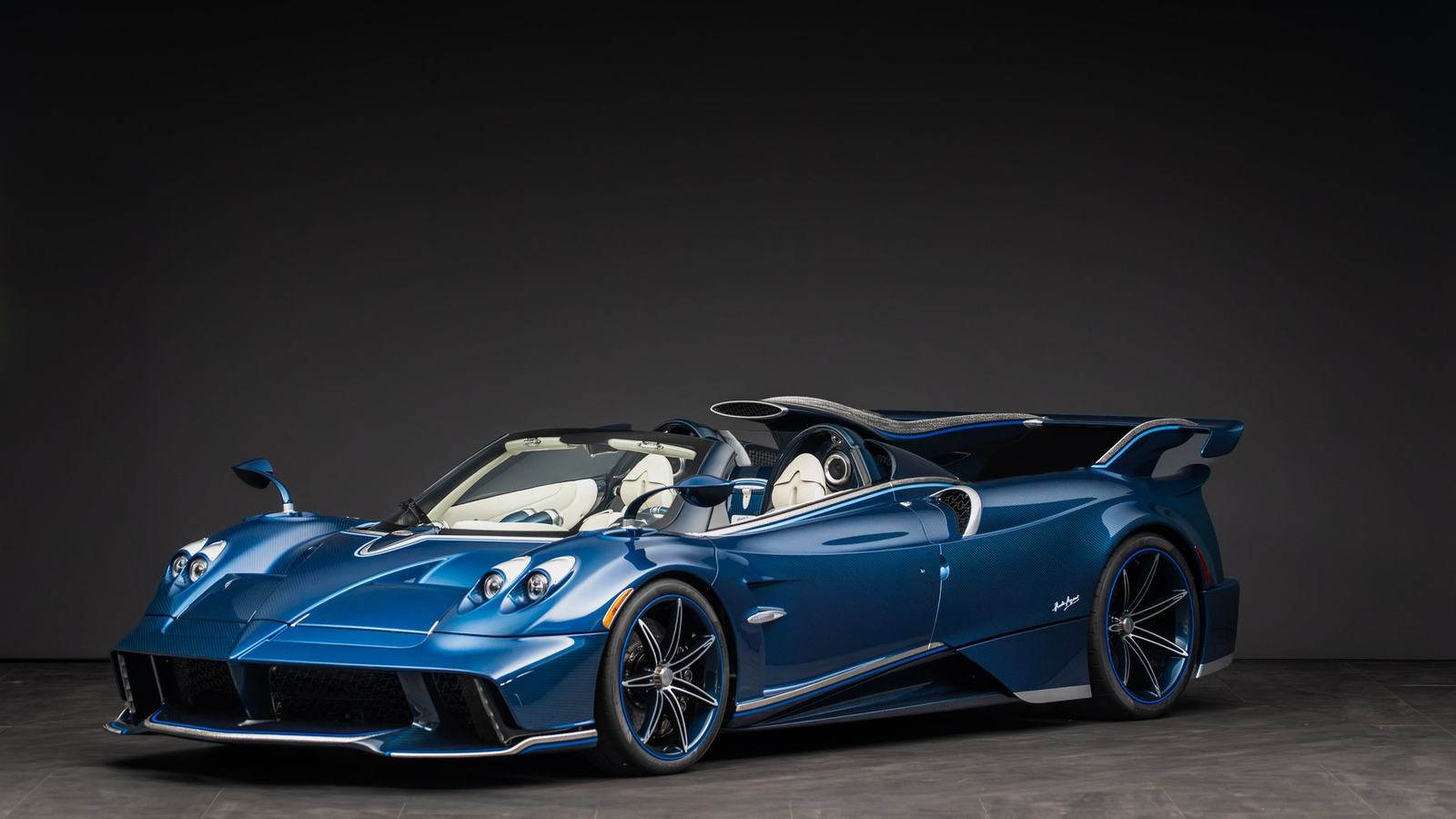
Pagani Automobili has presented the Huayra 70 Anima at Concours at Wynn Las Vegas, bringing all three cars in the Huayra 70 programme together for the first time. The final creation uses blue carbon, diamond dust, platinum leaf and individually commissioned cabin details.
A three-car gathering in Las Vegas
Pagani Automobili has brought together all three cars in its Huayra 70 programme at Concours at Wynn Las Vegas. The gathering, announced on 2 November 2026, introduces the third and final car, named Anima, while presenting the complete trio together for the first time. It is a significant moment for a manufacturer that makes personalisation central to its identity. The occasion is less about announcing a conventional new production variant than revealing a particularly individual commissioned creation.
Pagani says the Huayra 70 cars were developed through its Grandi Complicazioni programme, a division devoted to one-off and very small-series projects. The three-car presentation places them side by side and makes the differences in each owner's vision visible. For collectors, that is often more interesting than a list of factory options. It shows how a shared engineering foundation can support very different expressions of material, colour and form.
The meaning of Anima
The name Anima means soul in Italian, a fitting choice for a car Pagani describes as shaped by the owner's memories and imagination. According to the company, the commission developed through an extended dialogue with the design team rather than a short exercise in selecting finishes. The project joins an already exceptionally rare group of cars celebrating Horacio Pagani's seventieth birthday. The emotional story is part of the manufacturer's own account, not an independently documented biography of the customer.
That distinction is important when considering modern ultra-luxury cars. A customer may be able to buy considerable performance, but the appeal of a bespoke programme is the opportunity to participate in a creative process. The result may incorporate details that have personal significance and would not necessarily appear on another owner's specification sheet. In that sense, Anima is being presented as a commissioned object rather than simply a particularly expensive version of a standard model.
The Grandi Complicazioni approach
Pagani's Grandi Complicazioni division is intended for projects that go beyond conventional customisation. The company's description emphasises collaboration between the client, designers and craftsmen, with a willingness to revisit the usual boundaries of a model. Such a process can involve complex engineering as well as visual design, although the announcement does not publish a complete technical specification for Anima. Readers should therefore distinguish confirmed design details from performance figures associated with other Huayra variants.
The name of the programme borrows the language of watchmaking, where a grand complication brings together intricate mechanical functions and considerable craftsmanship. That comparison suits the collecting culture around Pagani, where minute construction details are openly celebrated. Yet a car is also a working mechanical object subject to safety, handling and regulatory requirements. Even the most personal commission has to reconcile aesthetic imagination with the discipline of engineering and the needs of its eventual owner.
A blue exterior with unusual materials
The Anima's exterior combines custom metallic light blue and an inky blue finish beneath a clear treatment, according to Pagani. Diamond dust is incorporated into the visual effect, giving the surface an unusual quality in changing light. The principal stripe uses hand-applied platinum leaf, while a secondary stripe alternates shades of blue. These materials are central to the press announcement, but photographs alone cannot fully convey how they behave in direct sunlight or under exhibition lighting.
Such choices demonstrate the difference between a bespoke surface and an off-the-shelf colour. The intended effect depends on texture, depth and craftsmanship as much as on the basic shade. Hand-applied metal leaf introduces an element of individual variation that a printed graphic would not reproduce in quite the same way. For a collector, that can make the surface feel closer to a piece of decorative art, while also creating a responsibility to understand its long-term care.
Details designed to be noticed
The manufacturer identifies solid-milled aluminium components with a silver anodised finish and diamond-cut wheels combining inky blue with a contrasting perimeter. The brake calipers are finished in chrome, and the six-pipe exhaust system has a white ceramic coating. Under the bodywork, selected components use blue finishes, including a Tricolore Blue treatment and Argentina Light Blue accents. Together these choices form a deliberately layered specification in which technical parts are also visible elements of design.
A collector viewing Anima in person would be well advised to look beyond the overall silhouette. The fine details help explain why this particular car exists as a standalone commission. A wheel edge, a fastener or a piece of anodised hardware might require more specialist work than its size suggests. These are the details that can disappear in a wide exterior photograph but become central to the way an owner experiences the car in a garage or at a concours.
Inside the commissioned cabin
Pagani describes an interior combining beige and milk-coloured leather with exclusive Loro Piana fabric. Exposed carbon fibre is predominantly finished in inky blue, while custom metallic light blue appears on tactile pieces such as the steering wheel and manual gear knob. The company also identifies diamond dust on selected touchpoints. Its account places the cabin within the same palette as the bodywork while using softer materials to moderate the visual intensity.
The result is an intriguing balance between an elaborate exterior and a space intended to be touched and used. Leather, textile, metal and carbon each respond differently to light, temperature and wear, making the quality of the finishing particularly important. A bespoke cabin cannot be evaluated entirely by a list of materials. Its success depends on how those surfaces meet, whether the controls remain intuitive and whether the environment feels coherent once the initial spectacle has passed.
Personal references in the design
The car incorporates graphical references to Argentina and Las Vegas, both identified in the official description of the interior. Pagani also notes Argentina Light Blue finishes for selected chassis components, continuing the geographical references beneath the bodywork. These are unusual details for a programme in which the car is meant to reflect an owner's personal story. The manufacturer does not explain every private association, and it would be inappropriate to assign meanings that the company has not disclosed.
Personalisation at this level raises an interesting distinction between a private object and a public exhibit. The owner may know why a particular shade, symbol or material matters, while spectators can appreciate only the visible result. That separation can be part of the attraction. A piece of design can communicate confidence and individuality without requiring the commissioner to share every aspect of the story behind it with an audience.
Horacio Pagani's design philosophy
Founder and chief designer Horacio Pagani used the Las Vegas unveiling to emphasise the relationship between technical reasoning and artistic workmanship. His company's public statement presents form and function as complementary rather than competing ambitions. Designer Lorenzo Kerkoc also described a lengthy process of listening and interpretation with the customer. Those comments help explain why the programme treats the commissioning conversation as a major part of the finished product.
An automobile designed in this way is inevitably a collaboration among people with different skills. Engineers assess structure and mechanical feasibility, craftspeople execute difficult materials, and the client brings an intended identity to the work. The challenge is to keep the outcome recognisably Pagani even when the details are highly individual. The public launch of Anima offers an example of that balance, though the full result can only be judged through closer examination.
An event built around collectors
The Concours at Wynn Las Vegas gathering was also planned to include approximately forty other rare and unusual Pagani models, according to the manufacturer. That broader assembly matters because it places the new creation in the context of the brand's history and the people who collect its cars. It offers a chance to compare changes in design language, interior execution and bespoke commissions across different generations, rather than viewing Anima as an isolated launch photograph.
A concours is a useful environment for an exotic car because spectators often have time to study details that are difficult to observe on the road. It is also a setting in which owners exchange stories about specification, maintenance and provenance. None of this establishes the future market value of a particular vehicle. Rarity, an unusual material finish and an important debut may interest collectors, but any price or valuation would require evidence beyond a manufacturer's presentation.
What the debut does and does not establish
The confirmed news is the public presentation of the third Huayra 70 car and the first gathering of the complete trio. Pagani's announcement describes the design materials, the Grandi Complicazioni commissioning process and the Las Vegas exhibition. It does not provide a published transaction price for Anima, a full performance specification, or a market appraisal. Those omissions should be respected when reporting on a vehicle whose exclusivity makes speculation tempting.
For luxury enthusiasts, the bigger story is the increasingly close relationship between cars, fine craftsmanship and personalised collecting. The blue finish, platinum leaf, special fabrics and individual references all contribute to the character of a machine that must still function as a car. Like a carefully commissioned yacht interior, it asks whether engineering can support an owner's individual aesthetic without losing its underlying purpose. Anima offers one particularly vivid answer.
Editorial source: Pagani Automobili — official press announcement, 2 November 2026. This original lifestyle feature is based on information from the named source; confirm current menus, seasonal schedules and reservation conditions with the hotel before visiting.