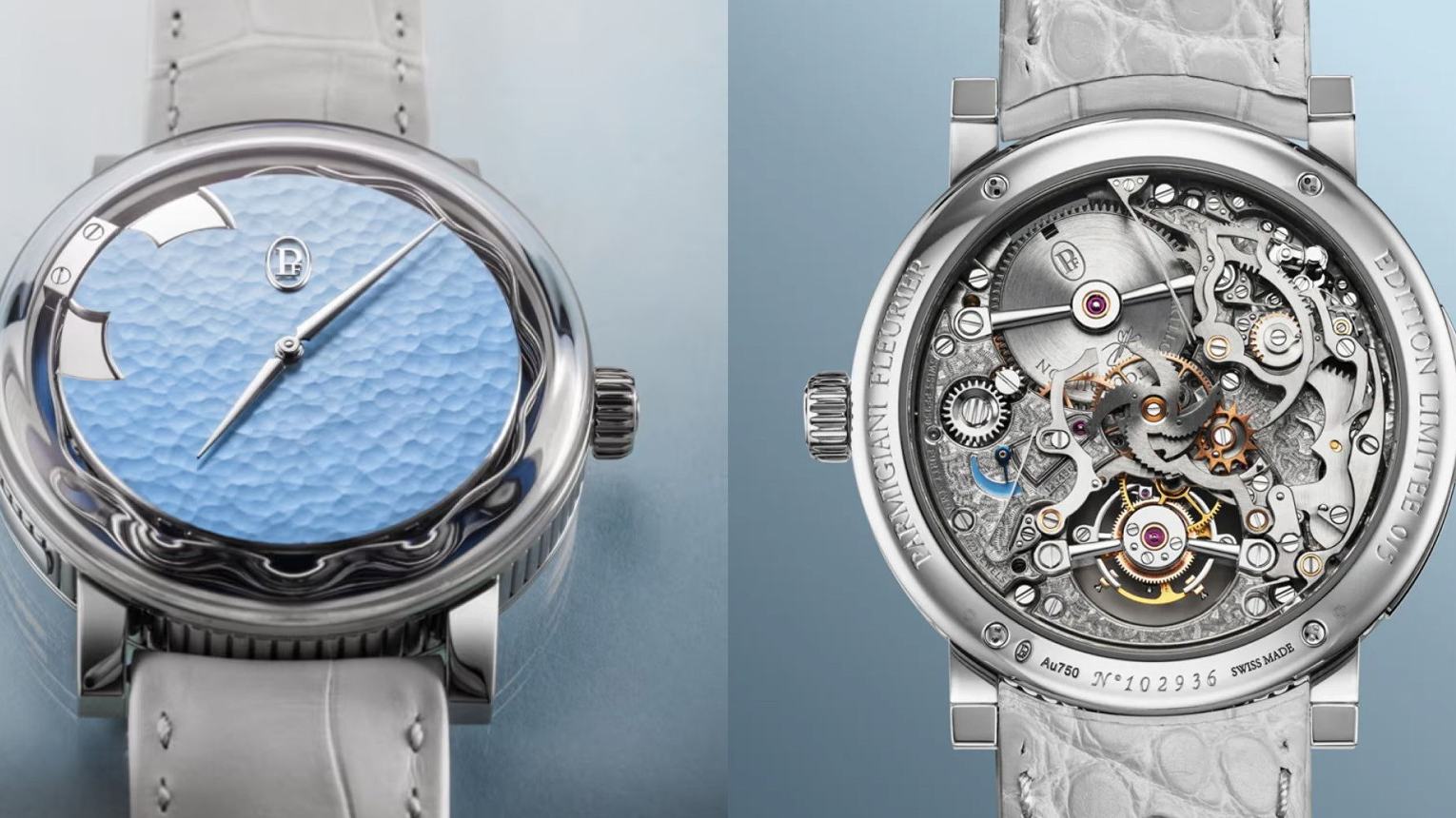
Parmigiani Fleurier's thirtieth-anniversary Carillon Tourbillon combines a four-gong chime, a tourbillon and a 12-day reserve, in five examples.
An anniversary heard as well as seen
Parmigiani Fleurier has chosen a particularly intimate way of marking its thirtieth anniversary: a watch that announces time through a sequence of notes. The Carillon Tourbillon, presented in May 2026, is limited to five examples and positions acoustic watchmaking at the centre of the maison's identity. It is a distinctive approach to an anniversary that might otherwise have been represented simply by a commemorative dial or a precious-metal case. Instead, the object asks its owner to stop and listen, turning a familiar measurement into an experience that occupies a room.
An acoustic complication is difficult to explain through the ordinary language of specifications alone. A sequence of hammers striking gongs must produce a sound that is clear, balanced and consistent, despite originating in an object small enough to wear beneath a cuff. The watchmaker is coordinating the storage of energy, the speed at which it is released, and the resonance of the surrounding metal. A masterpiece of this kind belongs to the same tradition as a concert instrument: its engineering is significant precisely because the result must appeal to the senses.
That sensibility has roots in Michel Parmigiani's career as a restorer of historic horological objects. Long before the independent brand became known for modern wristwatches, he examined watches, clocks and mechanisms created by earlier generations. The anniversary piece translates that discipline into a contemporary design rather than copying a museum object. For an owner who collects fine art or commissions a bespoke interior, the distinction is familiar. Conservation teaches not only how an artefact was made but why its makers chose particular solutions, providing a foundation for genuinely personal new work.
Four gongs and the memory of a pocket watch
The direct historical inspiration is an early-nineteenth-century Perrin Frères pocket watch from the Sandoz Collection, restored by Parmigiani Fleurier in 2000. Its unusual serpentine gongs suggested a form that could be reinterpreted on the wrist. In the Carillon Tourbillon, four long, curved gongs help define the entire architecture below the sapphire crystal. The shape is not a decorative flourish added after construction; it is part of how the instrument communicates its character, giving the sound-producing mechanism an unusually prominent visual role.
Parmigiani specifies one low-pitched gong for the hours, one high-pitched gong for the minutes, and two further gongs for the quarters. Together they form a four-note sequence with a different sonic identity from a simpler two-gong minute repeater. An integrated regulating flywheel is intended to keep the cadence steady, avoiding the sensation that a chime accelerates or decelerates as the stored energy is used. Such details may be invisible to an observer, but they affect the impression of poise that distinguishes a demanding acoustic complication.
The choreography of the dial reveals the hammers that initiate this performance. Watching a miniature striking mechanism operate is a rare pleasure because the viewer can associate movement with a specific musical result. Around it, the hand-hammered Morning Blue dial leaves space for the mechanism rather than hiding it beneath a conventional arrangement of indications. The result is restrained in colour but expressive in construction, bringing together the visual intimacy of a skeletonised watch with the emotional surprise of sound.
Twelve days of energy beneath a white-gold case
The movement contains 456 components assembled by hand according to the maison's technical presentation. Two superimposed barrels serve the main train and provide a quoted twelve-day power reserve, a substantial duration for a mechanism that also carries a tourbillon. A third barrel is dedicated to the striking complication, winding automatically when the slide is used to activate the repeater. Separating these functions is essential to the watch's logic, because the stored energy for keeping time and the energy required to sound the hours have different responsibilities.
At the rear, the owner can observe the tourbillon, power-reserve indication and much of the movement's construction. Parmigiani deliberately places some of this complexity away from the front of the watch, leaving the principal dial legible rather than turning every component into an overt display. The arrangement speaks to a particular taste in collecting, one that values discovery through handling and inspection. A watch can appear calm at a first glance while containing a remarkable degree of invisible labour beneath its surface.
The white-gold case carries vertical gadroons inspired by classical architectural columns and relates to the maison's Armoriale design language. Its metalwork contributes more than visual identity: the case is also part of the acoustic system through which vibrations are transmitted. The glass-box sapphire crystal gives the curved gongs space to be appreciated, while hand engraving introduces further texture to selected movement surfaces. Careful attention to proportion and finish is necessary here because adding complexity without restraint would undermine the instrument's central purpose.
Five examples and the culture of transmission
Limiting production to five pieces does not automatically produce greatness; scarcity is meaningful only when the object deserves prolonged attention. In this instance, the scale of the work and the coordination of specialists help explain why the series is exceptionally small. The project draws upon movement design, acoustic regulation, engraving, case making and the specialised judgement gained through restoration. Each discipline contributes to the effect the owner experiences when the chime is activated, making the watch an unusually concentrated expression of collaborative craftsmanship.
The piece is also a reminder that a great watch collection should include more than familiar categories and investment narratives. Some objects are compelling because of their historical references; others because they solve a difficult engineering problem with unusual elegance. A carillon offers both. Its music is fleeting, but the labour required to make it repeatable becomes part of its lasting value as an artefact. It can be enjoyed privately and passed between generations, provided it receives the care and specialist attention such a demanding mechanism requires.
For the collector who moves between a yacht, a town residence and quiet country retreats, the Carillon Tourbillon is almost an argument for unhurried time. It transforms a simple request for the hour into a deliberate action and a brief listening ritual. The watch's real luxury is the space it creates for appreciation, not the number of functions it can show simultaneously. Thirty years after the brand's founding, Parmigiani Fleurier has produced an anniversary object whose lasting story is about the sound and memory held within its mechanical architecture.