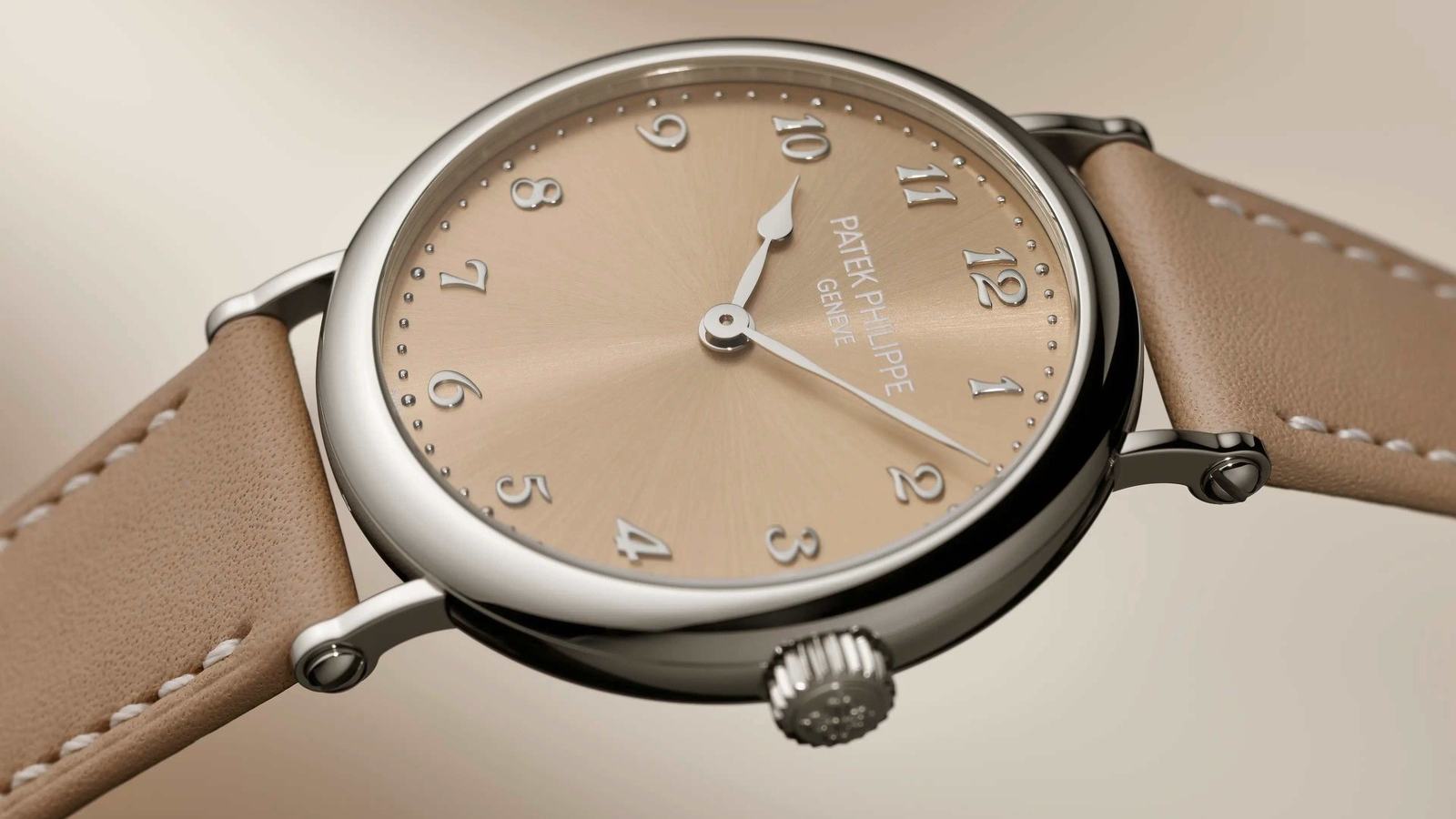
A close look at the 2026 Calatrava 7200/50G-001, combining a 34.6mm white-gold case, sunburst beige dial and ultra-thin self-winding calibre 240.
A Calatrava that relies on proportion, not spectacle
Patek Philippe’s Calatrava reference 7200/50G-001 is an unusually persuasive example of a luxury watch whose principal effect comes from restraint. Introduced in the 2026 collection, it uses a 34.6mm white-gold case, a soft sand-beige dial and a similarly coloured leather strap. None of these elements demands attention across a room. Together, however, they create the sort of coherent visual language that can remain engaging through years of ownership. For someone who divides time between the city, a Mediterranean summer residence and life aboard a yacht, that adaptability is more useful than a dramatic statement piece.
The particular appeal of this reference lies in its control of contrast. The case is polished white gold, yet the dial does not rely on bright white or high-contrast black to communicate time. Instead, the sunburst sand-beige surface catches shifting light while applied Breguet numerals and pear-shaped white-gold hands provide familiar watchmaking cues. The minute track uses applied white-gold cabochons, adding relief without producing an overly busy face. Those choices suggest a watch intended to reward close inspection, and they also explain why official photographs can reveal details that disappear in small product thumbnails.
At 7.37mm thick, the case contributes to an impression of delicacy that is not merely aesthetic. A relatively slim watch sits beneath a cuff and feels less conspicuous during a long dinner or business meeting. Its Officer’s-style architecture introduces straight lugs and screwed-in strap bars, distinctive details that quietly separate this Calatrava from more generic round dress watches. Patek Philippe describes the case as fully polished, which means the surrounding surfaces play a substantial part in the design. Everyday owners should therefore think about scratches, handling and storage as part of the ownership experience.
The movement is small, precise and central to the design
The mechanical heart is Patek Philippe’s self-winding calibre 240, an ultra-thin movement built around an off-centre winding rotor in 22-carat gold. The brand specifies a movement diameter of 27.5mm and thickness of 2.53mm, dimensions that help explain how the finished watch stays so slender. This is a good illustration of genuine mechanical engineering serving design rather than being displayed for its own sake. A wearer sees a slim, balanced case, while the mechanism works beneath the dial and through a sapphire-crystal case back.
Technical figures make the engineering choices easier to appreciate. The calibre uses 152 components and 27 jewels, with a stated minimum power reserve of 48 hours and a frequency of 21,600 semi-oscillations per hour, or 3Hz. Patek Philippe also identifies its Gyromax balance and Spiromax balance spring among the movement details. Those names will interest seasoned collectors, but the practical point is simpler: the watch is a mechanical object that requires careful maintenance and periodic winding or wearing. It should not be treated like a battery-powered travel accessory.
The sapphire back is particularly important for an owner interested in craftsmanship. An ultra-thin movement leaves limited room for mechanical ornament, so the view concentrates attention on the mini-rotor, finishing and the compact arrangement of components. Patek Philippe associates the model with its own quality seal, yet a collector should still inspect the individual watch, its papers and its service history before purchasing. Official specifications describe what a reference should be; they cannot independently confirm the condition of any particular example offered on the secondary market.
How white gold and beige fit into a maritime wardrobe
A yacht-based wardrobe has practical constraints that are rarely visible in glossy campaign photography. Days can move from open decks to air-conditioned interiors, then on to a formal shore-side dinner, with little opportunity for a complete change of accessories. The white-gold Calatrava addresses the elegant end of that schedule. Its pale metal and neutral dial are compatible with natural linen, muted tailoring and evening clothes, while the sand-beige calfskin strap avoids the hard visual break that a black band can create. Its role is sartorial rather than sporting.
That last distinction matters: the manufacturer specifies water resistance to 30 metres, but this should not be confused with an invitation to swim, snorkel or handle wet deck equipment in an expensive dress watch. The calfskin strap is another reason to remove it before water-based activity. Owners who travel by tender or spend time near the sea should take normal precautions against salt spray and avoid exposing the watch to knocks during transfers. Admirable finishing and valuable materials do not eliminate the limits of the product’s intended use.
Many collectors now rotate watches according to setting, and this reference makes most sense within that broader approach. A robust sports watch may be the practical choice for a morning on the water; the Calatrava becomes appealing when the day shifts towards social occasions. Its proportions also help it stand apart in an era when oversized cases can dominate the wrist. Rather than attempting to look universally technical or rugged, the 7200/50G-001 offers a specific proposition: finely judged form, traditional display and mechanical sophistication in a restrained package.
The ownership questions that matter beyond the photograph
Anyone evaluating this Calatrava should start with fit. A 34.6mm measurement describes diameter, not how the Officer’s-style lugs distribute across a wrist, and photographs cannot convey that relationship reliably. The strap’s colour and texture can also change appearance in outdoor and indoor light. An appointment with an authorised retailer provides an opportunity to assess legibility, comfort, buckle operation and the warmth of the sand-beige dial in person. These details are relevant whether the watch is being selected as a personal purchase or a significant gift.
Travel and storage deserve similar consideration. A leather strap benefits from staying dry and away from prolonged direct sunlight, especially in the environment of a yacht cruising through warm climates. Secure storage should protect the case and buckle from contact with other jewellery or metal accessories. Buyers also need to understand how the maker’s service network and warranty arrangements apply across borders. That may sound prosaic for a luxury acquisition, but preserving an intricate mechanical watch is an ongoing commitment rather than a single purchasing decision.
The wider significance of this 2026 reference is the confidence of its design. Patek Philippe has not needed an elaborate complication or a large case to define the watch’s character; the movement, case thickness, numerals and closely matched strap are enough. The 7200/50G-001 will not suit someone looking for a rugged daily instrument, and that is precisely why its identity is clear. For collectors who value discretion, a well-proportioned dress watch can offer a particular sort of luxury: quality revealed gradually, without any need for spectacle.