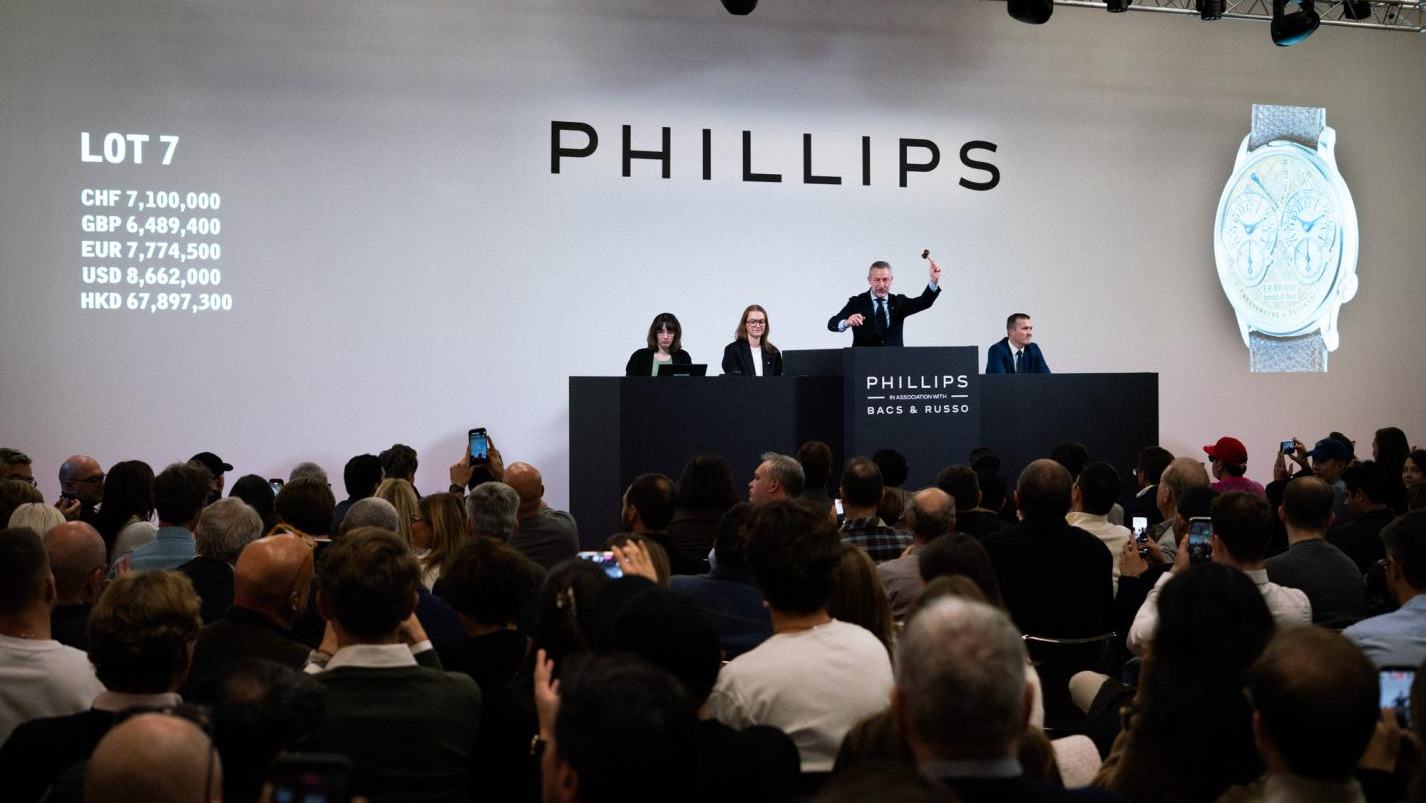
Phillips reports a $112.3 million Geneva watch auction, with rare independent and vintage timepieces leading the results. A closer look at collector priorities.
Phillips in association with Bacs & Russo has reported a record result for its November 2026 Geneva watch sale. Held on 7 and 8 November at Hotel President, the auction generated CHF 92,045,568, or approximately US$112.3 million, from 217 lots. All the offered watches and clocks sold. The auctioneer describes this as the first live watch auction to pass the hundred-million-dollar threshold. For a superyacht owner who collects significant timepieces, the result offers an unusual opportunity to examine what sophisticated international buyers will pay for particular examples, rather than speculate about the general direction of watch prices.
Reading the record in context
Phillips reports twenty-four auction records, seventeen individual results above one million Swiss francs and registrations from 2,121 bidders representing 69 countries. Those figures indicate both substantial international reach and an unusually strong concentration of expensive objects within a relatively compact catalogue. They describe the outcome of a particular sale, however, rather than an index of every watch sold during the autumn. The auction house's ability to obtain notable consignments and attract collectors interested in their specific characteristics naturally affects the figures.
An owner evaluating a private collection should consequently avoid applying the sale-level average to individual watches. A few very expensive pieces contribute disproportionately to the aggregate, and the absence of unsold objects does not mean that watches offered elsewhere will achieve similar results. A more useful approach is to identify transactions involving the same reference, configuration and comparable condition. Even then, the purchase history and originality of the components must be examined before an apparently comparable price can be treated as a reliable guide.
Independent watchmaking attracts the largest commitments
The results from F.P. Journe were particularly substantial. Phillips attributes nearly CHF 31.8 million of the proceeds to thirteen watches by the maker. Its leading Résonance wristwatch, the Régence example, reached CHF 8,680,500. A different Résonance made for the Tokyo boutique sold for CHF 6,146,000. The scale of the bidding illustrates the interest in highly unusual executions of a complication that has become closely identified with the history of this independent manufacture.
A collector interested in these watches needs a greater understanding than familiarity with their outward appearance. Resonance-based mechanical timekeeping presents a specific engineering problem involving the relationship between two regulating systems. A rare example may also belong to a particular developmental stage in the maker's output. Determining what distinguishes the individual piece from the rest of the reference requires evidence, including the original documentation and an informed examination of the movement. Repairs or replacements that are unremarkable in an everyday watch may matter enormously in a rare historical example. That is one reason to build relationships with specialists before pursuing the most sought-after independent pieces.
The precise attributes of a vintage wristwatch
Vintage results at Geneva similarly demonstrate the importance of individual configurations. A steel split-seconds chronograph by Patek Philippe, reference 1436, fetched CHF 6,267,000. A Rolex reference 6062 with the distinctive Stelline dial reached CHF 2,334,500; Phillips described it as a recently discovered watch sourced from the original owner in Japan. These are not simply transactions involving two familiar manufacturers. The particular metal, dial, surviving components and history are substantial elements of the objects' identities.
In practice, a reference number is the beginning of an assessment, not the conclusion. An expert can consider the shape and condition of the case, the relationship between dial signatures and the period of manufacture, and whether components have been changed during earlier restoration. Where an auction description claims exceptional originality, a bidder should obtain the fullest available supporting records and condition information. The significance of an unusual reference cannot be translated into a price without understanding whether the offered example actually retains the qualities that make it rare.
A clock as a significant decorative object
Among the leading results was Cartier's Portico Mystery Clock No. 4. It achieved CHF 4,815,000, setting what Phillips identifies as a record auction price for a Cartier timepiece. The clock illustrates the overlap of fine watchmaking and the decorative arts. The visual mystery associated with suspended-looking hands can make a historical clock an architectural and artistic presence in a room, quite apart from its capacity to indicate the time.
Acquiring an object of this type for a collection requires a different practical approach from purchasing a wristwatch. A carefully designed interior may provide a compelling setting, but an owner should discuss the proposed installation with a conservator, a specialist clockmaker and the relevant insurer. On a yacht, even apparently sheltered interiors are subject to motion, possible vibration, changes in humidity and maintenance operations. The safest position for important historical clockwork may be in a controlled shore-based residence rather than aboard. The suitability of any actual location should be assessed individually, with the protection and service needs of the object taking precedence over aesthetic considerations.
Different generations of independent makers
Geneva also brought significant prices for other independent manufacturers. A platinum Simplicity by Philippe Dufour achieved CHF 1,968,500. A tantalum Vingt-8 Inversé by Kari Voutilainen realised CHF 1,524,000. These figures are worth considering alongside the highest vintage results, because the objects represent a different way of creating lasting interest: distinguished technical choices, personal craftsmanship and a body of work associated with recognisable individuals.
The smaller scale of a manufacture can be attractive to collectors accustomed to commissioning bespoke items, yet it raises a particular set of practical questions. A specialist watch may require highly individual technical knowledge when serviced. It is sensible to establish the maker's recommendations for maintenance, the availability of qualified technicians and the treatment of replaced parts before purchasing. Original invoices, service receipts and any correspondence explaining the movement should be kept together with the collection record. The long-term appeal of an exceptional mechanical creation is enhanced when a subsequent custodian can understand and care for it correctly.
Estimating the full cost of an acquisition
The result announced at an auction is not necessarily the figure that a bidder sees on the screen while the bidding is under way. Auction houses publish prices according to their own conditions and conventions, which commonly include a buyer's premium in the final reported realisation. A prospective owner must read the applicable terms before setting a maximum bid. The budget may need to account for taxes, professional transport, currency exchange, insurance and any recommended examination by an independent specialist.
An internationally mobile owner faces additional considerations. Moving a recently purchased watch from Switzerland to a residence or yacht in another jurisdiction can trigger obligations that differ according to the country, ownership structure and intended use. A qualified adviser should identify the correct customs treatment in advance. The appropriate procedure may also change when a piece is transported for servicing, loaned for an exhibition, or sold. Maintaining a complete purchase file makes those later transactions easier to document. Neither the cost nor the administrative complexity should come as a surprise after the auction hammer falls.
A collection that can outlast the collecting moment
The availability of notable examples within a single catalogue can tempt experienced and relatively new collectors alike to bid across several unrelated categories. A more deliberate acquisition strategy starts with identifying what the owner values intellectually and aesthetically. A collection might concentrate on a particular complication, a period of technical innovation, the extraordinary achievements of one maker, or the dialogue between independent watchmaking and decorative art. Establishing that focus permits the collector to recognise when an appealing lot genuinely improves the collection.
Documentation is particularly important for a geographically dispersed group of objects. A private inventory should identify each timepiece by its specific reference, serial where appropriate, actual photographs, relevant documents and condition history. Access to the details of valuable property should be restricted to authorised individuals. A collection manager should also know which professional can approve service, transport or changes to insurance arrangements. The objective is stewardship of the actual object, not merely the recording of a headline valuation. Those disciplines provide considerable value even when the owner's appetite for new acquisitions changes.
The lesson of an extraordinary Geneva sale
Phillips has demonstrated that a live watch auction can attract sufficient demand for a carefully selected catalogue to produce a nine-figure dollar total. The prices achieved for several different kinds of timekeeper suggest that serious collectors recognise distinct forms of significance: an unusual surviving vintage configuration, a maker's individual achievement in contemporary horology, or an object whose value bridges mechanical engineering and the decorative arts.
The result should not be mistaken for a guarantee of future appreciation. When any individual watch returns to market, its condition, the prevailing economic environment and the presence of suitably interested buyers will help determine the outcome. The more enduring lesson is that expertise matters. For an owner with the means to pursue outstanding examples, time invested in understanding the designs, makers and provenance is likely to provide a richer collecting experience than simply pursuing the objects currently attracting the most attention. Geneva's record is noteworthy precisely because the strongest results concern particular pieces with stories and attributes that deserve detailed consideration.
Primary source: Phillips in association with Bacs & Russo, official results press release, 8 November 2026.
Phillips in association with Bacs & Russo, photograph by Joy Corthesy. The auction-room photograph is reproduced from page one of the results press release. Official source.