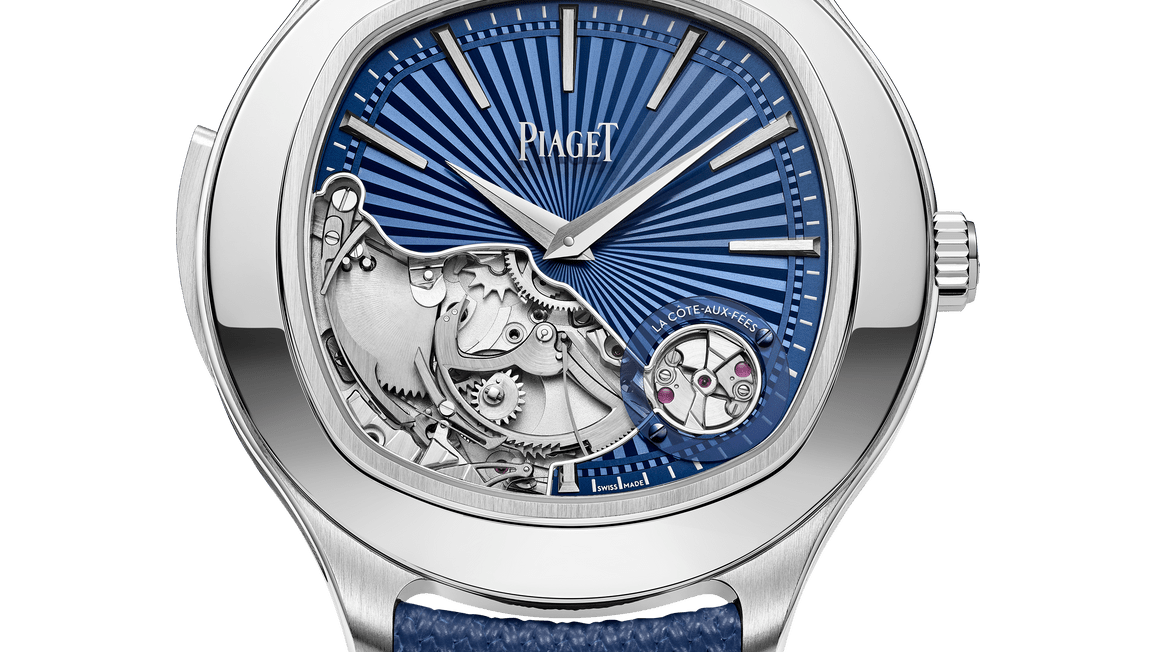
Piaget's new Polo Minute Repeater pairs a 48mm white-gold case with its ultra-thin 1290P movement and production of only five numbered pieces per year.
Piaget has pushed the Polo line into serious collector territory with a minute repeater that will be produced as just five numbered watches per year. The piece combines the casual identity of the Polo case with one of traditional watchmaking's most demanding acoustic complications.
A 4.8mm movement drives the complication
At the centre is Piaget's automatic Calibre 1290P, an ultra-thin movement measuring 4.8mm high and built from 407 components. It provides a 40-hour power reserve while accommodating the minute-repeater mechanism inside a watch that remains recognisably part of the Polo family.
White gold and an open acoustic architecture
The 48mm case is made from rhodium-plated 18-carat white gold, with a blue openworked and guilloché dial exposing much of the movement beneath. A sapphire caseback continues that view from the reverse, turning the mechanical architecture into part of the visual experience rather than hiding it behind a conventional dial.
Scarcity is built into the production plan
Piaget says only five numbered examples will be produced each year, placing the watch firmly in the realm of allocation-led collecting. That rarity is likely to matter as much as the complication itself for clients who already collect watches alongside cars, art or yachts and want pieces unlikely to appear on another wrist at dinner.
The appeal is mechanical rather than digital
In an age of connected devices, a minute repeater remains deliberately analogue, translating time into sound through a complex mechanical sequence. That tension between technical difficulty and apparent simplicity is exactly why such watches continue to occupy a special place in high-end collecting.
Source
Piaget