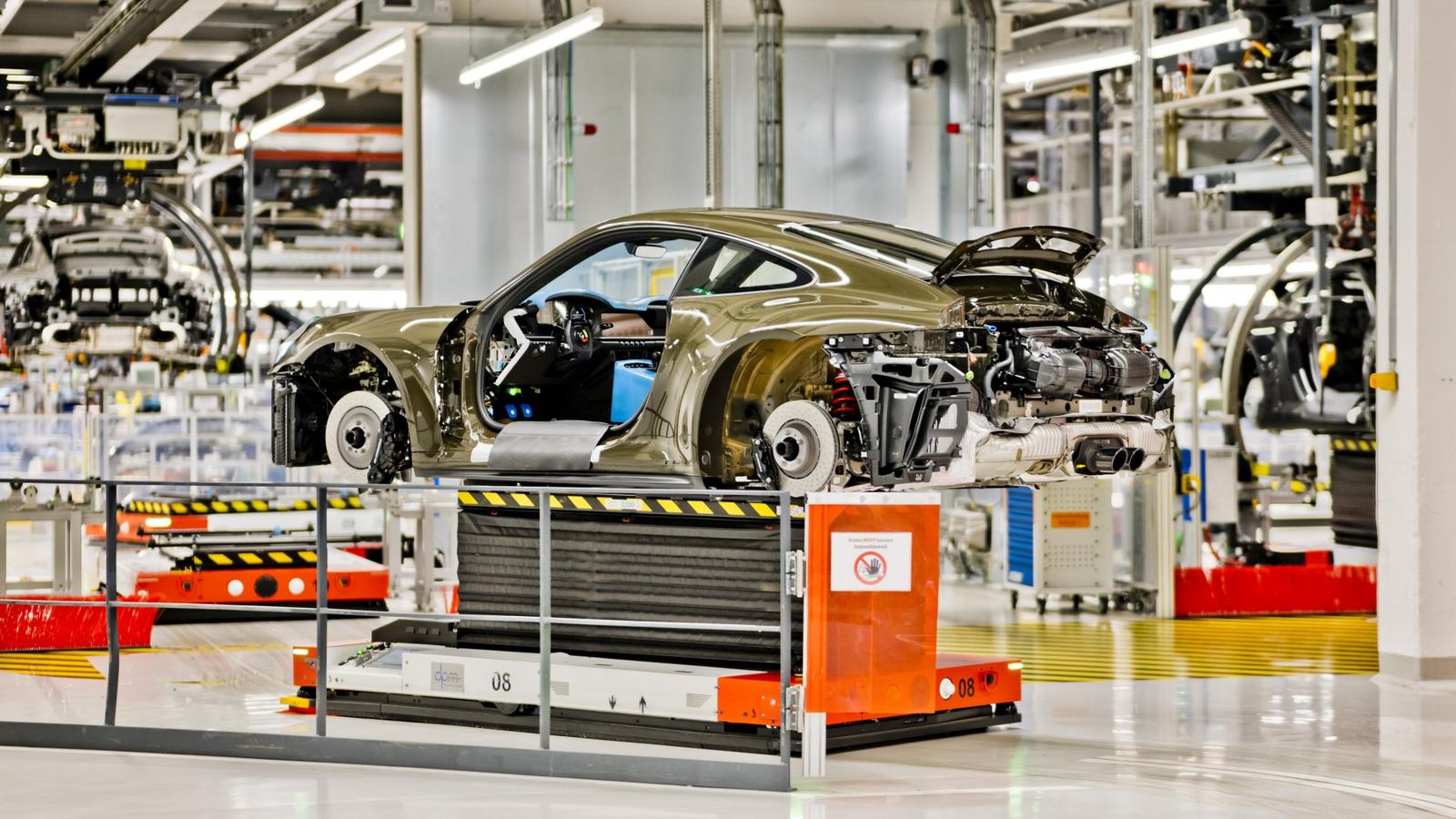
Porsche has opened the production process behind its 911 GT3 Bergsport, showing how the market edition moves from the normal 911 line into Exclusive Manufaktur hand-finishing.
Porsche has taken the camera inside Zuffenhausen to show how the 911 GT3 Bergsport moves from ordinary series production into something closer to a hand-finished collector car. Photographer Stefan Bogner followed the market edition through the factory as its Valleygreenmetallic body and standard 911 production processes gave way to badges, leather embossing, contrast stitching and colour-matched accessories applied by Porsche Exclusive Manufaktur.
Every Bergsport starts on the same line as other 911s
The GT3 Bergsport is based on the current 911 GT3 with Touring Package and initially follows the same body, paint and assembly path as the wider 911 family. Porsche says around 1,900 components go into a 911 and that 25 variants are currently produced on the same highly flexible line in Zuffenhausen.
That common starting point is important because the limited character of the Bergsport is not created by separating it into a boutique workshop from the first weld. Precision manufacturing does the structural work, while individuality is layered on after the core car has passed through Porsche's established production system.
A 911 takes roughly four days before the bespoke work begins
Porsche says a 911 takes about four days to move from body construction and painting through final assembly. Robots handle tasks where repeatability and precision matter most, but the factory still relies heavily on technicians for fitting, inspection and processes where judgement cannot easily be automated.
For collectors, that combination is part of the modern luxury-manufacturing story. The appeal no longer comes from pretending every component is made by hand; it comes from using automation where it improves consistency and reserving human craft for the areas where finish, feel and small variations actually matter.
Exclusive Manufaktur adds the pieces that identify the edition
Once series production is complete, Porsche Exclusive Manufaktur adds the Bergsport-specific details. These include a circular B-pillar badge, a rear-lid grille badge, leather embossing on the centre-console lid and decorative stitching in orange, black and white.
The treatment extends beyond the car itself. The key, leather key pouch and document wallet are finished to match the Bergsport colour palette and logos, turning objects that might normally be peripheral into part of the ownership experience. That attention is familiar to yacht clients who expect tenders, tableware and loose accessories to follow the same design language as the main project.
The production story gives the edition more depth than colour alone
Porsche introduced the GT3 Bergsport as an Alpine-inspired market edition, but the factory story adds another layer by showing exactly where the difference between a standard GT3 Touring and the special version is created. Its value proposition therefore rests not only on rarity and a distinctive specification but also on the visible intervention of a specialist finishing team.
For collectors, that can make the car more interesting over time. Paint and badges create immediate recognition, while a documented manufacturing process helps explain why the edition exists and how its details were executed, giving provenance to features that might otherwise be dismissed as cosmetic.
Official sources: newsroom.porsche.com.
Source
newsroom.porsche.com