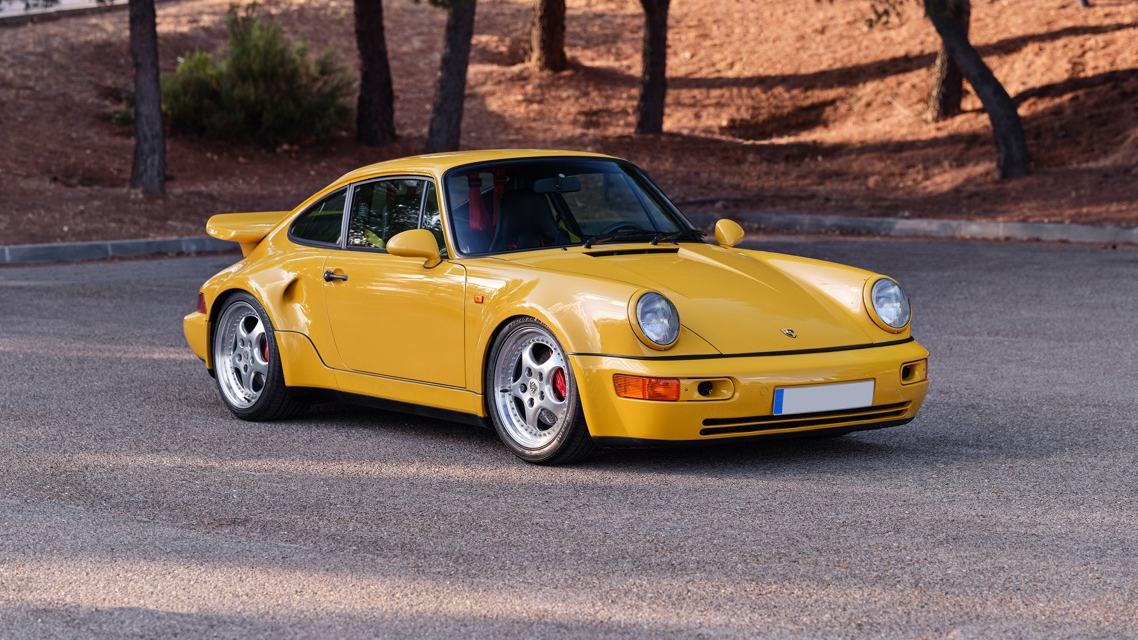
RM Sotheby’s offers a Speed Yellow 1992 Porsche Turbo S Lightweight with long family ownership and an €800,000–€1 million estimate at its Munich sale.
A rare air-cooled Porsche comes to the Munich sale
On Friday, 20 November 2026, RM Sotheby's will offer a particularly individual 1992 Porsche 911 Turbo S Lightweight at Motorworld Munich. The auction house places an estimate of €800,000 to €1 million on chassis WP0ZZZ96ZPS479021, lot 126, which has remained in the same family since 1993. Its Speed Yellow finish and specially selected three-colour interior distinguish the individual car within an already small production series. The catalogue identifies it as one of 86 Turbo S Lightweights manufactured and reports an odometer reading of 30,933 kilometres when the car was catalogued. An inspection carried out by Porsche Classic Center Gelderland in October 2026 forms part of the documentation associated with its sale. For an owner assembling a collection of historically significant sporting cars, the lot provides a timely opportunity to examine the relationship between factory customisation, competition-derived engineering and the documented history of a particular vehicle. Its estimated value remains a presale assessment rather than an achieved price.
Porsche Exclusive and the origins of the limited-production model
RM Sotheby's traces the development of the Turbo S Lightweight to Porsche's Exclusive department, which took responsibility for the model's construction. The auction house relates the car's concept to the 911 racing programme that succeeded in the 1991 IMSA Supercar Championship in the United States. The intention was to develop a road-going automobile with the character of a comparatively uncompromising competition-derived machine. It should not be confused with an original race car simply because it draws on a competition programme. The resulting car retained a production-derived identity while undergoing substantial alterations to its equipment and powertrain. The significance of the Exclusive department's role is especially relevant to collectors who follow the development of factory personalisation. The opportunity to select an exterior colour and interior treatments existed alongside changes to the car's mechanical specification. Those two strands of the vehicle's identity can be examined independently, rather than assume that all examples of the model were commissioned with precisely the same decorative and functional equipment.
Mechanical changes within the 964 architecture
The auction house identifies the underlying model as a 964-generation 911 with a turbocharged 3.3-litre flat-six. Changes to the turbocharger, fuel injection and camshafts resulted in a quoted output of 381 PS, transmitted through a five-speed Getrag gearbox. In this context the performance specification is useful for understanding the position of the model within Porsche's historical range. It does not establish the output currently achievable by the particular car offered in Munich or provide a guarantee of the mechanical condition of its components. A specialist examining an example before purchase can consider the state of the engine and transmission, the originality of relevant parts and the relationship between past maintenance and the owner's intended use. The actual assessment should be based on the information accompanying the car and direct inspection rather than a general description of the model. An owner intending to drive it regularly may have different priorities from a collector mainly concerned with preserving its existing materials and appearance.
Reducing mass rather than concentrating only on output
According to the catalogue, the model's development reduced its weight by more than 180 kilograms relative to the standard Turbo S. Among the measures identified were the removal of air conditioning, power steering, rear seats and sound-insulating material. That approach reveals something of the intended character of the Lightweight. Removing equipment can affect many aspects of an automobile beyond its absolute performance, including the character of the cabin, the effort needed to operate certain controls and the requirements of passengers. A collector considering this model for regular road use should therefore evaluate it according to its actual equipment rather than compare it directly with a more contemporary high-performance vehicle. The absence of a particular comfort feature is part of the historically intended specification, not necessarily an omission requiring correction. Alterations designed to make an older sporting car easier to use may change its character and affect the evidence of its original construction. A buyer should assess the individual vehicle's condition before making any such decisions.
A specially ordered colour and interior
Chassis number 479021 was completed in September 1992 for the German market and delivered that December, according to RM Sotheby's. Its original purchaser was a Porsche VIP customer who specified Speed Yellow through the manufacturer's individual colour programme. Black leather forms the basis of the interior, with yellow and grey details incorporated into the bucket seats and steering wheel. The catalogue also identifies an onboard computer and limited-slip differential among the additional equipment, alongside eighteen-inch Speedline split wheels originally supplied with Dunlop tyres. These details illustrate the scope for individual choice even within the comparatively Spartan character of the Lightweight. A collector examining the car should establish the actual condition and originality of its materials independently from the original specification. Historical photographs, invoices and factory records may assist in distinguishing equipment delivered with the car from compatible components installed later. The published description is an account of the particular vehicle's documented specification, not a guarantee that every consumable component has remained unchanged.
The transition from Germany to a Spanish family collection
The car moved to Spain in 1993 and has remained in one family since then, according to the auction house. The accompanying service history includes stamps recording visits to Porsche España in 1993 and 1998. The catalogue identifies six Spanish technical inspections between 1997 and 2007, with further examinations in 2021 and October 2023. These records provide chronological points against which the car's history can be examined. Their existence should not be taken to mean that every service or maintenance operation has been recorded in the publicly described file. A buyer may wish to examine the full set of available records to establish how the car has been stored and operated during its extended ownership. The odometer showed 30,933 kilometres at cataloguing, and the auction house says that much of this distance was accumulated in the earlier years of family ownership. Use on public roads reportedly became infrequent after the turn of the millennium. Relatively limited recorded distance does not by itself establish the condition of ageing components.
An October inspection adds another source of evidence
The car was inspected by Porsche Classic Center Gelderland in October 2026. RM Sotheby's states that the report identifies the engine and gearbox as corresponding to the car's original numbered assemblies. It also lists the engine number as 61N01540. Matching numbered assemblies are an important element of an assessment of a historic car, but the significance of those numbers should be considered alongside physical condition and the documented work undertaken during its history. The actual inspection report is available through the auction house rather than reproduced in full in its public description. A prospective buyer considering a substantial bid should obtain that report and seek appropriate specialist advice about any aspects requiring further examination. A vehicle can retain its original mechanical assemblies while having experienced servicing, repairs or replacement of other components. The catalogue also identifies the owner's guide folio as accompanying the car. Retaining those records after purchase can help preserve the connection between the physical vehicle and its documented history.
Friday's auction and the transaction basis
The Munich sale is scheduled to begin at 4 pm Central European Time on November 20, following a public preview between 10 am and 2 pm. The auction's location at Motorworld places the sale within an environment associated with historic and collectible automobiles. Attendance at the auction itself is subject to the organiser's admission arrangements. The published terms specify a €100 bidder registration charge, with advance online registration required and late requests not assured. The estimate of €800,000 to €1 million is not a prediction of the final bid and does not establish the buyer's complete acquisition expenditure. Applicable premiums, taxes, transportation and any other charges should be confirmed through the auction house. International purchasers should also establish the necessary arrangements for registration, movement and insurance in their intended jurisdiction. The catalogue identifies Spanish registration documentation for the Lightweight, which should be examined in relation to the actual purchaser's intended ownership and use.
A collector's opportunity rather than a forecast
The Munich lot combines a small production series, an individual factory colour and interior configuration, long family ownership and a recent inspection. These characteristics make it a useful illustration of the way a particular historic Porsche can be distinguished from superficially similar examples. For a yacht-owning household maintaining a separate automotive collection ashore, the decision to acquire such a car may depend on the role it is expected to fulfil within that collection. Preservation, occasional motoring and participation in organised automotive events can impose different requirements. It is important to identify those objectives before undertaking work that may affect historically significant materials. The November catalogue has provided a defined opportunity to inspect and bid on chassis 479021. Its actual sale outcome will be established only when the auction takes place, and no particular return on acquisition can be inferred from its rarity or the upper estimate.
Primary source: RM Sotheby’s official Munich auction lot 126 catalogue, accessed 18 November 2026.
Further official information: RM Sotheby’s official auction schedule and conditions.
Photography: RM Sotheby’s, lot-specific auction catalogue publicity image, November 2026. Official source.
