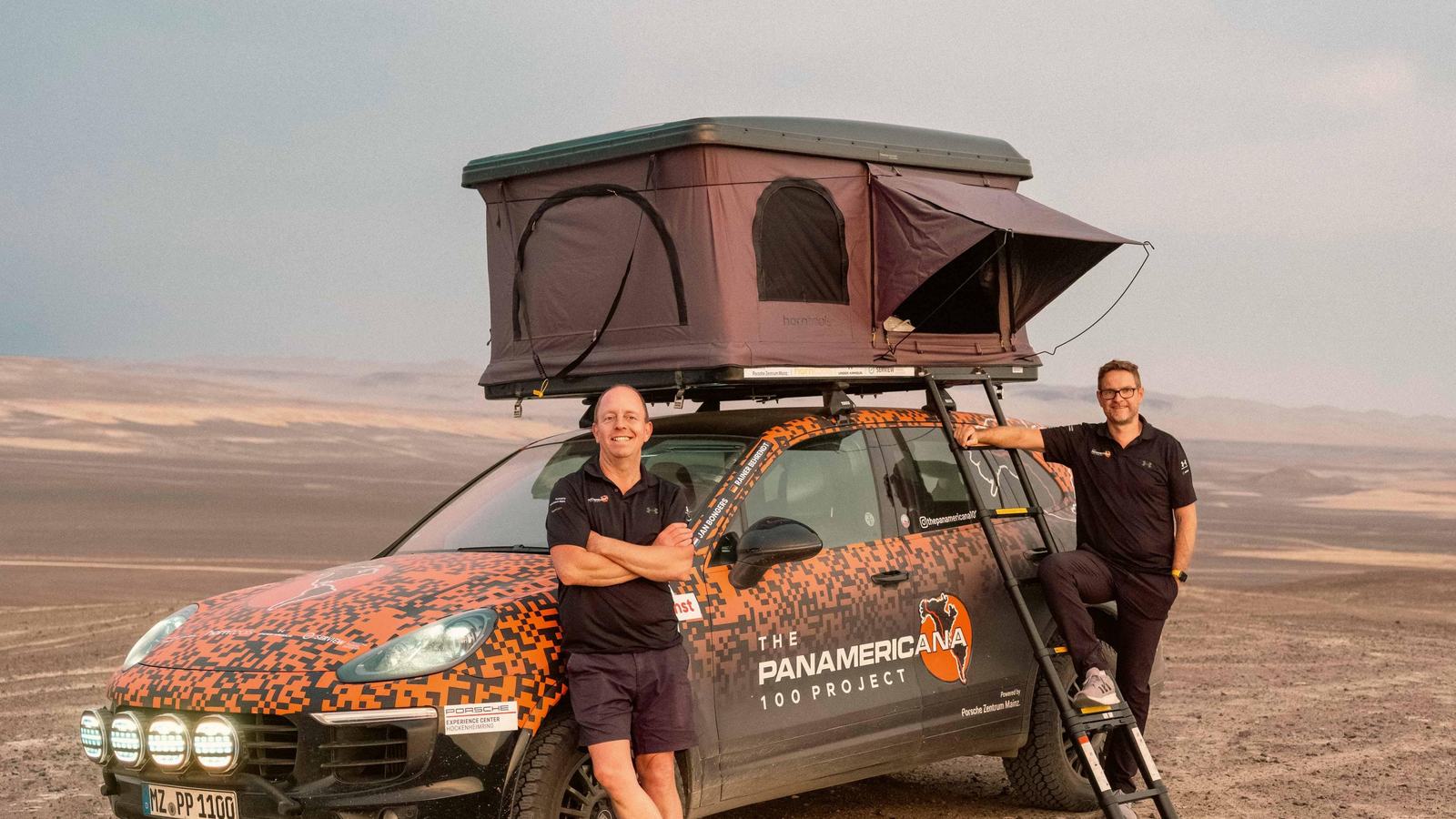
Rainer Behrendt and Jan Bongers drove a Porsche Cayenne from Ushuaia to Deadhorse in 100 days, crossing 15 countries and more than 40,000 kilometres.
Rainer Behrendt and Jan Bongers turned one of the world’s great overland routes into a tightly defined challenge: drive from Ushuaia in Tierra del Fuego to Deadhorse in Alaska in 100 days. Their Porsche Cayenne covered more than 40,000 kilometres through 15 countries, moving from southern Patagonia through the Andes, Central America and Canada to the far north.
The route is larger than a conventional road trip
The Pan-American Highway can extend to roughly 48,000 kilometres when connecting routes are included, making it less a single road than a continental network. Compressing such a journey into 100 days requires disciplined movement even before weather, borders and mechanical realities are considered.
The scale changes the character of travel because each landscape is encountered as part of a continuous geographic story. Patagonia, high Andes, tropical Central America and the Arctic north become connected by the experience of driving rather than by separate flights.
The Andes tested the human side of the expedition
Porsche’s account makes clear that the difficult moments were not limited to terrain or vehicle reliability. Long days at altitude and the accumulated physical strain of constant movement pushed the drivers personally, reminding readers that endurance travel is as much about human resilience as equipment.
That makes the story more useful than a simple durability demonstration. Luxury adventure often depends on excellent machinery, but comfort cannot entirely remove fatigue, uncertainty or the mental pressure of maintaining a schedule across enormous distances.
Photography turns the route into a visual archive
Porsche joined the travellers with professional photographers in Peru and Canada, while Behrendt and Bongers also opened their own private archive from the journey. The combination gives the project both polished editorial imagery and more personal evidence of daily life on the road.
For travellers planning their own ambitious routes, those informal moments can be as informative as the dramatic landscapes. Fuel stops, weather, luggage and ordinary roadside decisions reveal how a journey actually works beyond its headline distance.
The appeal is continuity rather than speed
A Cayenne can cover distance quickly, but the deeper luxury of a trip like this is the ability to remain connected with the changing land between two remote endpoints. The car becomes a private moving base rather than merely transport from one destination to another.
That idea has an obvious parallel with long-range yachting. Owners often value the passages and gradual shifts in geography as much as the famous ports, because continuous travel creates a richer understanding of scale than disconnected destination hopping.
Official sources: newsroom.porsche.com.
Source
newsroom.porsche.com