Porsche Design's new Grenchen facility unites Swiss craftsmanship, configurable chronographs and automotive-inspired materials in a purpose-built watchmaking space.
A new setting for a familiar design philosophy
Porsche Design's newly opened watchmaking facility in Grenchen, Switzerland, is the subject of a 10 November 2026 feature from Porsche Newsroom. The manufacturer has moved production into a renovated building encompassing approximately 3,600 square metres, replacing its previous accommodation in Solothurn. For collectors accustomed to commissioning highly individual objects, the development is interesting not simply because a workshop has moved but because the manufacturer has deliberately organised its operations around carefully specified individual orders.
The relationship between Porsche's automotive business and mechanical watchmaking is visible in the company's approach to materials, readable instruments and the coordination of colours and finishes. The result can be a timepiece that corresponds closely to an individual car without being merely a piece of branded merchandise. A collector considering such a commission should think about the qualities the watch will retain when it is worn far away from the vehicle that helped inspire it.
Understanding what bespoke means
Bespoke watchmaking encompasses very different forms of personalisation. At one end, a manufacturer may allow a choice of strap or inscription on a finished reference. At the other, an entirely new movement or case may be developed for a private client. Between those extremes lies a particularly interesting category in which proven components are selected and assembled in an individual configuration. Porsche Design's current programme belongs to that world of carefully integrated manufacturing choices.
The company reports that close to three-quarters of its timepieces are individually configured. Porsche enthusiasts can discuss colours corresponding to particular 911 and Cayenne specifications, together with materials and details that relate to their vehicles. Such a scheme can provide considerable individuality without requiring every chronograph to be developed from a blank drawing. It is important for a collector to understand which features are configurable and which remain fixed by the mechanical requirements of the watch.
Personalisation is most convincing when the final result has a deliberate visual identity. Request a record of the selected components and allow time to consider the relationship between the dial, hands, case, strap and winding arrangement. More options do not necessarily produce a more satisfying design. A relatively understated combination may be easier to wear across differing settings than a collection of conspicuous details selected simply because they are available.
Automotive details translated into a different object
A sports car and a mechanical watch are both concerned with precision, but the resemblance between them should not be taken too literally. Their materials operate under very different loads, and the requirements of a wearable instrument differ from those of a vehicle. The success of an automotive-inspired watch depends on whether its references remain appropriate within the smaller object.
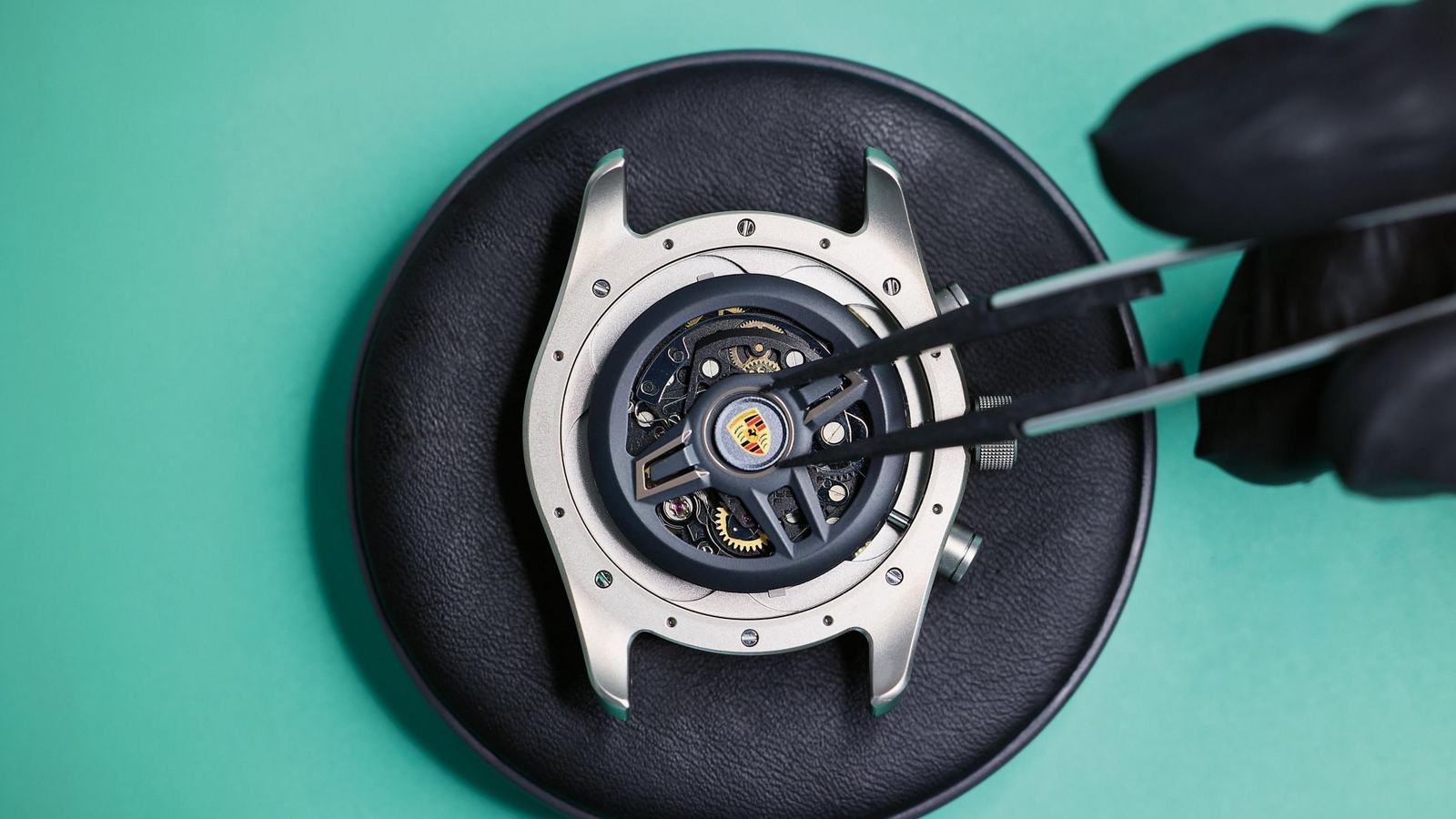
A winding rotor is a good example. Porsche's report describes a configuration reflecting the appearance of a wheel, with tungsten used to produce the imbalance needed for winding. A wheel on a sports car is balanced for its own reasons; the mechanical rotor inside an automatic watch must respond to movement. An effective design can therefore borrow the language of automotive engineering while adapting the underlying component to a completely different task.
Collectors should examine such details in person if possible. A photograph may communicate the outline of a rotor, but the operation, finishing and visual relationship to the movement are better appreciated with the watch at hand. The design's appeal should survive the initial recognition of its connection with a particular car.
The value of an organised workshop
The Grenchen building dates from 1955 and has a connection with earlier Porsche Design watch production under licence. Its recent renovation has allowed the manufacturer to establish a compact sequence of component selection, assembly and inspection. The company describes ten watchmaking workstations situated in a controlled clean-room environment, supported by an organised component-storage system.
A bespoke manufacturing process creates logistical challenges precisely because each order may differ from the one before it. The assembler must have the correct set of components available, and those components must be checked against the client's specification. A well-organised sequence reduces unnecessary handling and helps ensure that an unusual dial or finish is not confused with a similar option intended for another commission.
This relationship between individual choice and standardised procedures is familiar to superyacht owners. A tailored interior can incorporate features selected by the client without abandoning disciplined engineering or quality control. The ability to accommodate variation is most valuable when the maker also knows which aspects of the underlying design must remain consistent.
Manual assembly remains important
The attraction of mechanical watchmaking lies partly in the skill required to assemble remarkably small interacting elements. The manufacturer describes its watchmakers as trained across the stages of assembly instead of being permanently assigned to one operation. For an owner, that broader understanding can matter when a commissioned object later needs diagnosis, adjustment or servicing.
The standards applied to components should be as meaningful as the care evident during assembly. Surfaces need to be protected against contamination, hands must align correctly, seals must be fitted as designed and the movement should be assessed for reliable operation. A beautifully finished object still requires the performance expected of a watch.
Ask which tests are carried out on the finished reference and which results are included in its documentation. A chronology of individual inspections can be particularly valuable if the watch later returns to a workshop. It also allows the purchaser to distinguish the technical qualities actually established through testing from descriptive claims made during the sales process.
Choosing a watch for life aboard
For a superyacht owner, the watch's materials and design should be considered in the context of where it will be worn. Salt, ultraviolet light, perspiration, sunscreen and repeated changes between air-conditioned interiors and humid exterior spaces can affect straps and finishing materials. A beautiful leather strap suited to an occasional evening ashore may not be the most practical option for time spent at the beach club.
Water-resistance ratings need to be interpreted in accordance with the manufacturer's specific instructions. A watch advertised as resistant to water should not automatically be assumed suitable for every swimming or diving activity, particularly with a chronograph's controls in use. Confirm the limitations of the chosen reference, including requirements relating to its crown, pushers and servicing.
Owners who travel frequently may prefer a small rotation of watches rather than expecting one bespoke piece to cover every purpose. A commission designed around personal colour choices and an important car may be particularly appropriate for formal occasions or for use ashore. Other watches can fulfil more demanding roles without changing the character of the bespoke object.
The relationship between a car and a watch collection
Commissioning a watch inspired by a sports car can give the collector an opportunity to preserve something about the car beyond the garage. It may recall a particular delivery, significant journey or unusual paint specification. Its value is then partly a matter of personal association. That value should not be confused with a prediction about the secondary market.
A highly individual specification will not necessarily be equally attractive to another buyer. Collectors considering resale should investigate demand for comparable references and avoid assuming that an unusual inscription or colour automatically increases financial value. A private commission is most readily justified when the owner genuinely wants to wear it and appreciates the choices made during its development.
Keep the records from both commissions, including documents identifying the vehicle specification and the watch configuration. Accurate provenance can make those relationships intelligible to future custodians even when the circumstances of the purchase have become less familiar. Retain the original packaging and service documentation without assuming that pristine storage is more important than the enjoyment the watch was intended to provide.
Grenchen's wider significance
The location within Switzerland's established watchmaking region gives the company access to an experienced network of specialist businesses and training institutions. That relationship is important to a manufacturing operation whose finished products depend on very precisely made components. A distinctive brand identity alone cannot replace the technical capabilities of those contributing to its products.
For collectors interested in the circumstances of manufacture, the region is a reminder that watchmaking is a substantial industrial and cultural tradition as well as a luxury business. The new facility's connection with an earlier period of Porsche Design production adds another dimension to that story. Any proposed factory visit or individual configuration appointment should be arranged through the manufacturer rather than assuming that a production environment is open to casual visitors.
What a commission should establish
The Grenchen development offers collectors a clearer sense of the workshop behind Porsche Design's individualised chronographs. Before commissioning a piece, confirm the available configuration choices, the precise movement and case specification, the total price, the expected delivery conditions and the provisions for future service. Ask how a uniquely finished component would be replaced if it were accidentally damaged.
A considered commission should produce a timepiece whose design remains satisfying independently of the novelty of ordering it. The connection with an individual Porsche can be meaningful, but the watch must still earn its place as a well-made mechanical object. The new manufactory's emphasis on individual assembly within a disciplined production environment is particularly relevant to collectors who value that combination.
Primary source: Porsche Newsroom.
Porsche Design timepiece movement — Porsche AG, Scanderbeg Sauer / Samuel Müller. Official editorial press material from Porsche Newsroom. Official source.
Source
Porsche Newsroom