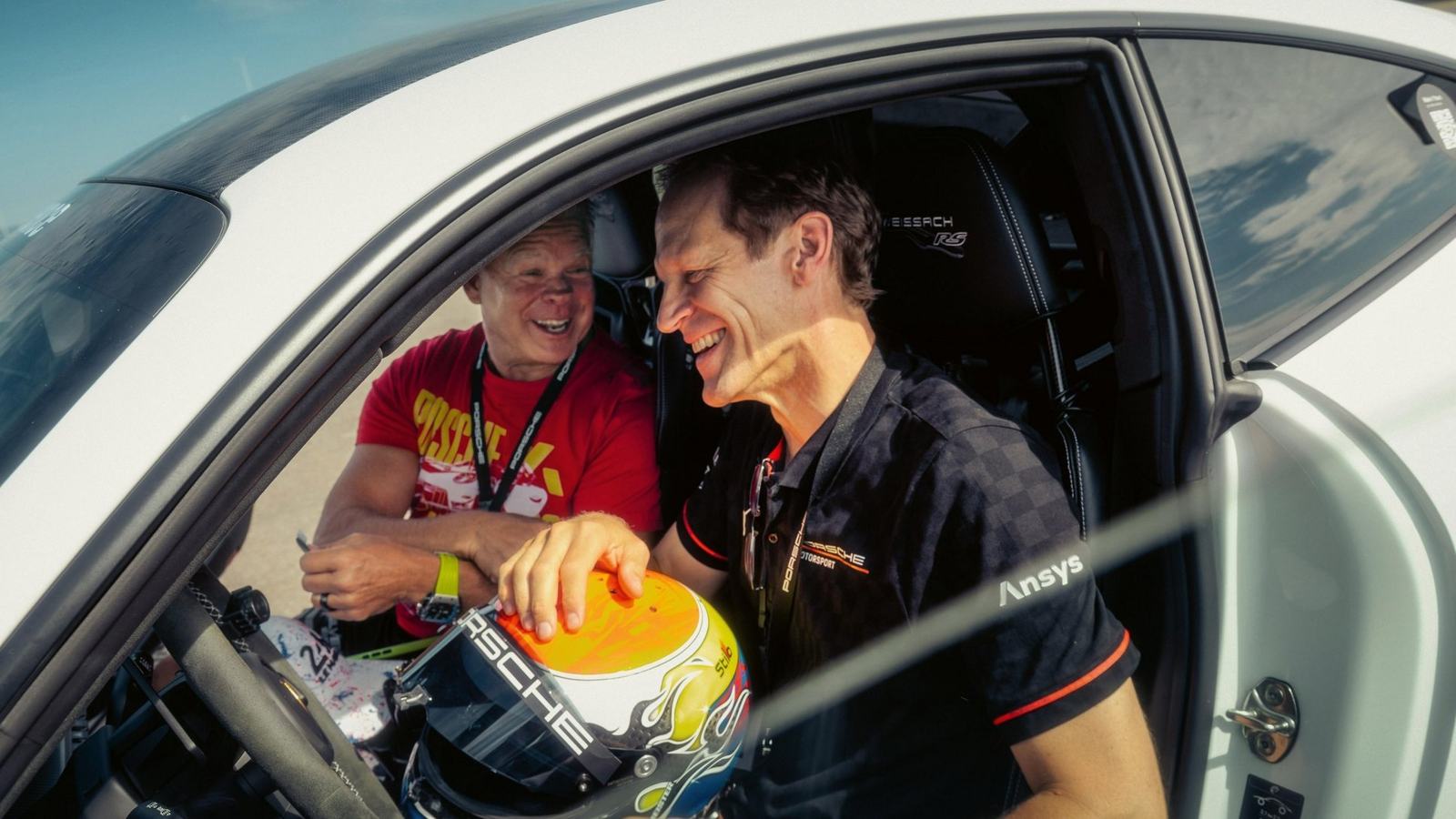
Porsche documents a personalised GT3 RS coaching programme in Hungary, pairing a collector and former professional racer Jörg Bergmeister with telemetry analysis.
An experience that goes beyond purchasing the car
Porsche's November 17, 2026 Newsroom feature recounts a particularly individual Track Experience in Hungary, where California-based entrepreneur Bruce Dereschuk worked with former professional racing driver Jörg Bergmeister in a pair of 911 GT3 RS cars. The manufacturer's account describes a two-and-a-half-day Master GT3 RS programme adapted to the participant's requirements, with a professional instructor assigned exclusively to him. It offers a perspective on a form of luxury motoring in which the acquisition of a desirable car is the beginning of a longer relationship with the machine. For a collector accustomed to commissioning a yacht, arranging private travel or developing a specialist collection, professional tuition can offer a comparably personal experience. This is a report about Porsche's published example rather than the introduction of a new GT3 RS model or an assurance that the same instructor can be booked on every future course. The value of the experience depends on the participant's objectives, the availability of suitable tuition and the venue.
Why the Hungaroring is an instructive setting
The course took place on the approximately 4.3-kilometre Hungaroring near Budapest. Porsche's account describes the circuit as a demanding sequence of bends with relatively little opportunity for a prolonged straight-line interval between them. That character makes a circuit session considerably different from a demonstration primarily intended to showcase the maximum acceleration of a vehicle. A participant must consider a succession of demands and remain attentive to what is happening during an entire lap. The particular significance of the venue to Dereschuk was that he had not previously driven there. An owner may be familiar with the behaviour of a car on a home circuit without having comparable knowledge of a new location. Learning an unfamiliar environment with suitable instruction offers an opportunity to examine that distinction in a controlled setting. Track driving should remain within an organised programme, with the applicable safety arrangements and the instructor's assessment of the participant's experience. The course is not a justification for reproducing competition-style driving on public roads.
Individualised tuition rather than a conventional group experience
The standard Master GT3 RS programme described by Porsche includes three theoretical workshops and two full days of circuit driving. Participants are divided into groups and undertake sessions of around thirty minutes, with different forms of instructor observation. Dereschuk and Bergmeister followed a more individual arrangement in which the instructor could devote time to one participant and discuss the results between sessions. This makes the experience particularly interesting as an example of tailored service. A client may prefer repeated opportunities to work on one issue rather than proceed through every element of a standard programme at a fixed pace. Conversely, a group course may be an attractive social occasion and provide opportunities to compare experiences with other owners. The manufacturer's report does not supply the price of the personalised arrangement or a list of instructors available for exclusive bookings. A prospective participant should establish the content, prerequisites and commercial terms of the actual course rather than assume that the case described represents the standard inclusion.
The instructor's experience with the car itself
Bergmeister's professional background is important to the context of the feature. Porsche identifies his successes in the Porsche Supercup and class victories at the endurance races at Le Mans and Daytona. It also highlights his work as a test driver during development of the current generation of the GT3 RS. His involvement with the car goes beyond familiarity acquired through participating in an owners' event. An experienced development or racing driver can offer insight into how the vehicle behaves under a range of circuit conditions and can use personal observations to identify particular elements of a participant's performance. This should not be confused with a promise that a student will achieve the instructor's results. The purpose of individual tuition is to develop the participant's understanding at a pace suited to their experience. The appointment of a particular instructor, the suitability of the training environment and the objectives agreed before the event will all matter to the character of the course.
Telemetry gives the discussion a measurable foundation
Porsche describes the use of VBox equipment to record information from the two cars and compare selected data after their track sessions. The instructor focused on a subset of available signals, including speed, braking demand, steering, accelerator position and selected gears. This is a useful distinction between the collection of a large quantity of information and the selection of a manageable set of observations that can contribute to instruction. For an owner who is interested in the engineering of a high-performance machine, the discussion can become a practical means of understanding how the vehicle responds to particular inputs. Video records provide another perspective on the observations. The results should be interpreted within the actual conditions of the training session, including the condition of the vehicles and the location on the circuit. A single trace does not necessarily reveal the cause of a difference between two laps. The instructor's professional interpretation and the participant's understanding of the circumstances are central to the usefulness of the information.
The role of preparation and mechanical support
The manufacturer describes technical support during the Hungarian sessions, including attention to the tyres and provision of fresh Michelin Pilot Sport Cup tyres towards the end of the course. That support forms part of a distinction between an organised training event and simply taking an exceptionally capable vehicle onto a circuit without a wider plan. The condition of relevant components, the suitability of the vehicle for the intended activity and arrangements for technical assistance should all be considered before participation. A client travelling internationally may need to decide whether to transport a privately owned car or use one supplied through the programme. The available arrangements may differ between locations and course formats. The manufacturer's public account does not establish that every equipment or support service will be included in every booking. Owners should confirm insurance, vehicle responsibility and any charges associated with consumables or damage. Professional instruction cannot remove the inherent risks of circuit motoring, and the participant must respect the requirements of the organiser and venue.
Progress is not simply a question of outright speed
In Porsche's account, Dereschuk improved his lap time by almost four seconds by the conclusion of the programme. That figure describes one participant's recorded improvement in the circumstances of the example. It is not a performance commitment that can be applied to other drivers. His earlier experience of track activities in the United States and at several European circuits provides relevant context. Someone attending an introductory programme may instead benefit principally from gaining confidence, learning venue procedures and developing consistent control without pursuing a particular time. For a collector, this can be a more meaningful way of experiencing a car than comparing a numerical result against those of professional drivers. The ability to explain why a vehicle behaves in a particular manner may also inform later decisions about which cars to acquire, retain or use. Any performance assessment should take account of the instruction received and the participant's own goals, without creating pressure to exceed the conditions appropriate to a safe, supervised exercise.
A different way to organise an automotive collection
Many private collectors make decisions about an automobile's acquisition, preservation and use separately. A historical vehicle may be retained principally for conservation and display, while another is selected for regular participation in professionally organised driving events. The GT3 RS example concerns the latter approach. Dereschuk told Porsche that the car's ability to undertake sustained track activity was part of its appeal alongside its appearance. A collection assembled with different intended uses may therefore benefit from a parallel plan for maintaining the cars and developing the owner's experience with them. For someone whose annual programme also includes yacht use and international travel, the logistics of an automotive event can be coordinated with other activities rather than treated as a spontaneous addition. Transport, storage, technical support and accommodation may require separate arrangements. The published example illustrates the potential for an unusually personal motor-car experience, without suggesting that every collector needs to participate in circuit motoring.
The distinction between a case study and an available booking
Porsche's feature confirms the individual Hungarian training experience and outlines the format of the Master GT3 RS course. It does not announce confirmed future dates for identical private tuition with Bergmeister. Anyone wishing to arrange a comparable programme should consult Porsche Track Experience about venue selection, entry requirements, the possibility of exclusive instruction and the availability of vehicles and technical support. The specific case provides an illustration of how the relationship between a collector and a high-performance automobile can develop after purchase. For luxury clients accustomed to individually designed experiences, the significant element is the combination of specialist expertise, dedicated time and information relevant to the participant's own progress. The opportunity is not primarily a promise of a faster lap. It is access to a structured environment in which an owner can develop a deeper understanding of a machine and its capabilities with professional supervision.
Primary source: Porsche AG official Newsroom feature, 17 November 2026.
Photography: Porsche AG, official Newsroom imagery accompanying its Hungaroring feature. Official source.