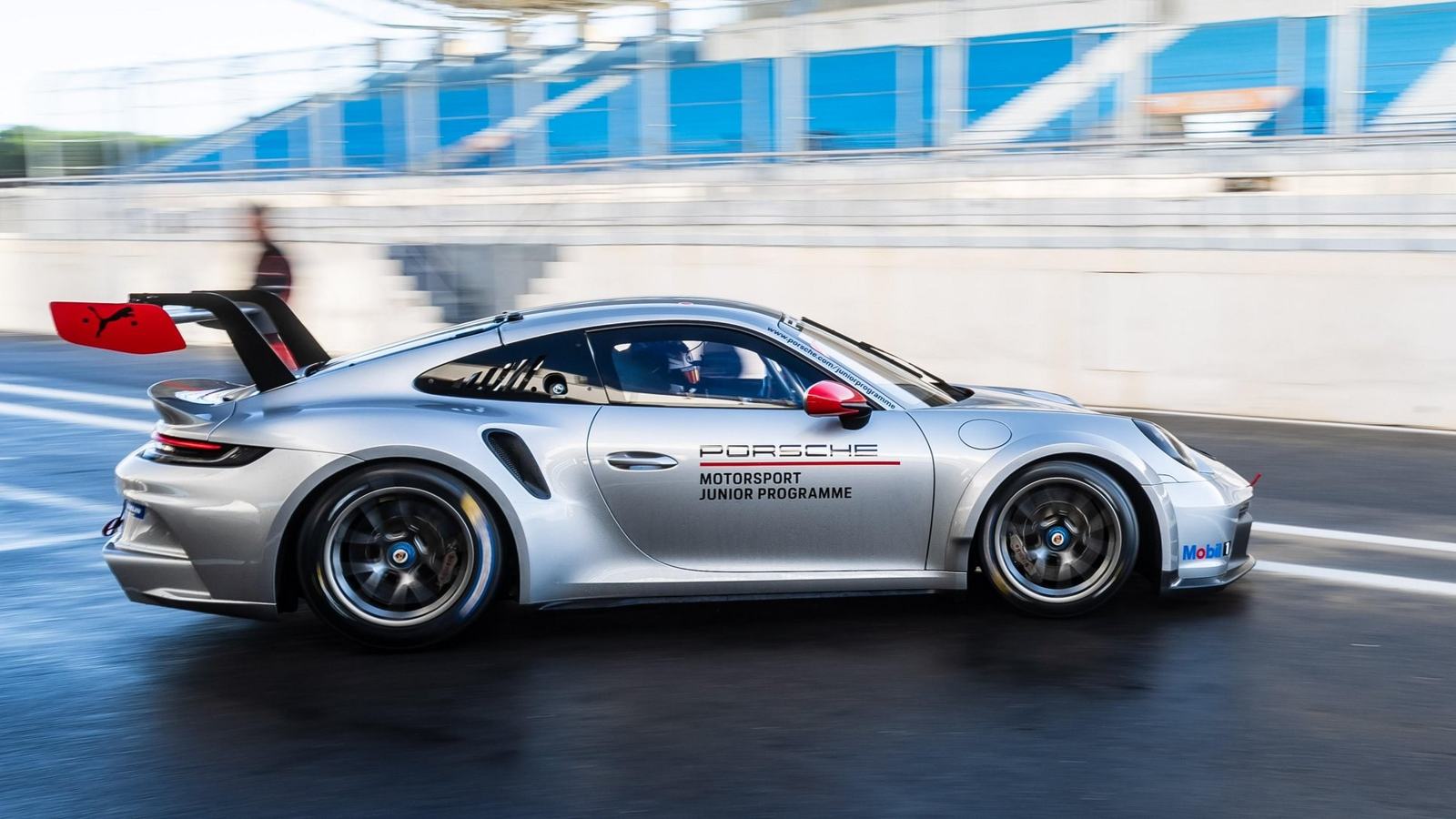
Porsche's 2027 Junior selection brings twelve young drivers to Cologne and Portimão, with a separate pathway connecting simulator racing to real competition.
Developing talent beyond the traditional paddock
Porsche announced on 11 November 2026 that twelve young drivers from ten countries will take part in the selection process for its 2027 Junior Programme. The candidates, nominated through national Carrera Cup competitions, will undertake assessments in Cologne and on the Algarve circuit at Portimão. In a separate competition, five simulator-racing candidates will compete for support to enter a real-world Porsche one-make series. The two selection processes are important to distinguish: the simulator competitors are not simply additional participants vying for the same Porsche Junior position.
The development creates an interesting perspective for superyacht owners and collectors who take an active interest in motorsport. Professional racing requires more than purchasing a capable car or acquiring access to an exceptional circuit. It also involves learning how to use equipment consistently, manage a competitive programme and work productively with engineers and other specialists. Porsche's selection programme illustrates that wider relationship, while the separate digital initiative recognises the increasing significance of simulator experience.
The role of the one-make series
The Junior Programme, which Porsche established in 1997, draws on the manufacturer's network of racing championships based around closely related competition cars. The selected Junior is expected to contest the Porsche Mobil 1 Supercup during 2027, with financial and professional support from the manufacturer. Porsche says the series will accompany eight European Grand Prix events. That places the selected driver within an environment where race schedules, media obligations and competition preparation intersect with the operation of major international events.
One-make racing can be valuable because it offers a reasonably defined framework in which to assess performance. The cars remain sophisticated racing machines, and differences in setup, team preparation and driver experience still matter. The structure nevertheless allows a prospective participant to understand the level of the competition and compare development against relevant peers. A collector interested in entering club or amateur racing should not confuse ownership of a particular model with qualification for a professional championship. Each series has its own entry requirements, sporting regulations and financial commitments.
Assessments in Cologne and Portugal
Porsche has chosen its Esports Performance Centre in Cologne for the initial interviews, simulator work and related evaluations. The selected Junior candidates will then drive on the Autódromo Internacional do Algarve, using the 992.2-generation 911 Cup. According to the manufacturer, that racing car develops 382 kW, or 520 metric horsepower. It was already used in the Supercup and selected Carrera Cup competitions during 2026.
The choice of two locations reflects an important feature of driver development: a racing driver is assessed in more settings than the cockpit of a moving car. The ability to interpret information, communicate with a team and respond to feedback can influence the effectiveness of the work on track. Simulator sessions also offer a structured environment for observing decisions under controlled circumstances. The tests announced by Porsche should not be read as an indication that the winner has already been determined. They represent the selection process for the forthcoming season.
What a simulator can teach
The relationship between virtual and real racing is particularly interesting for owners considering a home or yacht-based driving simulator. A well-designed simulation can introduce a user to circuit geography, race procedures and the repeated decisions involved in a lap. It also offers a way to explore changes in setup and receive immediate feedback without consuming tyres, fuel or track time. The most important benefit for an experienced participant may be the opportunity to practise deliberately rather than merely record a fast lap.
There are limits to what can be inferred from a simulator result. The physical demands, forces, visibility, consequences of errors and environmental variations in a real racing car differ markedly. A driver transferring from simulation to circuit work needs appropriate instruction and familiarity with the actual vehicle's safety systems. No level of virtual proficiency establishes that a participant is prepared for a competitive real-world event. Porsche's new selection structure is notable precisely because its strongest simulator candidates will have the opportunity to demonstrate their abilities in a real vehicle.
A separate opportunity for digital competitors
The manufacturer reports that five participants have qualified from a field of 32 finalists in the Porsche Esports Supercup for the new talent assessment. Its initial stages use infrastructure shared with the Junior selection. The strongest candidates will travel to Portugal, where they are expected to undergo real-world testing in a Porsche 911 Challenge. The eventual winner will receive support for a season in a national one-make championship, a separate pathway from the Supercup opportunity available to the Junior.
This approach may be of interest to families considering how to introduce a younger person to motorsport responsibly. It demonstrates that digital competition can form part of a structured progression, while leaving the assessment of real-world skills to qualified professionals. The availability of a simulator at home does not provide the same opportunities as membership of an established development programme. It can, however, encourage an interest in disciplines such as precise control, consistent preparation and the interpretation of data.
The importance of expert feedback
A particularly interesting aspect of serious motorsport participation is the exchange of information between the person driving and the specialists responsible for the car. Reliable observations can help an engineer understand whether a change has improved a particular aspect of vehicle behaviour. A driver who is able to identify a consistent difficulty may contribute more useful information than one who requests a succession of adjustments without being able to explain their effects.
The lesson applies to recreational track driving as well. Rather than approaching a high-performance car as an instrument for setting a personal record on the first visit, a participant can benefit from coaching and a defined programme of familiarisation. Choose instruction appropriate to the person's experience, arrange a suitable vehicle and allow sufficient time to learn the circuit. Track participation should be organised through approved facilities, with applicable licensing, protective equipment and insurance arrangements understood. Private ownership is compatible with responsible professional instruction; it does not remove the need for it.
Fitness and professional preparation
Porsche's announced support package encompasses physical conditioning, driving dynamics, psychological preparation, nutrition and communication with the media. The inclusion of these disciplines indicates that participation in a professional race season is not confined to the acquisition of speed. Competitors must manage repeated periods of concentration while responding to changes in conditions, equipment behaviour and competitive circumstances.
For a visitor accustomed to arranging activities through a private concierge, that can offer a different form of personal challenge. An experienced instructor can design a programme appropriate to the individual's abilities and interests without attempting to reproduce a professional selection competition. The participant may find that learning to recognise fatigue, interpret feedback and maintain consistency provides more lasting enjoyment than pursuing a single lap-time target. An owner commissioning a simulator or arranging a track visit should establish which objectives the programme is actually intended to meet.
The relationship between a collection and experience
For collectors, the distinction between a road-going Porsche and a purpose-built competition car deserves attention. The latter may be designed around specialised inspection, servicing, transport and support requirements. A decision to acquire a car for actual track use should therefore include consideration of the facilities and people needed to operate it. Investigate the availability of technical support, running costs, safety updates and appropriate storage arrangements.
A racing vehicle also creates a particular kind of provenance. Accurate maintenance records, event histories and documentation of changes can become valuable in understanding the object later. A collector who actively uses a car should preserve its history without assuming that competition use automatically increases its market value. The greatest justification for such ownership may be the personal experience it provides. Porsche's Junior and esports pathways highlight the skills and infrastructure that make that experience possible at a professional level.
Following the selection into 2027
The November announcement sets out the participants' next steps, rather than announcing the result. The programme will select one Junior for the Supercup and, through its separate digital pathway, a successful simulator competitor for national-series support. Both outcomes will depend on how the candidates perform in the planned selection process.
For readers interested in collecting, driving and supporting motorsport, the story provides a useful view of the relationship between access, education and meaningful participation. A privately owned racing car or simulator can be a remarkable addition to a leisure programme when its purpose is clear and its use properly organised. The deeper attraction of motorsport remains the opportunity to develop skill in a demanding environment, supported by people who understand the machinery and the discipline required to use it well.
Primary source: Porsche Newsroom.
Porsche 911 GT3 Cup, Porsche Motorsport Junior Shootout 2026 — Porsche AG. Official editorial material from Porsche Newsroom. Official source.
Source
Porsche Newsroom