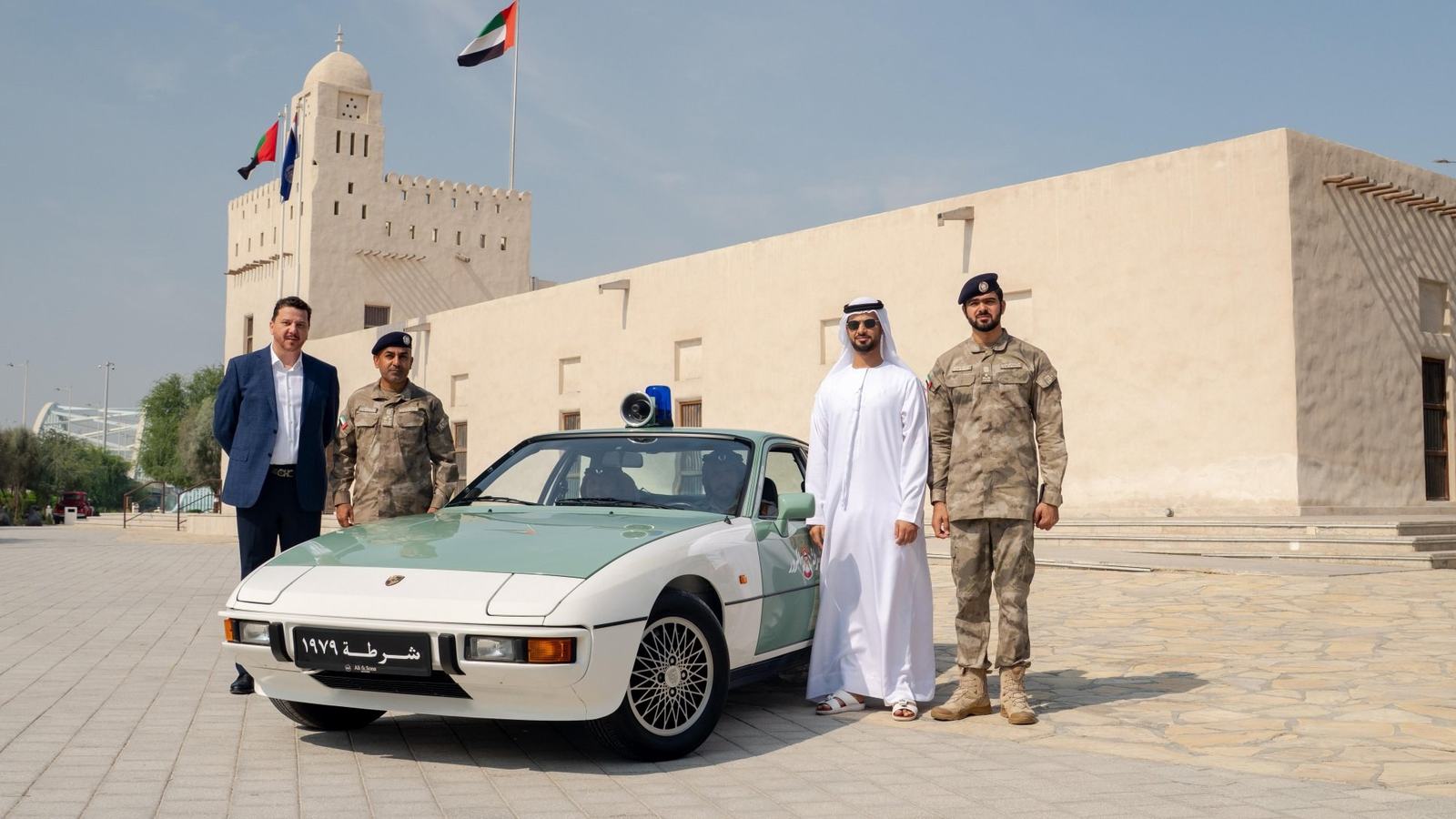
Porsche Centre Abu Dhabi and Al Ain restores the 1979 police Porsche 924 used during Queen Elizabeth II's UAE visit, before its Dubai festival display.
A remarkable survivor from the early United Arab Emirates Porsche has announced the completion of a historically significant restoration: a 1979 Porsche 924 that served as a police car in the United Arab Emirates and formed part of the escort for Queen Elizabeth II's first royal visit to the country. Porsche Centre Abu Dhabi and Al Ain, part of Ali & Sons Holding, carried out the work. The restored vehicle was formally handed back to Abu Dhabi Police at Al Maqta Museum, with a public appearance planned for the Icons of Porsche festival in Dubai on 21 and 22 November 2026. The company published the story on 9 November. Its importance lies not in an auction value or a speed record, but in the car's connection to national history and an unusually specific ceremonial assignment.
A sports car in a police fleet The Porsche 924 was the first sports car to join the United Arab Emirates Federal Police fleet, according to Porsche's own account. That distinction is more precise than describing it as the first Porsche to arrive in the region, a different historical claim for which the release provides no evidence. The choice of a front-engined sports coupe for police duties reflects a particular era, when authorities in newly developing cities sought equipment suitable for both operational and representational requirements. A car's police role can involve visibility, escort logistics and symbolism as well as conventional patrol duties. The restored 924 is particularly interesting because its specific assignment is documented by the parties involved rather than inferred solely from the colour scheme of a preserved vehicle.
The 1979 royal visit provides the historical context Queen Elizabeth II and the Duke of Edinburgh visited the United Arab Emirates in 1979, a relatively early period in the country's development after the federation's establishment in 1971. Porsche reports that the royal party travelled through the Gulf on the royal yacht Britannia and that the visit to the UAE was accompanied by a ceremonial escort including the 924. The car's significance therefore extends beyond automotive design. It links transportation, policing, diplomacy and the country's institutional history. The narrative should not confuse the yacht with a separate Porsche-related vessel, nor imply the car escorted Britannia at sea. Its documented role was as part of the land-based royal escort during the visit.
The restoration was carried out locally The work was undertaken by Porsche Centre Abu Dhabi and Al Ain in partnership with the authorities who preserve the car's institutional history. Porsche says the objective was to return the vehicle to its original character and document its place in the early police fleet. The release does not provide a component-by-component restoration schedule or an invoice for the work. A responsible account should therefore avoid inventing engine rebuild details, special materials or a precise budget. Any historic vehicle restoration requires decisions about original components, later changes, paint, badges, mechanical functionality and the level of patina to preserve. Those decisions are most credible when supported by records and careful engagement with the object's custodians.
Why provenance matters more than cosmetic perfection Collectors often distinguish between a visually flawless restoration and a well-documented restoration that respects an individual vehicle's history. A police Porsche once used for a royal escort carries information in its markings, equipment, fittings and recorded ownership. Replacing everything with modern equivalents might make it look immaculate while erasing important historical detail. Conversely, leaving a vehicle deteriorated can jeopardise its long-term survival. Porsche's story emphasises preservation, but it does not disclose the complete condition of the vehicle before work began. Readers can admire the result without claiming the team retained any particular percentage of its original components. That level of detail belongs in specialist restoration documentation.
A museum handover anchors the car's public role The formal return took place at Al Maqta Museum in Abu Dhabi, a location connected to the emirate's policing history. This setting matters because the vehicle is not being presented primarily as a private collectible offered to the highest bidder. It is an artefact associated with public service and a historic state visit. Its return to the police reflects custodianship as well as automotive craftsmanship. For visitors, a museum can provide contextual material that an isolated car display may not. Yet the announcement does not specify permanent opening arrangements, tour access or photography permissions for each day of the year. Those details should be confirmed with the relevant institution before a special visit.
Icons of Porsche provides a first public display Porsche says the car's first public display following restoration is scheduled for the Icons of Porsche festival at The Square, Nad Al Sheba, Dubai, on 21–22 November 2026. The vehicle is then expected to return to its museum setting. The timing provides enthusiasts with a relatively immediate opportunity to see the work, but the event remains in the future as of this article. Attendance should not be described as completed, and opening times or ticketing conditions must be checked against current event information. It is also not evidence that every historic police vehicle from the period is on public display. This is a single surviving car with a particular institutional history.
The 924 is an important Porsche in its own right The Porsche 924 was part of the company's move toward front-engined, transaxle sports cars, a different engineering arrangement from the better-known rear-engined 911. Its significance can be overlooked in a market focused on the most expensive racing derivatives and limited-production models. A working police example reveals another aspect of the car's contemporary identity: it could be chosen for use in a demanding, public-facing role. The release is about the restoration, not a newly discovered technical specification, so this background should be kept in proportion. It helps explain why the 924 is worth preserving even if it has not traditionally attracted the prices commanded by rarer Porsche models.
National heritage and private collecting intersect A historic vehicle can be valuable to several communities for different reasons. Porsche enthusiasts may admire the model and the restored details. Historians may be more interested in the official visit and early policing practices. Residents of Abu Dhabi may recognise an object linked to the city's development. Collectors sometimes seek cars with equally distinctive provenance, but the restored police 924 is not offered for sale in this announcement. Its value here is cultural and documentary rather than a published market estimate. That distinction is central to responsible luxury coverage, where every rare object should not automatically be described as an investment opportunity.
Why credible photographic records are essential Preservation projects benefit from images showing the car before, during and after intervention, particularly where its distinctive equipment or paintwork has historic significance. Porsche's release offers an official press-photo gallery of the returned vehicle and its presentation to authorities. Those pictures can illustrate the restoration story without relying on generic photographs of unrelated 924s. They should be credited accurately to Porsche AG, and a caption must not claim to show the 1979 royal visit if it depicts the 2026 handover. The distinction between archival photographs and contemporary images is especially important when an article connects a vehicle with a royal event several decades in the past.
An instructive example for owners of valuable machinery The project has wider relevance to people who maintain historic cars, yachts or other complex machines. Conserving a vehicle with an important past involves documentation, sympathetic technical choices and specialists capable of separating original design intent from later modifications. A yacht's history may similarly be altered by refits, changing flag requirements and successive owners. The comparison has limits: a static museum car and a seaworthy yacht face different operational and regulatory responsibilities. Still, the principle of recording what was changed and why is useful across both fields. A restoration becomes more credible when future custodians can understand its evidential basis instead of relying on the memory of one technician.
Preserving an object without inventing a legend There is no need to embellish the police 924's story. Porsche's verified account already establishes that it joined the fleet, took part in the 1979 royal escort, was restored by local Porsche specialists and was returned to Abu Dhabi Police. Claims about dramatic chases, secret royal instructions or exceptional horsepower would add colour but not evidence. The car's actual connection to a national milestone is sufficient. This approach also protects the publication's credibility. Even a compelling photograph can mislead if its caption confuses one period with another or presents a reconstruction as original archival footage.
The next chapter is public interpretation After its November festival appearance, the restored Porsche is intended to become part of the museum's presentation of Abu Dhabi's police heritage. How that story is told will determine whether visitors see merely an unusual sports car in police colours or understand its role in the 1979 royal visit. For Porsche, the project demonstrates the value of maintaining historical knowledge beyond its familiar competition-car legacy. For the UAE, it returns a tangible piece of institutional history to the public record. The story is a reminder that exceptional automotive objects can carry meaning through service, place and memory rather than through exclusivity alone.
**Primary source:** Porsche Newsroom, 9 November 2026. Official Porsche AG 2026 photographs depict the restored car and handover; they are not represented as archival images of the 1979 visit.
Primary source: Porsche Newsroom.
Photo: Porsche AG official 2026 Abu Dhabi police-car restoration press gallery; not an archival 1979 photograph. Official press photograph.
Source
Porsche Newsroom