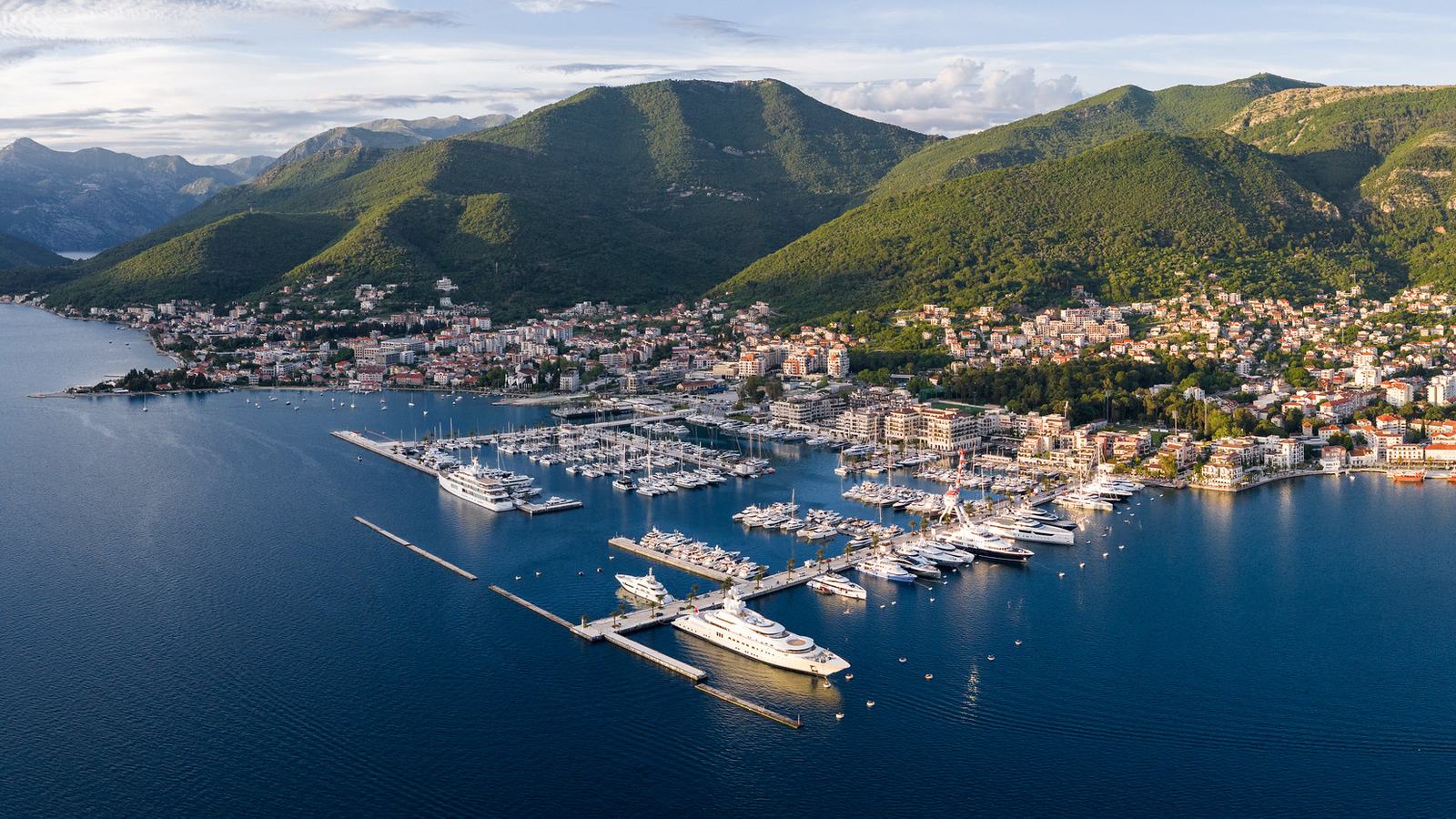
Porto Montenegro combines professional superyacht berthing at Tivat with an elegant waterfront and access to the Bay of Kotor's historic towns, offering a rewarding Adriatic base.
A superyacht base with the bay on its doorstep
Porto Montenegro in Tivat offers a distinctive proposition for an Adriatic superyacht itinerary. It combines a purpose-built marina and year-round support with the atmosphere of a carefully managed waterfront neighbourhood. Yet one of its most compelling attractions is not within the development at all: the surrounding Bay of Kotor, where steep mountains, historic maritime settlements and sheltered inlets create an unusually memorable setting.
For an owner considering more than a brief fuel or provisioning stop, Tivat provides a base from which different kinds of days can unfold. Some guests may prefer relaxed mornings on the marina promenade, others an excursion to Kotor's historic streets, while the bridge team will be interested in the practical value of a well-supported berth. A successful visit makes room for all three, rather than treating the destination as a single fashionable photograph.
Start with the berth and the vessel's requirements
Porto Montenegro describes itself as a superyacht marina with berths for vessels well beyond the ordinary leisure-boat range. Its official berthing guidance sets out arrival procedures, shore services, concierge support, crew facilities and options for stays beyond the high summer season. The marina is therefore relevant to a large private yacht as well as to a charter visit whose guests want a walkable shore environment.
A captain should contact the marina with the vessel's exact length overall, beam, draft, tonnage, preferred dates and electrical requirements. An advertised maximum berth length is not a guarantee that a particular yacht can be accepted on demand. Berth geometry, availability, mooring arrangements and operational restrictions remain a matter for direct confirmation with the harbour team.
The operator publishes VHF communication and arrival guidance, together with information about pilotage obligations for larger vessels. These are practical matters for the professional bridge team using current charts, port instructions and notices, not directions that should be improvised from a lifestyle feature. Guests can nevertheless appreciate why that organisation matters: careful arrival planning creates more time for the things they have come ashore to enjoy.
The waterfront itself is part of the stay
One advantage of Porto Montenegro is that the marina is integrated with a shore-side district rather than separated from it by a remote industrial quay. The operator describes a mix of restaurants, boutiques, recreation and hospitality alongside its marine services. After a passage, this allows a guest programme to begin with little more complicated than stepping ashore and deciding whether the day calls for a quiet table, a walk or a longer outing.
For yacht owners who use their vessel as a base over several weeks, that everyday convenience has real value. Crew may need time for stores and technical tasks while guests occupy themselves without a constant succession of vehicle transfers. The same proximity can work well for charter itineraries, provided guests understand that the character of the development is different from that of Montenegro's older waterfront settlements.
A waterfront dinner is an appealing first evening because it makes minimal demands after arrival. The next day can be more ambitious once weather, transport and local opening arrangements have been checked. A captain or concierge familiar with the bay can help avoid the temptation to schedule every attraction before the yacht has even secured its lines.
Kotor: heritage on a dramatic harbour
The historic town of Kotor is one of the major cultural reasons to linger in the bay. UNESCO recognises the Natural and Culturo-Historical Region of Kotor for the way its fortified towns, monuments and maritime settlement patterns fit into the surrounding mountains and sheltered waterways. The World Heritage description is about an entire cultural landscape, not simply a picturesque old town.
Kotor is best explored at walking pace, with room to notice its churches, lanes, stonework and the relationship between the town walls and the rising terrain. A private guide can place the architecture in context, explaining how maritime commerce, civic life and regional cultural traditions shaped the area. Trying to turn the visit into a quick stop between unrelated activities tends to flatten what makes the place remarkable.
Guests should dress for uneven historic streets and allow more time than a map alone might suggest. Traffic and seasonal visitor volumes can affect transfers around the bay, while steep routes and steps may not suit every traveller. A good guide can tailor the experience to mobility needs and provide an alternative to strenuous ascents, keeping the emphasis on heritage rather than endurance.
Perast and the quieter rhythm of the inner bay
Perast offers another perspective on the bay's maritime history. UNESCO's account singles out Kotor and Perast as characteristic historic towns, valued not only for their individual buildings but also for their setting. The relationship between the water, architecture and surrounding hills is especially tangible here, where the waterfront scale feels more intimate.
A visit need not be complicated. Time spent looking across the water, considering the town's merchant and seafaring past and enjoying a relaxed meal can be more rewarding than filling the afternoon with too many appointments. The attraction is precisely that Perast differs from the purpose-built marina district, giving a superyacht itinerary a broader sense of Montenegro.
Any local boat excursions should be arranged through authorised operators with clear boarding instructions and an understanding of prevailing conditions. Shore access, landing facilities and the needs of smaller craft vary; a superyacht tender operation should be planned properly rather than based on the apparent closeness of a destination on a map.
A considered balance between yacht and shore
Porto Montenegro is well suited to an itinerary that alternates time on the yacht with focused cultural outings. One day might remain entirely around the berth and waterfront. Another could be dedicated to Kotor, with a guide and a carefully chosen place to eat. A third could explore the inner bay and Perast, leaving the afternoon open for the vessel, spa or an unhurried dinner.
That balance matters for guests who are travelling together but do not have identical interests. Someone who wants architectural history should be able to pursue it without obliging everyone aboard to spend a full day touring churches and ramparts. Equally, a guest seeking rest should not feel that remaining near the marina means missing the destination. The best yacht itineraries allow meaningful choices without sacrificing time together.
A private driver can simplify some shore programmes, although travel time around the bay can fluctuate. Transfers should therefore be discussed as part of each individual excursion. Tivat's location is useful, but it does not remove the need to organise appointments, guide availability and realistic departure times.
Beyond the summer peak
The marina promotes winter berthing as part of its year-round offer, which may interest owners who want a different pattern from a brief midsummer call. A quieter season can give the waterfront a more residential character, and the mountains around the bay can feel especially atmospheric in changing light. The trade-off is that individual restaurants, leisure services and excursions may operate differently outside their peak periods.
For a long stay, the operational side of the programme becomes more important. Captains should discuss utility arrangements, security, access for maintenance contractors, local customs matters and the practicalities of moving the yacht at short notice. Crew welfare and a workable provision schedule deserve as much attention as a glossy list of guest attractions.
Montenegro's administrative and customs arrangements should be confirmed with the marina and qualified local agents. This is particularly important for charter yachts, non-resident owners and vessels moving between customs territories. A generic tourism guide cannot replace vessel-specific professional advice.
Respect the character of a protected landscape
The Bay of Kotor is not merely a spectacular place to anchor beside a historic building. UNESCO's description of the protected region also highlights pressure from coastal development and the need to conserve the wider relationship between settlements and landscape. Visiting yachts can help by treating sensitive shores and small towns with respect rather than as facilities created solely for their convenience.
Practical good habits include using authorised berths and landing places, following local speed and environmental rules, managing waste ashore through appropriate facilities and avoiding disturbance in confined waters. Large yacht operations should coordinate tender movements carefully where other vessels and swimmers may be present. These choices support the experience that draws visitors to the bay in the first place.
Guests can make their contribution through the way they travel ashore too. A locally informed guide, an appropriate itinerary and time given to lesser-known cultural details create more value than a rushed sequence of social-media landmarks. The region's history becomes much more engaging when the relationship between boat, town and landscape is allowed to remain visible.
Planning a refined superyacht stay
Before arriving, obtain a confirmed berth and discuss the yacht's requirements directly with Porto Montenegro's marina team. Ask the concierge to prepare options rather than a fixed programme: perhaps a heritage-led day in Kotor, a quieter exploration of Perast, and time for guests to enjoy the marina district. Confirm restaurant availability and ground transport only after the berth and arrival window are settled.
The marina's official berthing information is the primary reference for yacht services and operational contact. For the cultural setting, UNESCO's Natural and Culturo-Historical Region of Kotor entry provides authoritative background on why this landscape matters. Both are worth consulting, because the best visit combines professional maritime planning with a genuine understanding of the destination.
Porto Montenegro should not be judged solely by the scale of the yachts in its basin. Its strength is the way a capable marine base connects with a rich historic bay. For owners and charter guests prepared to slow down and look beyond the promenade, Tivat can become the beginning of a much more distinctive Adriatic story.