An in-depth guide to the glacier-filled fjords of Prince William Sound, Alaska, covering yacht gateways, wildlife interpretation, weather, ice and responsible expedition planning.
A wilderness that changes the rhythm of a superyacht voyage
Prince William Sound occupies a special place in expedition cruising: an intricate maritime landscape where forested islands, ice-carved fjords and mountainous horizons can be experienced from a vessel equipped for genuinely remote operations. It is not a destination for a rushed port-to-port itinerary or a showpiece arrival. The real luxury lies in the time to study a weather window, adjust the passage around wildlife and ice, and settle into an anchorage without expecting a resort ashore.
For a superyacht making an Alaska season, the Sound offers a different kind of passage from the crowded summer anchorages of more conventional cruising grounds. The United States Forest Service describes the shore as temperate rainforest backed by glaciers, while Alaska’s Department of Fish and Game identifies abundant marine mammals and seabirds. The drama is immediate, but so are the operational obligations: cold water, occasional floating ice, changeable visibility and distances that reward conservatism.
Choosing the right gateway: Whittier, Valdez or Cordova
Whittier is the most obvious starting point for many western Sound explorations because it connects land-based logistics with the inlets and glacier country nearby. Its access road and tunnel make crew movements and provisions more practical than the wilderness further out, but entry and exit logistics must be booked around the yacht’s actual dimensions, berth availability and the port’s requirements. A large yacht must confirm services directly rather than assume a marina that serves smaller local craft can accommodate her.
Valdez provides a gateway to the northern Sound, with the added attraction of a mountainous setting and access to the waters associated with Columbia Glacier. For expedition managers, its appeal is as much about a place to reorganise fuel, communications and supplies as it is about the scenery. Port operations, commercial traffic and local conditions warrant advance coordination, particularly when a large yacht intends to embark guests or deploy tenders.
Cordova presents an eastern option with a strong working-waterfront identity and proximity to productive wildlife habitat. The itinerary choice depends on weather, the vessel’s draft and range, the planned route and the interests of the party aboard. A thoughtful cruise may combine more than one gateway; a shorter one should resist treating them as interchangeable, because even sheltered waterways demand transit time and the Gulf of Alaska sits close beyond the islands.
Glacier experiences: spectacular views, disciplined distances
The Sound’s most memorable scenes often develop around tidewater glaciers and ice-filled fjords. Columbia Glacier, College Fjord and the Harriman Fjord system all appear in official NOAA hydrographic accounts, though their access and conditions are not identical. From the deck of a well-positioned expedition yacht, a guest may witness immense colour contrasts between glacial ice, dark water and clouded ridgelines. Such encounters should be planned around observation, not an ambition to bring the bow as close as possible.
Calving ice is dynamic. A collapsing glacier face can send waves into surrounding water, while large blocks extend far below the visible surface. Floating fragments can threaten stabilisers, propellers, hull coatings, tenders and divers. A captain should set conservative stand-off distances, assess prevailing conditions and be willing to view the ice from a distance. No published photograph or old track line should be treated as safe navigation advice.
NOAA’s account of hydrographic surveying in Prince William Sound explains why the waters near retreating glaciers deserve particular attention. Survey teams encountered moraines, bergs and places where recently exposed seabed needed new measurements. That is an operational lesson for expedition yachts: carry up-to-date official charts and notices, reconcile electronic displays with radar and visual observation, and never assume a recently ice-free area has the same survey quality as an established commercial route.
Barry Arm and an important natural-hazard distinction
The Barry Arm area adds another layer to this picture. The U.S. Geological Survey has investigated unstable slopes near retreating glaciers in Prince William Sound and documented how rapid landslides entering the sea can generate dangerous waves. It also released a broader inventory of large slope instabilities in central and eastern Prince William Sound in August 2026. These publications provide a reason for careful planning and attention to official warnings, not a prediction that a particular slope will fail during a visit.
For owners and guests, that distinction is essential. A spectacular fjord landscape can appear perfectly calm while underlying geology remains complex, but there is no justification for sensationalising a hazard into a claim of imminent catastrophe. An expedition captain should consult the latest USGS, state geological and emergency-management guidance, keep a route that allows room to manoeuvre and reconsider a planned stop if an advisory or unusual condition affects the area.
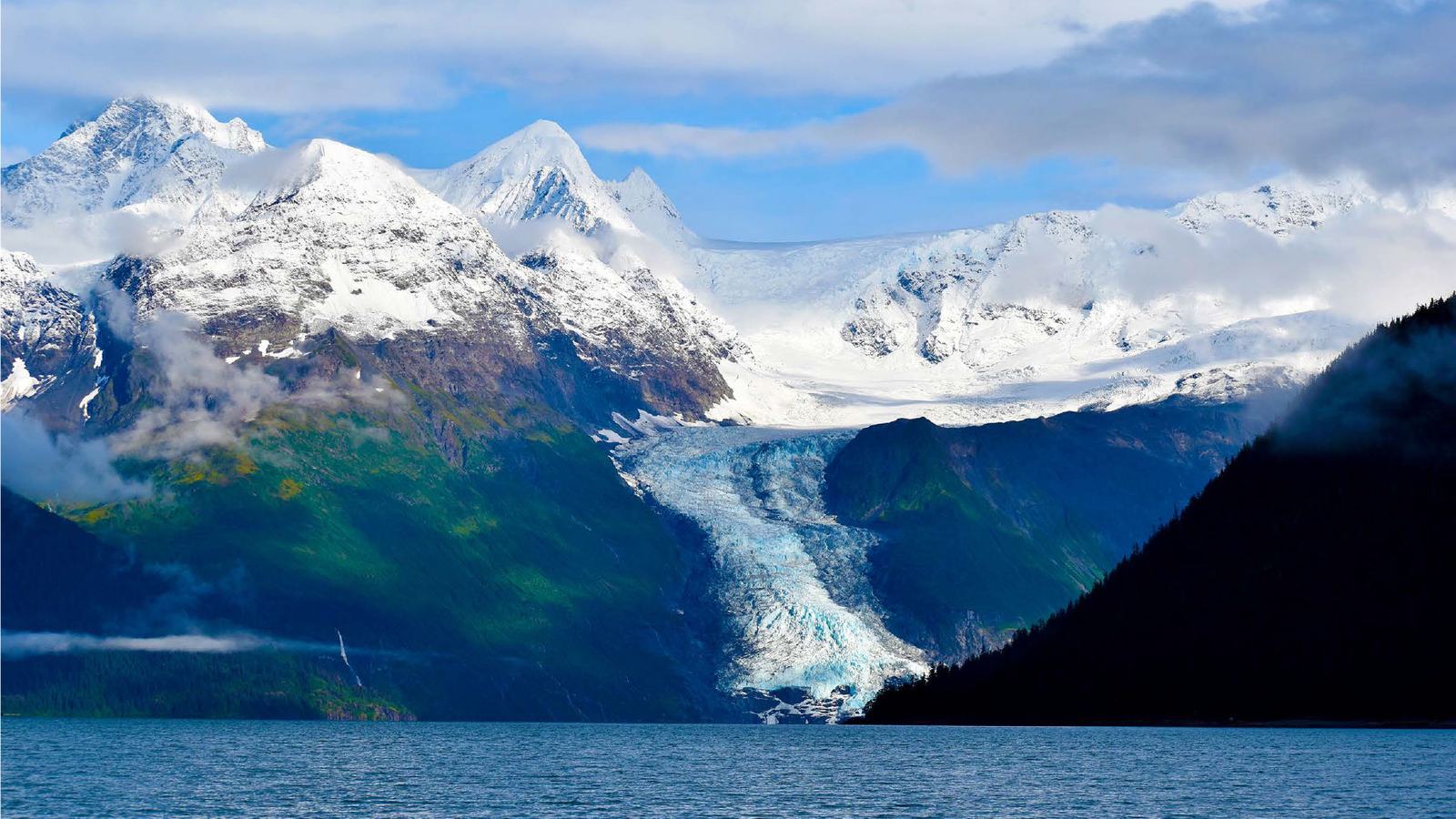
The USGS photograph accompanying this feature shows Barry Glacier viewed across Prince William Sound. It is an official public-domain image credited to geologist Drake M. Singleton, and it depicts an authentic part of the cruising region. The image is not a forecast or a navigation chart. Its value is to convey the scale and remoteness that make a professionally planned expedition here so rewarding.
Wildlife watching without disturbing the scene
Wildlife is central to the destination’s appeal. Sea otters, harbour seals, whales, sea lions and an extraordinary variety of birds may form part of a cruise through the Sound, although no particular encounter can be promised. An intimate sighting from a quiet yacht deck can be more memorable than an aggressive pursuit by tender. The objective should be to watch natural behaviour while leaving animals space to feed, rest and move.
Owners who wish to photograph whales should brief guests and tender crews on distance, speed and approach etiquette before an encounter begins. Wildlife protection rules differ by species and activity, and the captain must check current NOAA Fisheries and Alaska regulations. Drones, close approaches, repeated engine starts or tender circling can disturb animals even when guests are enthusiastic. A dedicated naturalist can make the experience richer while keeping the operating plan responsible.
Shore excursions require similar restraint. Bears may use beaches and salmon streams, and a quiet landing that looks deserted from offshore can still be wildlife habitat. Crews should assess the site before any guest goes ashore, follow local bear-safety guidance, manage food and refuse securely and maintain a means of immediate retrieval. A tender landing is never compulsory simply because a scenic coastline appears inviting.
Designing the onboard experience for a high-value expedition
A luxury yacht charter or private voyage here is best built around flexibility rather than a fixed sequence of headline sights. Some days may lend themselves to glacier viewing, while others are better for wildlife interpretation, photographic workshops, a carefully selected shore walk or quiet time aboard. Guests should understand that the captain may reverse a route, change an anchorage or cancel an outing when visibility, ice or wind make the original plan unwise.
Cold-weather equipment is part of the luxury experience, not an afterthought. Warm and waterproof layers, suitable footwear, lifejackets appropriate to tender work, heated recovery spaces and reliably dry storage all help guests enjoy their surroundings. Photography equipment needs protection from damp and cold. Any helicopter, submarine, diving or kayak programme should be separately assessed for permits, qualified staff, wildlife interaction and rescue capability rather than assumed safe because the yacht has the equipment aboard.
Food and interpretation can connect guests to place without inventing a theatrical wilderness. Regionally relevant menus, lectures on glacier science, charts displayed in a guest lounge and photographs compared with historical records all create a memorable sense of journey. The yacht should support that experience with good communications and thoughtful deck procedures, while leaving room for the unplanned moment when evening light illuminates a fjord.
The operational checklist behind the scenery
Remote Alaska cruising puts a premium on sound passage planning. Crews should review the National Weather Service coastal marine zones for northwest, central, eastern and southwest Prince William Sound, with attention to the relevant forecast rather than a single broad weather symbol. Fjord winds, rainfall, fog, tidal streams and exposure at entrances may differ dramatically between nearby locations. The operator should establish decision points for turning back rather than relying on fuel reserve alone.
Navigation deserves equal focus. Updated official charts, multiple position sources, radar, depth instruments and properly planned tender operations are basic tools, but the discipline of using them is what matters. A large yacht requires enough under-keel clearance, swing room and a realistic assessment of ground tackle in unfamiliar anchorages. Anchoring near floating ice or unstable shoreline features should be approached conservatively, and no suggested location should be used without assessing the current conditions.
Communications may degrade behind high terrain and away from towns. The vessel should have independent means of distress communication, medical planning, a shore liaison and clear arrangements for guest transfers. Long transits can separate the yacht from support facilities, and a helicopter or tender is no substitute for a tested emergency plan. The Forest Service warns visitors in the Sound that assistance can be hours away, a point that applies as much to well-appointed yachts as to small craft.
Environmental discipline is part of the operating plan. Grey-water and black-water management, fuel-transfer controls, spill response, shore refuse handling and low-impact wildlife observation all need deliberate procedures. If a programme includes a beach landing or overnight shore stay, check land-management requirements, local restrictions and conditions for commercial activity. The absence of a fee booth does not imply that any shore activity is permitted without further checks.
An itinerary shaped by seasons and contingency
Prince William Sound is primarily attractive to leisure expeditions in the more navigable months, but even summer does not eliminate cold water or abrupt weather changes. Early and late season trips can encounter very different daylight and service patterns. A prudent itinerary includes spare days so the yacht is not pressured to enter a marginal fjord to satisfy a predetermined guest schedule or departure flight.
Where a programme combines Alaska’s other cruising regions, the captain should distinguish between the sheltered water of the Sound and the exposed passages required to reach it. The yacht’s classification, polar or ice-related limitations if applicable, crew experience, fuel and insurance conditions must all suit the intended route. A vessel’s physical size alone does not make her an ice-capable explorer.
The finest itinerary might be the one with fewer named stops and more meaningful time at each. A day spent interpreting the landscape safely, followed by an unhurried evening aboard, offers a coherent experience without the false precision of a timetable that ignores weather. Professional planning can create remarkable freedom, but only when restraint is built into the plan.
Planning sources and responsible expectations
Official information is readily available for the essential first stages of research. The US Forest Service’s Chugach National Forest visitor material introduces the wilderness and shore-management context. NOAA’s account of hydrographic surveys explains navigation challenges around retreating glaciers, and the National Weather Service publishes marine forecasts for the individual zones. The Alaska Department of Fish and Game provides regional wildlife information, while the US Geological Survey explains slope-instability hazards.
Together, these sources offer a useful framework for an expedition briefing, but they do not replace current notices to mariners, local pilotage advice or the assessments of a qualified captain. Guests should be told from the outset that wildlife, weather and glacier conditions remain beyond an operator’s control. When these realities are treated as part of the adventure rather than interruptions, Prince William Sound becomes an exceptional setting for a thoughtful superyacht voyage.
Official resources
Read the NOAA Prince William Sound hydrographic account, the US Forest Service Chugach National Forest visitor guide, the National Weather Service Alaska marine forecast zones and USGS 2026 slope-instability inventory. A further USGS photograph record documents the image used here. Current local notices and operational advice must take precedence over a general cruising feature.