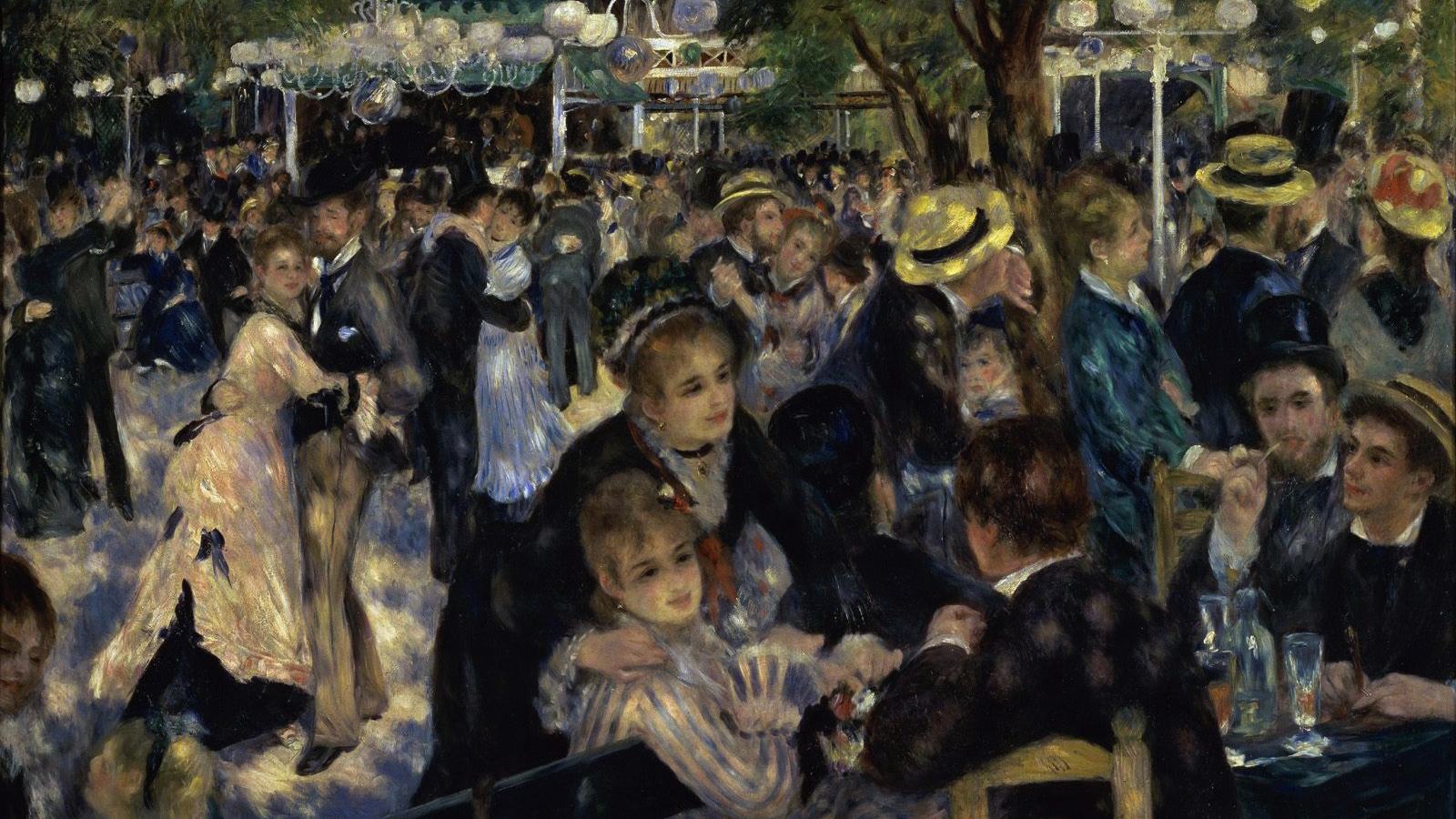
The National Gallery's major Renoir exhibition brings over 50 works to London until 31 January 2027, including Bal au moulin de la Galette.
London culture and collecting, 11 November 2026. The exhibition opened on 3 October and is scheduled to continue through 31 January 2027; this article is an editorial guide to a current exhibition, not a review claiming a personal visit.
London stages an unusually concentrated Renoir exhibition The National Gallery in London has brought together more than 50 works for Renoir and Love, an exhibition open from 3 October 2026 until 31 January 2027. The institution describes it as the most significant exhibition of the French painter's work in the United Kingdom for 20 years. That is a substantial claim about the scale of this particular exhibition, supported by the gallery's own announcement, rather than an assertion that every important Renoir painting is present. A carefully chosen group can be more illuminating than a survey that tries to cover an entire career without space to examine individual relationships between works.
The exhibition examines the period from the middle of the 1860s to the middle of the 1880s, when Pierre-Auguste Renoir repeatedly explored friends, courtship, public recreation and daily encounters. It is a natural addition to a London visit for yacht owners, charter guests and art collectors whose itineraries include museums as well as galleries, restaurants and private meetings. Those connections are editorial suggestions for readers, not special arrangements with the National Gallery. The attraction is the chance to see familiar images alongside less familiar paintings and to reconsider what makes Renoir's representation of people so distinctive.
Bal au moulin de la Galette is the exceptional loan The announced centrepiece is Bal au moulin de la Galette, painted in 1876 and held by the Musée d'Orsay in Paris. The National Gallery says the picture is being shown in the United Kingdom for the first time. Its crowded composition portrays an afternoon of dancing and conversation in Montmartre, dissolving the boundary between a portrait of identifiable people and a wider scene of communal life. Renoir presents the group under patches of light filtering through the trees, with figures sitting close to the viewer while dancers and guests occupy the deeper space. A photograph reproduces the composition, but not necessarily its full surface, colour or scale.
That is why an original loan matters. An exhibition creates a context in which a painting usually encountered in Paris can be compared directly with Renoir's different responses to conversation, friendship and intimacy. Bal au moulin de la Galette is not a painting of an actual yacht or a claim about maritime patronage. Its significance for a luxury-lifestyle readership is cultural: major art frequently becomes part of the reason to spend several days in a city. Visitors should use the gallery's official exhibition information for current ticket conditions, opening arrangements and any changes to individual loans.
Affection appears in ordinary social encounters The organisers have chosen love as a broad subject rather than treating it as a narrow sequence of romantic portraits. According to the gallery, the display considers affection, seduction, male friendship, conversation and the sociability of cafés and theatres, together with flirtation, courtship and family life. Those categories allow the paintings to be read as observations of modern society. A pair of figures conversing or a group assembled around a table may communicate a relationship without showing a dramatic event, and Renoir's attention to gestures can be as telling as his arrangement of brilliant colour.
The emphasis is also useful for distinguishing Renoir from an overly simple label of painter of pretty leisure scenes. The settings are often attractive, but the complicated placement of faces, arms, hats and people demands close visual decisions. Who looks at whom? Which figure is aware of the viewer? How does one group form and another dissolve? An exhibition arranged around human connection offers the visitor a way to ask such questions without needing prior knowledge of Impressionist terminology. It can be approached as a history of how social life was pictured at a particular moment in nineteenth-century France.
The Umbrellas shows an artist testing another language The National Gallery points specifically to The Umbrellas, a work in its own collection begun around 1881 and reworked in 1885. The painting is important within the exhibition's stated account because it illustrates how Renoir developed full-length figure compositions that could stand beside older traditions of ambitious museum painting. The composition contrasts the people closest to the spectator with the busy crowd under the umbrellas. Its histories of execution and alteration complicate any neat division between an early Impressionist Renoir and a later, more solidly drawn artist.
The organisers explain that, in the early 1880s, Renoir began moving towards firmer, more sculptural compositions without abandoning his interest in companionship and joy outdoors. Comparing works across this transition can be more rewarding than treating changes of style as a contest in which one phase wins. For a thoughtful collector, the larger lesson is to look at a work's specific date, context, medium and condition. A painter's name on a label does not make every object equivalent, and a famous image may tell a different story when placed next to a painting made only a few years later.
International loans make the exhibition a collaborative project Renoir and Love is organised by the Musée d'Orsay, the National Gallery and the Museum of Fine Arts, Boston. The London gallery identifies loans from collections including Copenhagen's Ny Carlsberg Glyptotek, Frankfurt's Städel Museum, Stockholm's Nationalmuseum, the J. Paul Getty Museum in Los Angeles, the Norton Simon Art Foundation in Pasadena and the National Gallery of Art in Washington. Each lending institution has its own responsibilities, and such partnerships explain why a large exhibition is not simply a decision by one museum to hang paintings already stored in its building.
The three-city itinerary also helps explain the public value of travelling exhibitions. The project was at the Musée d'Orsay from 17 March to 19 July 2026; it now continues in London before a scheduled Boston presentation from 20 February to 13 June 2027. These are the dates announced by the National Gallery and should be checked before making non-refundable arrangements. Seeing the exhibition in one city is not necessarily interchangeable with seeing it in another: displays, loans and practical access may vary. The common scholarly framework, however, gives each presentation a coherent subject rather than a loose assembly of masterpieces.
Curators ask viewers to see emotion as part of modernity The London curatorial team named by the National Gallery includes Christopher Riopelle, its Neil Westreich Curator of Post-1800 Paintings, and associate curator Chiara Di Stefano. Riopelle's explanation in the gallery's announcement treats friendship and love as fleeting experiences that Renoir attempted to record with the same sensitivity he brought to sunlight. That observation provides a strong starting point for a visit. Impressionism is frequently explained through changing light, but the human subject can be just as unstable as an outdoor shadow or passing reflection.
Curatorial interpretation is not a single mandatory way to view the work. Someone who focuses on textiles, gesture, the architecture of a café or the handling of paint may leave with different questions. The exhibition's strength is that its chosen subject permits several kinds of close attention. Those who work with professional art advisers might use the visit to discuss how museum scholarship builds a richer understanding of an artist over time. It should not be reduced to a shortcut for predicting auction prices; scholarly visibility and commercial value intersect, but they are different forms of evidence.
Planning a cultural stop around Trafalgar Square The National Gallery is in Trafalgar Square, a central London setting that can fit into a wider cultural programme. Guests arriving by air, train or yacht should plan their route using current transport information rather than relying on an imagined direct marine connection to the gallery. Public opening hours, admission rules for the exhibition and any timed-entry system need to be confirmed on the gallery's website. A major loan exhibition can attract substantial interest, particularly as the closing date approaches, so advance planning is sensible even for visitors who are flexible about the rest of their itinerary.
A deliberate visit leaves room to look rather than simply to check famous titles off a list. Consider selecting a small number of paintings in advance, spending longer with their details and returning to the central work after exploring its neighbours. Readers considering a private cultural itinerary can ask the relevant institution directly about available services, but no privileged access is implied here. The exhibition provides a reason for a visit on its own terms, without requiring a purchase, a specialist credential or any connection to the commercial art market.
Collecting lessons do not turn a museum visit into a sale An institutional exhibition offers valuable context for collectors because it draws attention to provenance research, conservation, chronology and the comparison of works. Yet no work's inclusion should be read as an invitation to buy it. Bal au moulin de la Galette is identified as a museum loan, and The Umbrellas belongs to the National Gallery. The exhibition is not an auction preview and does not publish estimates for these pictures. Claims that a particular display has increased a work's monetary value would require separate evidence and should not be assumed from the presence of famous lenders.
For readers who own art, the more useful questions concern stewardship: why particular works are regarded as important, how museums document alterations and how paintings move safely between institutions. These concerns have an indirect relevance to yacht owners considering artworks for properties or vessels, where climate control, security and transit call for specialist advice. The present story is simpler and stronger. For several months London offers an unusually focused encounter with Renoir's paintings of human connection, including a celebrated Parisian masterpiece that the organiser says has not previously been exhibited in Britain.
Primary source: The National Gallery, London: Renoir and Love exhibition announcement.
Photo licence and source
Pierre-Auguste Renoir, Bal du moulin de la Galette, 1876. Public-domain faithful reproduction of Renoir's 1876 painting at the Musée d'Orsay; source Wikimedia Commons. This painting is identified by the National Gallery as a loan to Renoir and Love. Public-domain image source.
