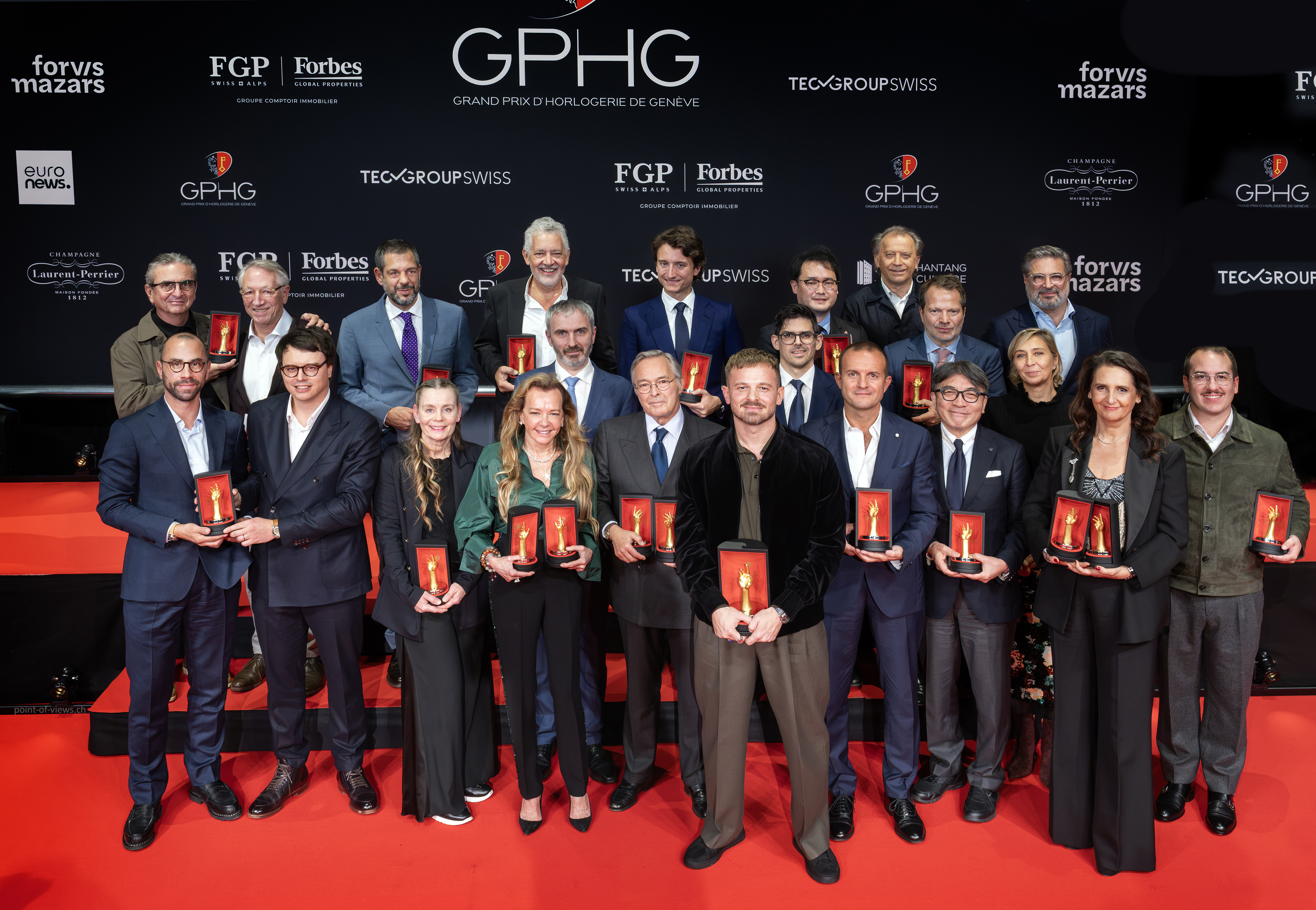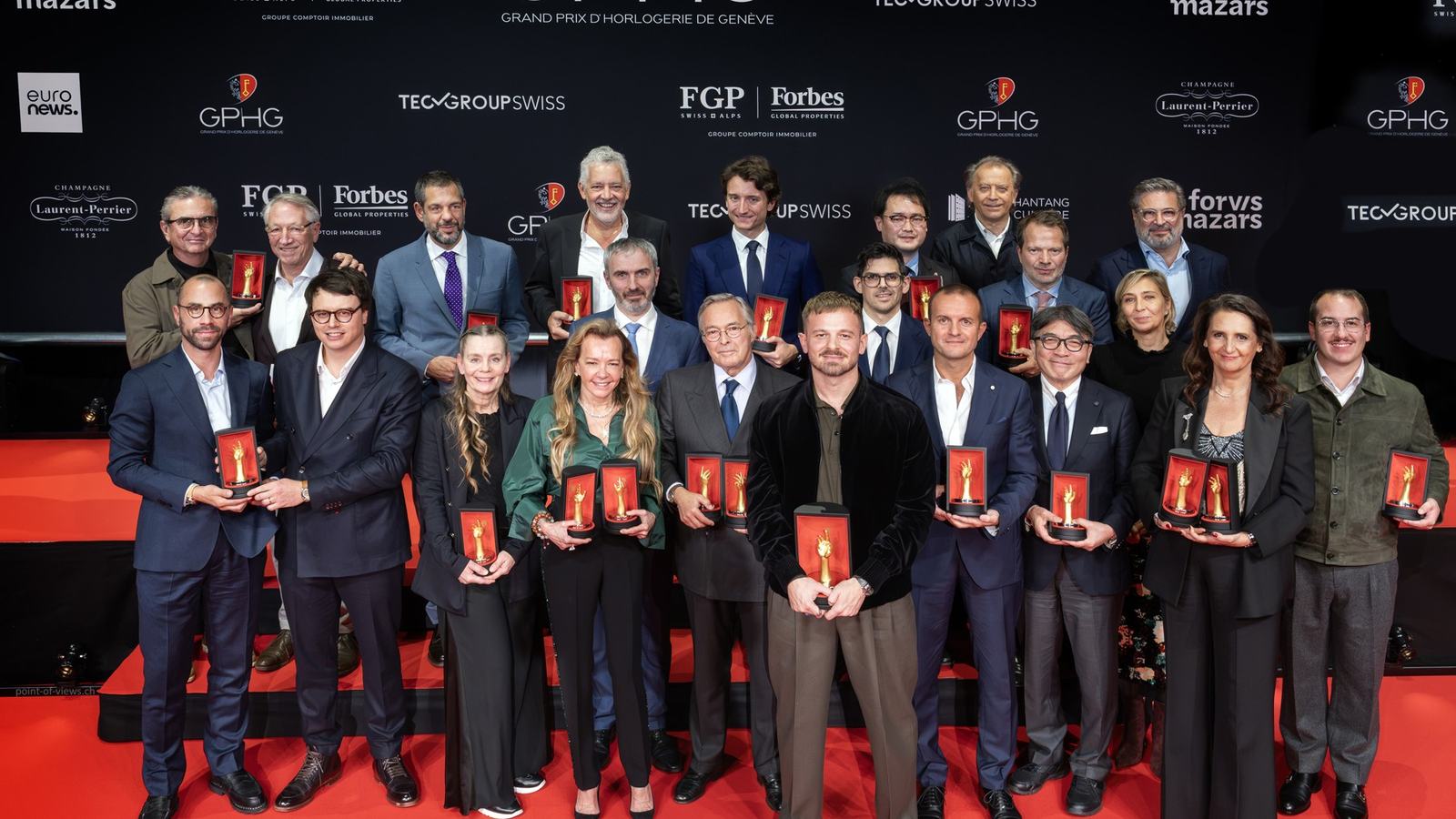
Rexhep Rexhepi's Chronograph Flyback receives the leading GPHG award in Geneva, with twenty prizes and a London exhibition of winning timepieces to follow.
An independent watchmaker receives Geneva's highest award
The Grand Prix d’Horlogerie de Genève has awarded its 2026 Aiguille d’Or Grand Prix to Rexhep Rexhepi for the Chronograph Flyback. The result was announced at the 26th GPHG ceremony in Geneva on 7 November. It places the independent watchmaker at the head of a year in which prizes were distributed among makers with very different traditions, from celebrated Swiss houses to small specialist workshops. Twenty prizes were announced by the foundation, with watchmaking experts serving on a jury chaired by Wei Koh after an initial selection involving its international academy.
For collectors, an independent watchmaker receiving the principal award is a reminder that scale and visibility are not the only measures of significance in haute horlogerie. A watch can be remarkable because of the decisions embodied in a movement, the relationship of its displays and mechanism, or the execution of individual components, even where its maker produces relatively few pieces. An award provides an important perspective on the object, but does not establish the price at which a collector could acquire one or assure the future performance of its secondary market.
The significance of the flyback function
A conventional chronograph provides a separate mechanism for measuring elapsed time. Its user starts a timing operation, stops it and resets the indications before measuring another interval. A flyback function allows the measuring sequence to be reset and restarted through a single action while it is running rather than requiring that conventional sequence. The difference can be appreciated in applications that involve successive timed intervals. It also illustrates the appeal of mechanical complications that alter a watch's operation in a way the wearer can actually experience.
The award announcement identifies Rexhepi's winning model by name but does not constitute a detailed technical specification. Collectors should therefore obtain information about the particular calibre, components, case and production arrangements from the maker instead of deducing them from the award alone. A mechanism with an attractive operating principle still depends on careful engineering, manufacture, assembly and adjustment. A finely made chronograph invites attention both to its visible architecture and to its less visible behaviour: resetting cleanly, returning precisely and responding consistently across repeated use.
Twenty prizes show the breadth of modern horology
The GPHG's list extends far beyond one winning chronograph. Audemars Piguet took the Iconic Watch Prize for its Royal Oak Jumbo Extra-thin Selfwinding Flying Tourbillon Chronograph RD#5 anniversary model, while the foundation recognised Blancpain's Grande Double Sonnerie in the Mechanical Exception category. In another branch of mechanical watchmaking, Cleguer received the Complication Watch Prize for Inspiration One and Parmigiani Fleurier won the separate Chronograph Watch Prize for its Tonda PF Chronographe Mystérieux.
The distinctions are useful precisely because they do not suggest that each watch is pursuing the same objective. One approach might emphasise the integration of several mechanisms into a constrained space, another a distinctive way of indicating time, and a third the design heritage expressed by a familiar shape. Comparing every model through a single commercial hierarchy would obscure those differences. A collector can use the list to discover a part of watchmaking they have not previously explored, or to develop a more precise vocabulary for discussing why a particular mechanism appeals to them.
Precision, display and restraint
Ferdinand Berthoud received both the Chronometry Prize for Naissance d'une Montre 3 and the Tourbillon Watch Prize for the Chronomètre FB 2TV. Chopard's L.U.C 1860 was recognised in the Time Only category. Daniel Roth won the Essential Watch Prize with the Extra Plat Rose Gold Skeleton. These awards span an interesting range of priorities: precision, construction, mechanical transparency and the restraint associated with an uncomplicated display of time.
A simple-looking watch can be demanding to execute. When few visual elements compete for attention, the design and workmanship of every visible component become more apparent. A more elaborate mechanism may reward slow inspection and a curiosity about the engineering decisions that have made it possible. Neither experience depends solely on the number of indications on the dial. In a carefully assembled collection, a restrained dress watch and a technically elaborate chronograph can complement one another without serving identical purposes or being worn on the same occasions.
The artistic crafts remain a separate field of achievement
The prize list also recognises watchmaking as a visual and material art. Louis Vuitton's Tambour Taiko Arty Automata Gemset received the Artistic Crafts Watch Prize, and Piaget's Swinging Pebble won the Gemset Watch Prize. Chopard also received the Jewellery Watch Prize for Mystery Nut. Each designation highlights a different approach to watches as objects whose character depends on proportion, surface, movement, materials or decorative techniques.
It can be useful for collectors to distinguish the visual ambition of a watch from the underlying mechanical functions, while recognising that a successful design often integrates both. The fact that a piece contains precious metal or gems is not a complete account of its quality. Setting, finishing, coherence of forms and the relationship between the wearable object and its mechanism can be at least as revealing. Photographs provide important access to these objects when a collection is dispersed internationally, but subtle reflections and the relationship of a case to the wrist are often better understood in person.
Unusual ideas and emerging makers find recognition
Konstantin Chaykin received the Audacity Prize for ThinKing Mystery, while Dominique Renaud's Pulse60 Titanium Black was awarded the Horological Revelation Prize. The Challenge Watch Prize went to the collaboration between SpaceOne and Baltic, Seconde Majeure. Otsuka Lotec's No.8, meanwhile, received the Petite Aiguille Watch Prize. These names provide a route away from a collection driven only by the largest international brands.
Unconventional watches can raise practical questions that are sometimes less obvious when considering well-established designs. A buyer may wish to understand how an unusual display should be read and how its mechanism can be serviced over time. They may want to know how parts will be supplied if maintenance is required many years after production has ended. Those concerns need not diminish the excitement of a new concept. Instead, they can encourage a deeper relationship with the maker and with the specialists responsible for preserving its work. The GPHG award itself is a recognition of the object and its creators, rather than a warranty of future service provision.
Patek Philippe's exhibition receives the Special Jury Prize
The jury gave its special award to Patek Philippe for the Watch Art Grand Exhibition. This distinction is particularly interesting because it acknowledges a cultural project, not simply a competing wristwatch. The GPHG announcement also records the presence of UNESCO's Director-General at the Geneva ceremony. Together, these aspects of the evening draw attention to the place of watchmaking in a broader culture of skilled mechanical and artistic workmanship.
For a collector, exhibitions offer an opportunity to understand the context of an object beyond its reference number. Historical displays can reveal how a solution developed for one problem became part of another maker's approach, while a demonstration of handwork can explain why apparently small differences in execution matter. Knowledge of that context may enrich the experience of ownership more than simply pursuing a list of celebrated names. A serious collection can be informed by the history of its field without being confined to antique objects or assuming that innovation belongs exclusively to contemporary watchmakers.
Geneva and London offer opportunities to encounter the winners
The foundation says that its exhibition of 84 nominated timepieces, already presented in Mumbai and Bangkok, remains at the Musée d’Art et d’Histoire in Geneva until 15 November. The award-winning watches are then due to be exhibited at the Watches of Switzerland boutique in Knightsbridge, London, from 18 to 23 November. These are announced exhibition dates, not assurances that individual watches will be immediately available for purchase or personal fitting.
For an international visitor travelling between a yacht, a residence and a winter programme of events, these exhibitions provide a concise way to explore contemporary watchmaking in a carefully selected setting. It is worth checking admission arrangements and whether an appointment is needed. Collectors can use their visit to compare designs, make notes and identify further questions for individual manufacturers. The winning Chronograph Flyback is the principal award of this edition, but the wider selection offers a valuable lesson in the diversity of the craft. Press contact supplied by GPHG: Aude Campanelli, aude.campanelli@gphg.org.
Primary source: Grand Prix d’Horlogerie de Genève official prize list, 7 November 2026.
Grégory Maillot / point-of-views.ch — GPHG official 2026 awards ceremony photograph. Official source.