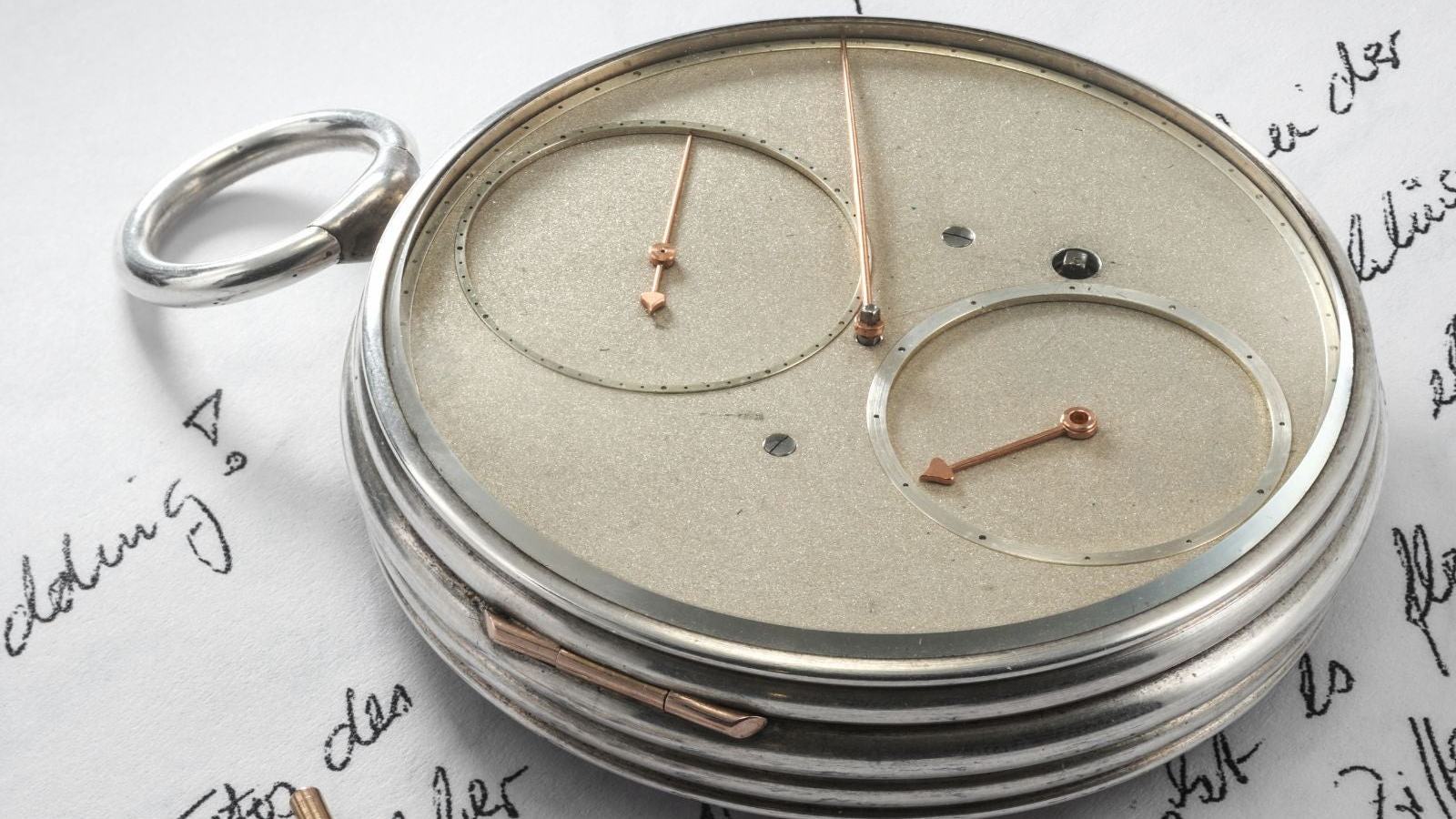
A hand-built silver pocket watch with flying tourbillon by mathematics teacher Richard Miklosch is offered at Phillips Geneva, estimated at CHF 300,000–600,000.
An extraordinary pocket watch from a small workshop
Phillips is offering a rare handmade pocket watch by Richard Miklosch as part of the Geneva Watch Auction XXIV scheduled for November 2026. The circa-1985 silver timepiece contains a flying tourbillon and detent escapement, advanced features produced by a maker who spent much of his professional life teaching mathematics.
The watch is catalogued as lot 61 with an estimate of CHF 300,000 to CHF 600,000, placing it firmly within the specialist collector market. The figure is an auction estimate rather than a confirmed value, and the eventual bidding result will depend on demand at the sale.
Miklosch worked in Aachen and is remembered for making much of his equipment and components with remarkably simple tools. The fact that a craftsman working outside a large manufacturing organisation could create a complicated precision watch is central to the interest in his surviving pieces.
A mathematical career alongside horology
Born in 1939 in what was then Czechoslovakia, Miklosch developed an interest in watch mechanisms as a child, according to the biographical account presented by Phillips. He later pursued mathematics as his main profession, working as a teacher while continuing to study mechanical timekeeping.
His interest extended to the demanding disciplines of chronometers, detent escapements and tourbillons, subjects in which precise geometry and careful mechanical adjustment matter enormously. The development of such expertise is particularly striking when viewed alongside the absence of a conventional long apprenticeship.
Miklosch’s workshop photographs show a practical environment crowded with instruments, components and unfinished devices. For a collector, these images communicate a working method, but physical examination of the watch itself remains necessary to assess its construction and condition.
The technical challenge of a flying tourbillon
A flying tourbillon supports the rotating escapement assembly in a way that creates an unusually open view of the mechanism. Combined with a detent escapement, the design involves delicate manufacturing and adjustments that few watchmakers could confidently undertake from scratch.
The offered pocket watch is unusual because it brings these complex mechanisms into a coherent, manually constructed object rather than presenting them as an industrially repeated movement. This is where evidence of authorship, machining practice and original components becomes particularly meaningful.
Collectors should examine the precision of finishing, service requirements and possibility of specialised repair if the movement ever suffers damage. A rare handmade component cannot necessarily be replaced from factory inventory, and insensitive later repairs may reduce the historical value of the object.
A place in independent watchmaking history
Phillips traces the influence of Miklosch through conversations with other horologists and researchers, including connections to the watchmaking world around Kari Voutilainen. His work shows how mechanical innovation can emerge in personal workshops rather than exclusively within famous Swiss maisons.
Relatively few Miklosch pocket watches were completed during his lifetime, with the auction house describing only about a dozen. That reported scarcity adds context but should be considered alongside documented provenance, preservation and the particular movement housed in this example.
The Geneva appearance offers a chance to view a very personal expression of precision engineering. Whether acquired as a collectible or studied as an object of horological history, the watch deserves evaluation for its technical integrity as much as for the romantic story of its maker.