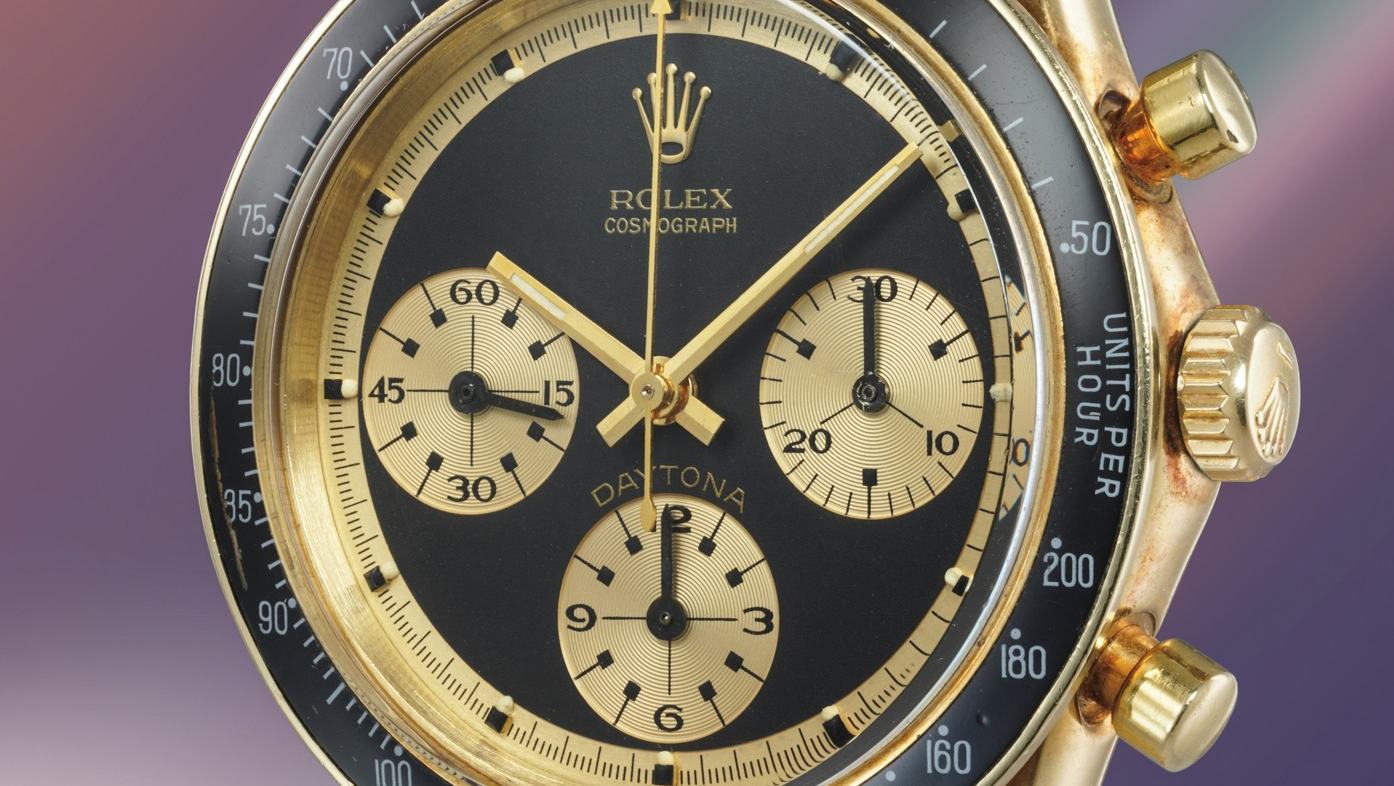
A rare circa-1969 14K-gold Rolex Daytona reference 6241 with a black-and-gold John Player Special dial is estimated at CHF800,000–1.6 million for Phillips' November Geneva watch auction.
A black-and-gold Daytona with a seven-figure estimate
A Rolex Cosmograph Daytona whose black-and-gold dial has earned it the collector nickname John Player Special is set to take centre stage at Phillips' Geneva Watch Auction XXIV in November 2026. The auction house has assigned the circa-1969 reference 6241 an estimate of CHF800,000 to CHF1.6 million, placing it firmly within the exceptional vintage-watch market. The attraction is not a complicated movement or a newly released design, but an unusually scarce combination of original-era details, precious metal and an immediately recognisable dial.
Phillips' official catalogue identifies the watch as a 14-karat yellow-gold chronograph with a black Paul Newman-style dial, a black bezel and a yellow-gold Jubilee bracelet. The distinctive pairing of black and gold has become one of the reference's most evocative visual signatures. The estimate is a pre-sale opinion, however, not a price paid or a guarantee of the eventual result. Buyers should also allow for the auction house's published premiums, taxes and any relevant import obligations when considering the total cost.
The reference, metal and dial that matter
The reference 6241 belongs to the early period of manual-winding Daytonas, which Phillips dates broadly to production between 1966 and 1969. This particular watch carries case number 2,084,348 and is catalogued with Rolex calibre 722-1, a manually wound chronograph movement with 17 jewels. Its diameter is given as 37.5 millimetres, comparatively restrained by the standards of many modern sports watches. Those proportions are part of why early gold Daytonas can feel as much like refined vintage jewellery as motorsport equipment.
The 14-karat case is especially noteworthy because most casual discussions of yellow-gold luxury watches assume 18-karat gold. Phillips states that very few John Player Special examples are known with 14-karat cases, and suggests that this specification was likely intended for the American market. That interpretation is the auction specialist's, rather than a documented claim about the original purchaser of this specific watch. What can be identified on the piece is the material, dial style, movement and relevant numbers recorded in the catalogue.
The dial is the focal point of the design: a black surface with contrasting gold details, accompanied by the particular layout collectors associate with Paul Newman Daytonas. Its appearance has made the John Player Special highly recognisable even among people who do not follow fine mechanical chronographs closely. But colour is only part of the collecting question. The watch's appeal also depends on the age, consistency, originality and condition of the individual components, all of which deserve close specialist scrutiny.
A racing name that arrived after the watch
The phrase John Player Special recalls the black-and-gold livery of the Lotus Formula One team sponsored by John Player & Sons in the 1970s. Phillips notes that the tobacco company's Lotus association began in 1972, several years after this circa-1969 Daytona was made. The connection is therefore one of visual resemblance and a later collector nickname, not an official motorsport partnership that produced this Rolex. That chronology makes the story more interesting, because it explains how a watch can acquire cultural meaning long after leaving the factory.
Paul Newman is another name that carries considerable collecting weight in vintage Daytonas, but it requires careful use. Here it describes the distinctive dial family and collector vocabulary, not evidence that Newman personally owned or wore the offered timepiece. The Phillips listing makes no such ownership claim. For collectors comparing similar-looking watches, respecting that distinction is essential: a dial nickname should never be allowed to stand in for verified provenance.
This particular example is also connected by its serial number to a narrow run of other known 14-karat pieces, according to the specialist cataloguing. Phillips identifies several related numbers, which it presents as contextual evidence for the watch's place among surviving examples. Serial proximity is useful supporting information, but it does not remove the need to inspect case markings, dial details and movement references directly. The rarity argument rests on a combination of research and examination.
Condition and the unusual bracelet signature
Phillips draws attention to the preservation of the dial, describing crisp printing, even luminous material and hands whose aged appearance remains harmonious with the hour markers. These observations are significant because bright or inconsistent replacement parts can change both the look and collecting status of an older chronograph. A prospective bidder should request the current condition report and study detailed imagery, particularly around the sub-dials, the outer scale and the hands. Photographs are helpful, but they cannot replace a qualified physical examination where one is possible.
The case is also described as retaining clearly defined hallmarks beneath the lugs, details that can be reduced or lost through repeated polishing. Wear, polishing and historical service are normal subjects of discussion in a vintage-watch purchase; the key is understanding exactly what has changed and whether the cataloguing supports the conclusion. An attractive case profile is not proof that every surface has escaped intervention. Condition must be considered together with the watch's age and documented history.
Perhaps the most unexpected detail is the bracelet, signed with an additional V.C.A. mark that Phillips highlights in its listing. The auction house describes the gold Jubilee bracelet and clasp as bearing that stamp, while the watch and its movement retain Rolex signatures. Collectors will recognise the initials, but the catalogue's description should not be stretched into an unsupported claim of a specific design collaboration or custom order. The stamping is a recorded attribute that deserves its own research and inspection.
Why Geneva's November sale is worth watching
The Daytona will form part of Phillips' Geneva Watch Auction XXIV, scheduled for 7–8 November 2026. It appears as lot 20, one of a broad selection that also includes important watches by Patek Philippe, F.P. Journe, Cartier and independent watchmakers. An auction of this kind draws buyers whose interests range from mechanical innovation to provenance and visual design. This Rolex sits towards the highly recognisable end of that collecting spectrum, while retaining several details that require connoisseur-level attention.
The auction house says the watch last appeared publicly at auction in 2018 and refers to an earlier history involving only two owners. Such information can add to the appeal if supported by documentation available to bidders. Before entering a sale at this level, it is prudent to establish the scope of any provenance paperwork, the permitted inspection process, payment arrangements and the rules governing post-sale claims. An estimate alone says little about those practical responsibilities.
The black-and-gold 6241 captures a distinct moment in watchmaking, when a manual chronograph in relatively modest dimensions could still be supplied in precious metal with a striking graphic dial. Its later John Player Special identity adds a story that extends into motorsport imagery without pretending the watch itself was created for Lotus. The November auction will reveal what collectors are prepared to pay for this example in its stated condition. Until then, its seven-figure estimate remains a marker of expectation rather than a result.