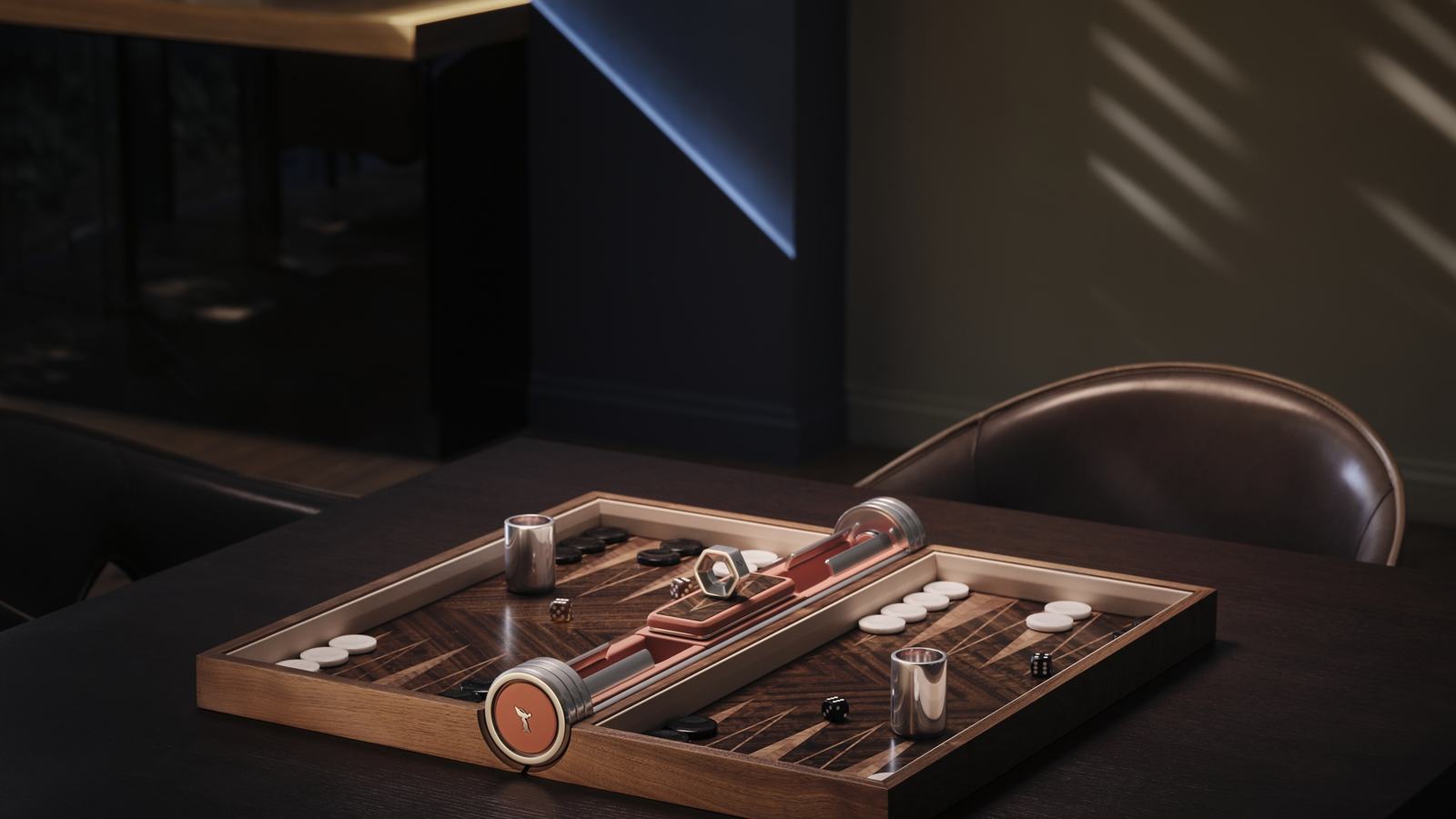
Rolls-Royce brings marquetry, precision engineering and its Bespoke leather palette to a commissionable backgammon set designed for display and play at home.
A commission beyond the motor car
Rolls-Royce Motor Cars has expanded its collection of commissionable accessories with a backgammon set developed by its Bespoke Collective at Goodwood. Announced on 16 November 2026, the piece brings together furniture making, precision metalwork and materials familiar from the interiors of its motor cars. Rather than developing a portable travelling game, the designers envisaged an object that could occupy a permanent place within a residence while remaining fully functional. Commissioners can approach the company's showrooms and Private Office boutiques. The announcement does not disclose a price, production total or delivery lead time. It is a particularly interesting example of the movement of specialist craftsmanship beyond its original application. A marque associated with the commissioning of individual vehicles has applied the same concern for material selection and mechanical detail to a form of private entertainment that can be shared by owners and their guests.
The historical references behind the design
Rolls-Royce traces the inspiration for the set to early board games identified through archaeological discoveries in Mesopotamia. It connects their origins with a period extending back thousands of years, during which the relationship between games of chance and strategy developed in numerous forms. This reference informs the company's choice of colours rather than suggesting that the rules and physical configuration of modern backgammon have remained unchanged throughout that history. The marque also identifies a more recent example from its own archives: a Wraith commissioned in 1938 with a backgammon board incorporated into the rear compartment. That earlier motor car illustrates how even a highly individual pursuit could become part of the specification of a coachbuilt vehicle. The new set takes a related idea in a different direction, because the object has been conceived for a home rather than integrated into the passenger accommodation of a particular motor car.
Designing an experience around the game
The development process occupied more than a year, according to the company. During that period the designers played backgammon themselves to explore the physical experience of moving the pieces and handling the associated accessories. Their research therefore concerned not only how the object might look when displayed but also how it would function when used. A board intended for frequent play needs a surface on which the counters move readily, sufficient space to manage the arrangement during a game and a convenient place for the accessories when they are not in use. The weight and texture of the counters influence the sensations experienced by the players. In an object intended to occupy a prominent place within a private interior, however, these requirements must be reconciled with the visual coherence of the materials. The resulting design reflects the attempt to bring both purposes together in one piece rather than treating practical use as secondary to decoration.
An opening movement conceived as a performance
A particularly distinctive feature is the mechanism that reveals the playing area. The central spine rotates in the opposite direction to the opening hinge, exposing the pieces stored within it. The aluminium hinge is produced from solid stock, polished by hand and anodised. Mounted on the mechanism is a self-orienting version of the Spirit of Ecstasy figure familiar from Rolls-Royce vehicles. Its behaviour recalls the marque's rotating wheel-centre emblems, although here it forms part of the transition between display and play. Mechanical features of this kind invite a different kind of attention from that attracted by a conventional hinged game case. Their movement makes the act of preparing for the game a significant part of the experience. A prospective commissioner should nevertheless establish the appropriate position for the object, allowing sufficient space around it for its complete opening movement and convenient access by the participants.
Walnut, marquetry and visual continuity
American walnut forms the structural body of the board, selected in part to support the hinge assembly. The surfaces use carefully selected veneers, with grain matched at an angle of 55 degrees in reference to a treatment employed within Rolls-Royce motor cars. The playing points incorporate Royal Walnut and Smoked Eucalyptus, each cut and incorporated into the marquetry. Their contrasting appearance allows the playing field to remain visually legible while drawing attention to the natural character of the timber. A well-executed marquetry surface must maintain the relationship between individual pieces over a broad area, because even small irregularities can interrupt the continuity of the design. The selection of veneer also affects how a surface appears as the viewer's position and the incident light change. These are familiar concerns within luxury interiors, where the appearance of a material in a sample may differ from its impression when applied across a larger piece of furniture.
A palette inspired by the landscape
Natural grain leather forms part of the treatment of the board, with the company identifying Sunrise and Sunset among the selected finishes. The palette evokes desert and earth tones rather than the high-contrast patterns associated with some traditional boards. The exterior also includes the placed perforation treatment used by the marque in its Bespoke interiors, with a pattern inspired by the appearance of dunes viewed from above. For collectors familiar with the company's motor cars, the details create a connection between the object and the materials that may already form part of another commission. Equally, the design can be viewed independently as a piece of decorative craftsmanship. The relationship between the leather, dark timber, lighter grain and polished metal allows different textures to remain identifiable. An interior designer might therefore consider the surrounding textiles, furniture and lighting before choosing where it should be exhibited.
The accessories form part of the design
The playing counters are manufactured from a composite incorporating bauxite ore. Black and white versions have been developed with polished surfaces and a subtle variation in appearance. Their design is intended to suggest the tactile quality of rounded stones. The dice shakers are produced from aluminium, with leather applied underneath to soften the contact during use. The set also includes a doubling die with an unconventional hexagonal form, drawing inspiration from naturally occurring honeycomb structures and mechanical fasteners. That particular element provides a link between engineering references and the game itself. The accessories have designated storage places, and a removable component also serves as the game's bar. This integration matters because a set of several small pieces can become difficult to manage if its storage is not suited to its regular use. Preserving all of the original components is also important for a collector seeking to retain the object's integrity over time.
A different approach to private entertaining
For a household that maintains residences and spends considerable time aboard a superyacht, entertaining can take many forms beyond formal dinners or organised excursions. A thoughtfully designed games area offers a quieter setting in which guests can participate without a complex programme of activities. The Rolls-Royce piece has been presented specifically for use within a residence. Its construction, storage and potential weight should be considered before anyone assumes that it is appropriate for installation on a yacht. An object intended for a fixed interior may require a different approach to securing it in a marine environment, where movement and humidity can affect furniture and loose components. If an owner wishes to introduce a similar leisure experience aboard, the appropriate designers should address those requirements at the specification stage. That distinction allows the announced object to be appreciated on its own terms while recognising the broader appeal of carefully commissioned recreational furnishings.
Commissioning and the value of a coherent collection
The set is now offered for commission through the marque's international retail and private-client channels. It joins a category of objects in which the interest of the purchaser may lie as much in the design process and the relationship between materials as in the scarcity of an individual example. Rolls-Royce has not announced that production will be limited to a specified number, and there is no basis for assuming a particular resale value or investment return. Prospective clients can seek details of the available options, manufacturing schedule, installation requirements and long-term care directly from the company. Its importance as a new addition to the luxury landscape is the application of a distinct automotive design language to private domestic life. The board can be understood both as an example of contemporary decorative craftsmanship and as a functional object whose character emerges most clearly when the carefully arranged pieces are put into play.
Primary source: Rolls-Royce Motor Cars official newsroom announcement, 16 November 2026.
Photography: Rolls-Royce Motor Cars, official editorial media kit. Official source.