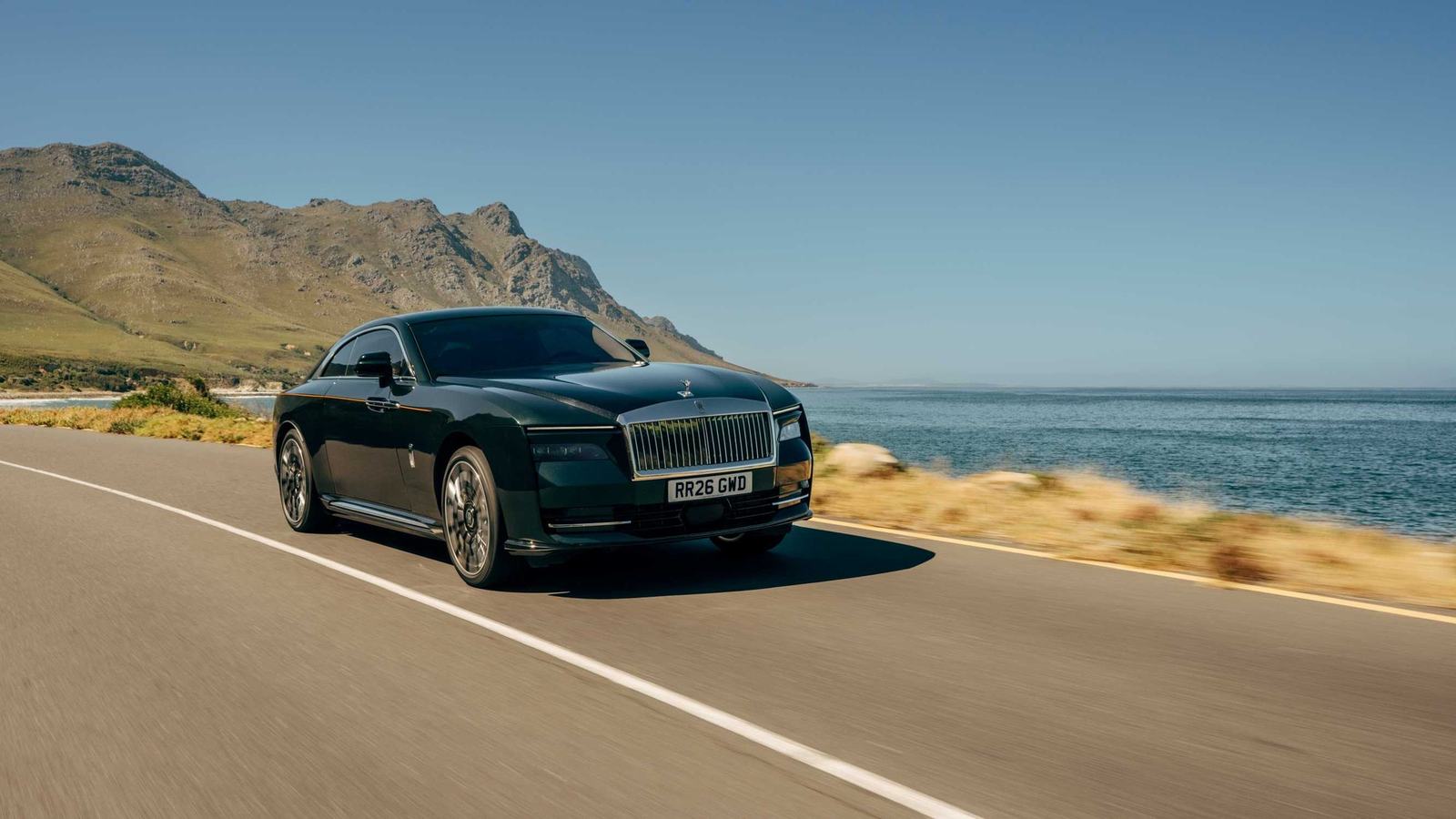
Rolls-Royce Spectre Series II has made its European public-road debut in Stockholm, with revised range, charging and expanded Bespoke options.
An electric coupé in a Nordic setting
Rolls-Royce Motor Cars has taken its Spectre Series II onto public roads in Stockholm, marking the latest European appearance of the all-electric grand tourer after its unveiling in June 2026. The manufacturer selected the Swedish capital as a setting for the car’s refinement, design and contemporary electric technology. Its October announcement outlines practical engineering changes as well as a broader programme of personalised finishes. The occasion is a demonstration on public streets, not the announcement of a new production model or a claim that the car is already available in every market.
For superyacht owners with homes and itineraries in different countries, an electric luxury coupé belongs to a wider discussion about quiet ground transport. A vehicle accompanying an owner’s time in a coastal city may be required to navigate narrow streets and formal arrivals as well as longer routes. Stockholm provides visual context for the Spectre, but any buyer should judge its suitability against their own travel distances, charging arrangements and road conditions rather than take the photographs as a performance test.
A revised range claim needs careful reading
Rolls-Royce gives the Spectre Series II a maximum electric range of 628 kilometres, or 390 miles, under the WLTP test procedure. The announcement describes this as an increase of up to eighteen per cent. The published range for the regular version is 582–628 kilometres, while the Black Badge version is rated at 578–628 kilometres. These are standardised testing figures, useful for comparison between vehicles but not guarantees that a driver will cover the stated distance on any particular journey.
Cold weather, motorway speed, tyres, accessories and the use of climate systems can all affect real-world results. A trip through Scandinavia in winter may therefore require different planning from a summer drive along the Mediterranean coast. Buyers who want to use the car at several homes should enquire about charging facilities in each location and consider whether their preferred routes involve reliable public rapid charging. The manufacturer’s WLTP figures are a starting point for that discussion, not a substitute for it.
Charging and torque are part of the update
The company says engineering revisions reduce charging time by up to fourteen per cent, though the published Stockholm release does not give a universal charging duration that applies to every charger and battery condition. Maximum torque for Spectre Series II is stated as 1,015 newton-metres. For Black Badge Spectre Series II, the claimed maximum rises to 1,100 newton-metres when its Spirited Mode is selected. These are manufacturer figures, not results from an independently supervised road test.
Electric torque changes how a heavy grand tourer feels in ordinary traffic, but a large number by itself does not establish comfort, efficiency or handling quality. Customers should test the response they would actually use, including the change between driving modes. Charging speed also depends on infrastructure and temperature. An owner who expects the car to be ready after a short stop should discuss charging profiles and practical turnaround requirements with the manufacturer rather than relying on an ideal percentage improvement.
Magma Red meets a wider Bespoke palette
Rolls-Royce photographed the Stockholm car in Magma Red, and the official announcement places particular emphasis on additional personalisation. Spectre Series II introduces a Gradient Two-Tone exterior treatment, extending possibilities for owners who want a more carefully considered transition between body colours. The brand also brings Duality Twill and Placed Perforation interior treatments to Spectre for the first time. These are design choices available through the marque’s Bespoke programme, not equipment that automatically appears in every customer car.
Such finishes are most interesting when they express a coherent idea rather than accumulating options. A yacht owner might favour a restrained colour story that relates to a particular residence, a piece of art or a vessel’s interior palette, but automotive and marine materials must still be considered in their different settings. Bespoke commissions also deserve an early conversation about cost, production timing and the ability to revisit a design before final approval. The official photograph is an example, not a promised specification for another customer.
Inside the cabin, texture has equal importance
The new Twill and perforation treatments give attention to surfaces occupants see and touch throughout a journey. Rolls-Royce positions its cabins as environments of quiet, considered detail, and Spectre’s near-silent propulsion makes the quality of those details especially noticeable. A strong interior design does not depend solely on the number of available materials. Tactile consistency, comfortable seating, ease of use and discreet technology integration are important for people who spend long hours travelling between appointments.
Customers should examine actual material samples in different lighting rather than rely on screen colours. A cabin that looks striking in showroom photography may appear quite different at night or in direct Scandinavian daylight. Maintenance also matters: complex stitching and perforations need appropriate care, particularly in a car used regularly rather than kept as a display object. Rolls-Royce’s announcement describes the options, while an individual commission requires separate technical and aesthetic decisions.
Stockholm adds context without changing the product
The company highlights Stockholm’s architecture, cultural reputation and attention to design as reasons for bringing the new Spectre to the city. That is a promotional interpretation of the setting, but there is a genuine relationship between luxury vehicle design and the streets in which it is experienced. A large electric coupé may feel effortless on a broad avenue while demanding greater judgement in an older urban quarter. The driving environment therefore offers more useful questions than a simple endorsement of the destination.
For owners arriving by private aviation or superyacht, the decision to keep a car at a European residence can turn on practical details: secure parking, reliable charging, local registration and maintenance access. Those issues are not resolved by the Stockholm debut. A prospective purchaser can use the demonstration as a reason to arrange a meaningful test route and obtain written answers about support arrangements. The car’s design merits attention, but ownership is a longer commitment than a launch event.
A new chapter for the Nordic retail network
Alongside the product news, Rolls-Royce reports the recent inauguration of Rolls-Royce Motor Cars Copenhagen. It says a new showroom will open in 2027, extending the company’s presence in Northern Europe. The immediate announcement does not provide a complete regional delivery timetable or customer-service network map. It would therefore be premature to conclude that every type of maintenance or charging issue can be handled at each retail point.
A buyer with several residences should ask who is responsible for service support in each country, how warranty processes operate across borders and whether the vehicle’s software and connectivity arrangements travel with it. These are ordinary but consequential questions for premium cars. A carefully managed ownership experience includes more than the purchase ceremony. The expansion in Copenhagen signals commercial interest in the region, while the quality of support must be assessed through the actual arrangements offered to individual clients.
Matching the car to the intended journey
The Spectre Series II announcement contains meaningful technical updates, but the available evidence is still a manufacturer release. Rolls-Royce specifies a WLTP electricity consumption range of 20.2–21.7 kWh per 100 kilometres for Spectre Series II and 20.2–21.8 for the Black Badge version. Those figures should not be treated as independent measurements or as a promise about winter performance. Buyers should request a current market specification and consider the equipment fitted to the particular car they are shown.
For the owner of a large yacht, the connection is lifestyle rather than a literal comparison between propulsion systems. Both kinds of transport involve decisions about quiet operation, individual design and the infrastructure needed to support them. Stockholm’s public-road debut provides an occasion to examine the electric coupé on those terms. A considered purchase would follow a proper drive, a detailed charging plan and a review of the Bespoke commission, with no reliance on unverified claims of resale value.
Primary source: official operator release. Information reflects announcements reviewed 31 October 2026; check current terms directly.