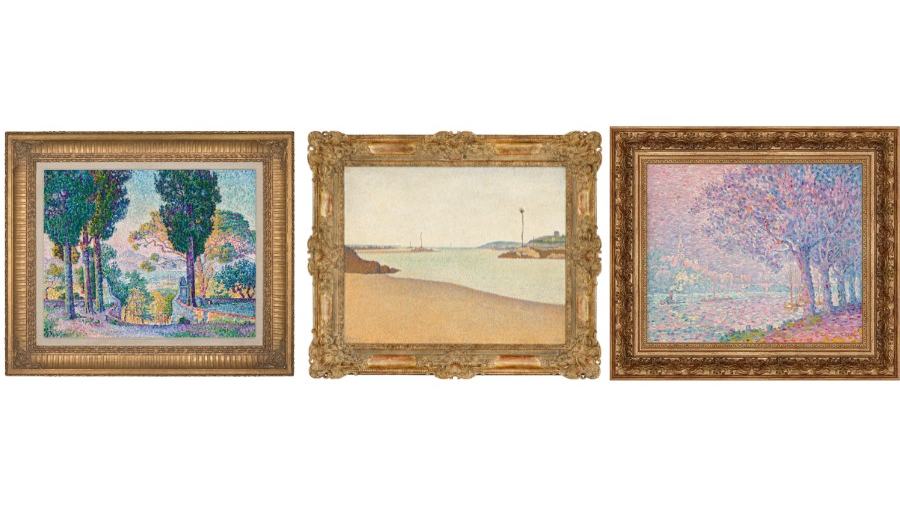
Signac's views of Saint-Tropez and Saint-Briac anchor Christie's 600-work Radiant Modernism collection ahead of October and November auctions.
A private collection built through four decades
Christie’s is preparing to sell works from Radiant Modernism, a European private collection assembled over approximately forty years, with October auctions in London and Paris followed by New York sales in November and further offerings in 2027. The collection contains nearly 600 works across paintings, drawings and prints, with the auction house placing its overall estimate in the region of $40 million to $60 million. The significance lies in the sustained collecting argument as much as in any individual valuation.
Paul Signac, Josef Albers, Odilon Redon and Lyonel Feininger help define the collection’s range, which reaches from late nineteenth-century experiments with light to twentieth-century abstraction. Christie’s identifies Pointillism, Symbolism and Expressionism as three principal strands, rather than treating every work as part of a single school. The approach allows a collector to examine how artists working decades apart tackled colour through very different technical means.
Unlike a single-owner collection dispersed in one evening, Radiant Modernism will appear over multiple dates and salerooms. Interested buyers therefore need to follow the programme by artwork and sale, not just the collection name, while allowing for different currencies, buyer’s premiums and inspection opportunities. Christie’s September announcement provides the structure; final prices cannot be inferred before bidding.
Signac's Saint-Tropez landscape returns to the London market
The London evening sale on 14 October is set to include Signac’s Sainte-Anne (Saint-Tropez), painted in 1905, with an estimate of £4.5 million to £6.5 million. In the composition the town’s harbour and bell tower appear beneath a glowing arrangement of trees, buildings and distant hills. It is a view of the South of France that treats the harbour as part of a study in light rather than solely as a geographical landmark.
The work also has an important collecting history. Christie’s traces its provenance to Gustave Fayet, an early supporter of Post-Impressionism, and notes that the painting appeared in Signac’s retrospective at Galerie Bernheim-Jeune in 1907. Those details are relevant to a bidder assessing the picture’s place in the artist’s career, although the published estimate is not a substitute for checking the full catalogue, current condition and provenance documents.
Saint-Tropez has become closely associated with international yachting, but in Signac’s work the port belongs to a different historical moment. His treatment of the Mediterranean shore records the sensation of colour and atmosphere more than the spectacle of wealth on the waterfront. That contrast makes the picture especially interesting for a collector whose own relationship with the Riviera is shaped by the modern maritime world.
The seascape that remains in private hands
An even more direct maritime subject appears in Saint-Briac, les balises, Opus 210, painted in 1890 and due for Christie’s New York 20th Century Evening Sale in November. Christie’s describes it as the sole example still privately owned among four related seascapes from that summer, with the others in museum collections in Boston, Zurich and Moscow. Its estimate is available on request, so a public numerical valuation would be speculative.
Signac was a keen sailor, and his experience of weather, water and coastal navigation informed the way he painted seascapes. In Saint-Briac, the beacons provide a recognisable structure while the surface is built from numerous distinct touches of colour. Christie’s explains how the artist moved away from strict naturalistic depiction towards a personal interpretation of what a maritime scene felt like in changing light.
The work was also included in the Radical Harmony exhibition at the National Gallery in London in 2025–26. That recent public exhibition provides a contemporary point of reference for scholars and prospective buyers, though an exhibition record is only one aspect of due diligence. The rarity described by Christie’s concerns this particular four-work series, not an unsupported claim that all Signac seascapes are scarce.
Paris and London reveal the breadth beyond the sea
Paris will offer Signac’s Saint-Cloud, dated 1903, in its 22 October evening sale with an estimate of €1.5 million to €2 million. The scene depicts a landscape west of Paris, with trees and the horizon translated into contrasting shades of blue, violet, pink, green, yellow and orange. Together with Sainte-Anne and Saint-Briac, it helps show how Signac returned repeatedly to water and nature while changing the emphasis and construction of his paintings.
The London sale will also include two Josef Albers paintings: Study for Homage to the Square: Warm Silence from 1971, estimated at £380,000 to £500,000, and the red composition R-I d-1 from 1968, estimated at £250,000 to £350,000. These prices are estimates from the original announcement, not realised results. Albers approached colour through abstract structure rather than recognizable harbours, giving the collection a counterpoint to Signac’s coastal imagery.
Christie’s records the former ownership of Warm Silence by Lee V. Eastman and notes that R-I d-1 appeared in Albers’ 1971 Metropolitan Museum of Art retrospective. Other represented artists include Toulouse-Lautrec, Félix Vallotton, Maurice Denis and Charles Théophile Angrand. The collection therefore rewards a reader interested in relationships between artistic research, patrons and exhibition history rather than concentrating attention on only two famous names.
What a serious international collector should consider
Because the sales span London, Paris and New York, prospective bidders face distinct conditions, time zones and practical arrangements. A collector pursuing a specific work should establish the full lot documentation, estimate currency, buyer’s premium, taxes where applicable and requirements for transporting or exporting the piece. These issues can become more involved with historically significant works that have extensive exhibition and ownership records.
For superyacht owners who display art across several properties, a purchased painting’s destination matters as much as the transaction. Environmental stability, security, insured transport and specialist installation should be assessed for each work, especially where a yacht’s motion, light and humidity differ substantially from a controlled gallery. It would be misleading to assume that every valuable painting is suitable for permanent onboard display.
Radiant Modernism offers an unusually instructive comparison between Signac’s sensitivity to the sea and Albers’ analytical use of colour. Its schedule begins in London on 14 October and continues in Paris on 22 and 23 October, ahead of November New York sales and later 2027 consignments. The auction house’s September release supports the works, estimates and dates reported here, while the results and ownership transitions remain to be determined.
Source
Christie's Press