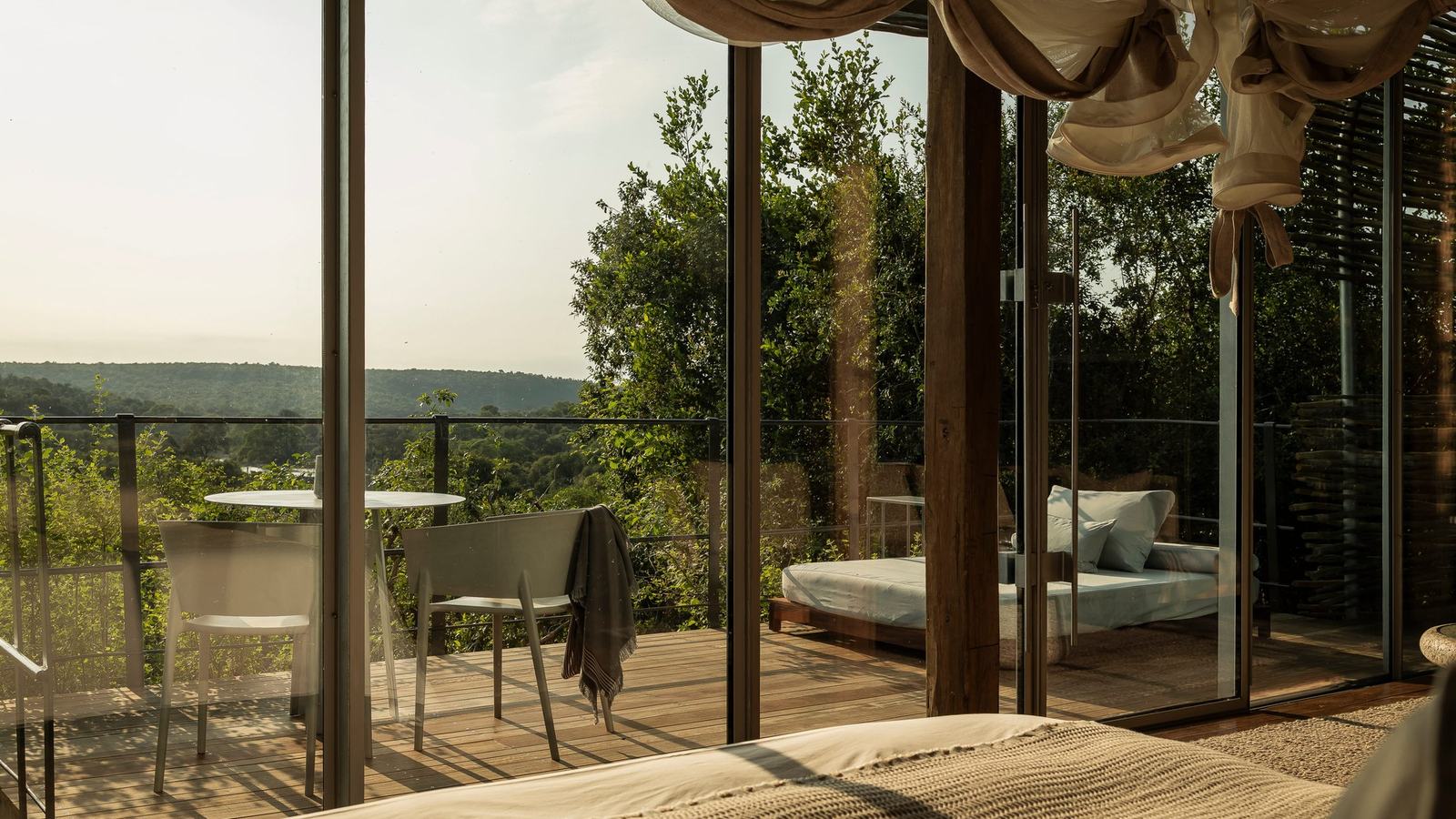
Singita Lebombo Lodge takes a striking architectural approach to safari hospitality, combining elevated glass-fronted suites with guided experiences in the Kruger region.
Architecture that frames the wilderness
At Singita Lebombo Lodge, the view is not an added attraction placed beyond the accommodation. The architecture is organised around it. Elevated suites, large areas of glazing and restrained interiors encourage guests to pay attention to the contours of the bush and the changing light above the N’wanetsi River in South Africa’s Kruger region. The result is a safari lodge with a recognisably contemporary visual identity.
The experience differs from a traditional tented-camp aesthetic. Its strength lies in the relationship between modern design and a wild setting rather than an attempt to reproduce an imagined colonial past. Guests arriving for the first time should therefore think of Lebombo as a destination for both exceptional wildlife observation and quiet immersion in an architectural landscape.
A deliberately limited number of suites
The lodge offers 15 loft-style suites in its principal accommodation collection, including configurations suited to couples and groups travelling together. Private terraces and thoughtfully arranged indoor spaces give guests opportunities to spend time alone between guided outings. The design encourages the changing sounds and colours outside to remain the focus, even when the day’s main activities have ended.
Suite selection still matters. A party travelling with children or friends should confirm the precise sleeping arrangements, any age rules and how separate accommodation units relate to one another. Beautiful architecture is not automatically the most convenient arrangement for every group. Advance discussion allows the lodge to match its accommodation to the way people intend to spend time together.
Wildlife on the landscape’s schedule
The lodge’s central purpose remains access to the natural world through guided safari experiences. Sightings cannot be scheduled or guaranteed, and that uncertainty is fundamental to the value of the encounter. An experienced guide reads tracks, weather and animal behaviour, adapting the route as conditions change. Travellers who leave space for that judgement often find the quieter observations as memorable as any dramatic encounter.
It is worth arriving with a few interests rather than a rigid list of animals. Birdlife, geology, plant communities and smaller species help explain how the wider ecosystem functions. A guide can also advise on appropriate photography practices and where to remain still or silent. The quality of a safari is measured as much by understanding and restraint as by the number of photographs taken.
A lodge designed for time between drives
The hours between excursions are not merely an interval to fill. At Lebombo, they can be spent reading, enjoying the view from a private terrace or exploring the lodge’s shared spaces. The property’s contemporary design gives these slower moments a distinct mood, and the sense of separation from urban routines is one of the principal rewards of a longer stay.
Singita also describes spaces devoted to art, design and its conservation narrative, allowing guests to engage with more than the immediate game-drive programme. For someone travelling with a partner who approaches safari at a different pace, this is significant. A successful itinerary should allow one person to be deeply active while another has genuine options for rest and reflection.
Food, wine and an unhurried evening
Dining at a remote safari lodge is closely connected to the sequence of the day. Early starts, afternoon excursions and sunset conditions mean that meals should provide flexibility as well as refinement. Singita’s broader hospitality approach puts emphasis on wine, cuisine and carefully considered service, giving evenings a social dimension distinct from the focused hours spent searching for wildlife.
Guests planning special dinners or travelling with dietary restrictions should speak with the property before arrival. Preferences can usually be accommodated more thoughtfully when the kitchen has advance notice, but a remote lodge has a different supply chain from a major city. A degree of adaptability preserves the experience and avoids treating the wilderness setting as if it came without practical realities.
Conservation in the foreground
Singita presents conservation as central to its operation rather than a decorative footnote. That includes the relationship between high-value, low-density tourism, protected landscapes and the people whose work supports them. Guests can ask how their visit contributes and what programmes are currently active. Transparent, specific questions are more useful than accepting sustainability labels at face value.
The lodge’s energy and operational initiatives also form part of this discussion. Infrastructure in a sensitive environment involves trade-offs around power, water, waste and transport. Travellers who want to understand the destination in depth can request information about current practices and the wider protected-area context. Responsible travel begins with curiosity about those systems, not just admiration for the setting.
Planning the practical side of safari
A luxury safari is best arranged around realistic travel times and a sufficient number of nights to allow weather and wildlife patterns to vary. The correct entry point and onward transfer depend on the wider itinerary and should be confirmed with the lodge or a specialist operator. Guests should also clarify baggage requirements, any medical advice relevant to the region and seasonal variations in temperature.
Photography equipment calls for particular thought. A longer lens can be valuable, but ease of handling, dust protection and sensible battery management matter just as much. A light layer for early drives is often more useful than another formal outfit. Guests should follow the guide’s instructions around vehicles and animals at all times; private access is not permission to ignore the safeguards of a protected landscape.
A different measure of luxury
Lebombo’s strongest impression is created by contrast: deliberate architectural lines against an untamed horizon, a composed interior against the unpredictable movement of wildlife, and highly organised service against days that cannot be completely planned. These tensions make the lodge distinctive. Its design does not compete with the surrounding landscape; at its best, it makes people notice that landscape more carefully.
Potential guests should confirm the current suite configurations, safari programme, seasonal access and any conservation experiences directly with Singita. What the official lodge presentation makes clear is the underlying philosophy: an intimate, contemporary place to observe, learn and spend time, with the wilderness remaining the principal event.