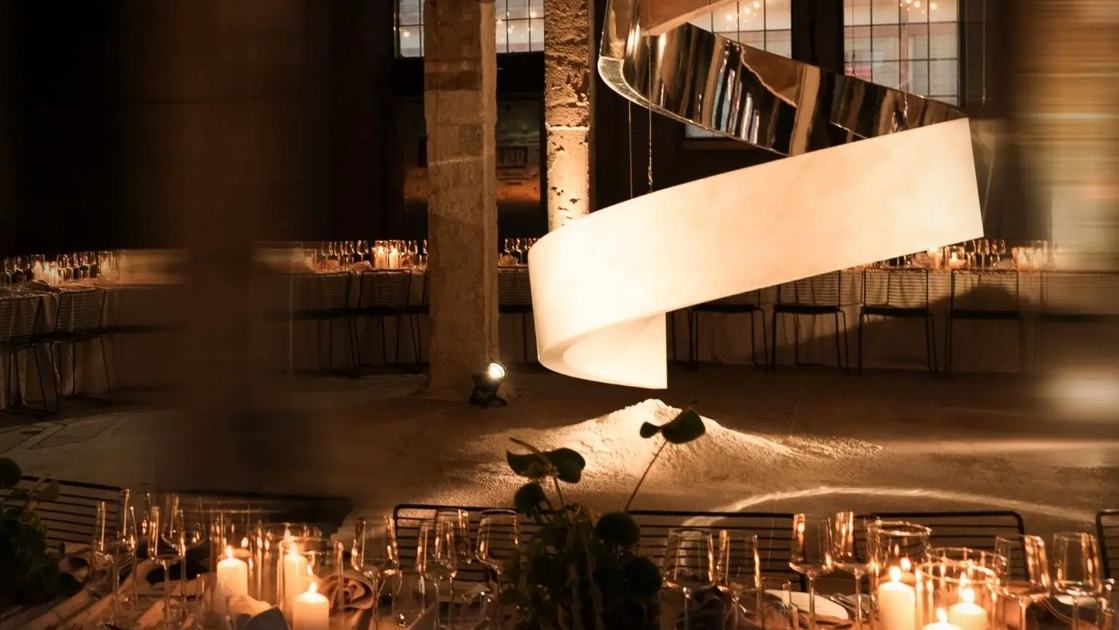
Artist Jacob Felländer transforms Soneva's signature slide into a three-material Stockholm sculpture, with creative workshops planned at Soneva Fushi in November.
A Maldivian waterslide becomes an artwork in Stockholm
Soneva has brought one of its most recognisable resort features far from the Indian Ocean, commissioning Swedish artist Jacob Felländer to reinterpret a waterslide as a contemporary sculptural installation. The work, titled Joy Takes Form, was unveiled on 23 September 2026 in Slakthusområdet, Stockholm's historic meatpacking district. Rather than reproduce a decorative feature from a luxury villa, the collaboration asks why an object associated with play has become such a powerful part of a hospitality brand's identity. Its setting in a converted industrial environment makes the contrast unusually direct.
The installation uses the familiar curve of the slide as a framework for exploring memory, movement and possibility. According to Soneva's official account, weathered metal, a mirrored surface and a lighter final section are intended to suggest past, present and future. Those interpretations belong to the collaborators' stated artistic concept, not to a scientific claim about how visitors will experience the work. The value of the project lies in the unexpected decision to treat an object of leisure as something worth considering in its own right.
The Stockholm presentation was staged for invited guests and friends of the resort group, with an evening of art and conversation. The installation is scheduled to remain at Slakthusområdet until 31 December 2026, giving it a life beyond a single private event. That longer period makes it a cultural project rather than a conventional launch-night decoration. For collectors and art-minded travellers, its appeal is partly that a familiar image from overwater-villa holidays has been lifted out of its expected location and given a different meaning.
Three materials carry three ideas
The material sequence is central to Felländer's design. Weathered metal at the beginning evokes the traces that experience leaves behind; the mirrored middle section draws the surrounding present into the work; and the final part aims for a sense of release and open-ended possibility. This is not a piece defined by technical complexity alone. The interaction between material, light and the visitor's movement provides its character, making the slide's curve both a physical line and a metaphor for passing time.
Using reflection in an artwork introduces a degree of unpredictability. What a person sees depends on the room, the lighting and where they stand, so the installation is not visually identical from every position. This can be particularly effective when an object is associated with motion. A visitor might remember the speed and anticipation of an actual slide while experiencing the sculpture at a walking pace, a contrast that invites a more thoughtful engagement than the original holiday activity.
Soneva describes its approach as Bare Luxury, a philosophy built around wonder, curiosity and connection rather than excess for its own sake. The sculpture can be read as an expression of that idea, although art should not be reduced to advertising copy. Its effectiveness depends on whether it remains interesting when the brand name is no longer the viewer's main point of reference. The three-part material arrangement offers a clear structure through which Felländer can explore a subject larger than a resort's signature amenity.
Art, gastronomy and the social life of luxury brands
The unveiling also brought culinary interpretation into the programme. Stockholm chefs Adam Dahlberg and Albin Wessman created a menu inspired by the characteristics of Soneva's three Maldivian resorts, with courses referring to earth, water and air, followed by a final element called Whimsy. The use of food as part of an art presentation was a deliberate way to create a shared evening, not evidence that the installation itself could be experienced only by the dinner guests. These linked experiences offered different routes into the project.
Collaborations between established hospitality groups and artists can produce more than limited-edition objects. They can allow a brand's familiar design language to be questioned, interrupted or moved into an unfamiliar setting. There is also a risk that cultural partnerships become predictable exercises in prestige. Felländer's transformation is most convincing when viewers can engage with the materials and ideas without needing detailed knowledge of Soneva's room categories or its commercial history.
The artist has spoken about imagination, empathy and the human capacity for play as reasons for making art. That emphasis resonates with a segment of luxury travel in which privacy and polished service are no longer the only measures of value. Guests increasingly have opportunities to meet artists, learn a skill or take part in something with a genuine creative component. Such experiences can be memorable precisely because they do not resemble another carefully staged product photograph or a routine itinerary of indulgence.
The collaboration returns to the Maldives in November
The Stockholm installation is not the end of the exchange. Soneva has announced that Felländer will be in residence at Soneva Fushi from 12 to 24 November 2026 as part of its visiting-guest programme, leading workshops centred on creativity, intuition and experimentation. These are announced dates, not confirmation that every resort guest will automatically have access to a particular session. Anyone intending to travel around the residency should establish availability, participation arrangements and the final programme directly with the property.
Taking an artist's work back to the environment that inspired the original commission creates a different encounter. In Stockholm the slide is a sculptural form amid industrial architecture; at Soneva Fushi, guests will have the sea, nature and the context of holiday life around them. The programme's promise is not to train every participant as a practising artist, but to create room for exploration. For travellers accustomed to highly programmed days, a session with no predetermined aesthetic outcome can itself feel pleasantly unfamiliar.
Joy Takes Form illustrates an increasingly interesting intersection between contemporary collecting, destination hospitality and personal experience. The project is rooted in a genuine artwork and a scheduled artist residency, rather than a vague announcement of future possibilities. Soneva's September statement supplies the details of the Stockholm unveiling and the November programme, while the sculpture and workshops will inevitably be experienced differently by individuals. Its broader point is simple: when luxury gives guests permission to be curious, play need not end when childhood does.