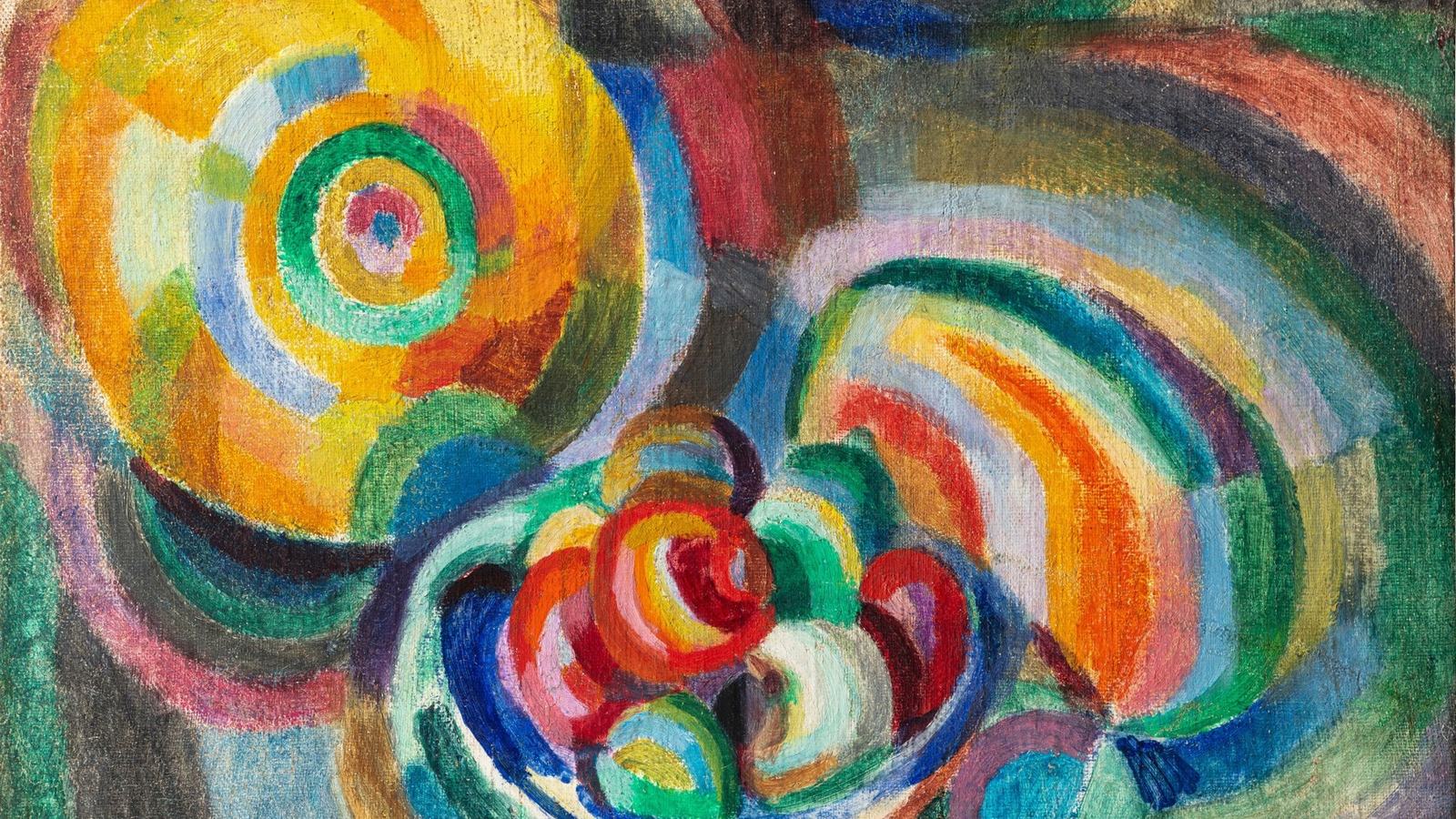
A 1916 Sonia Delaunay painting acquired directly from the artist by Claude and Georges Pompidou in 1961 is estimated at €200,000–300,000 for Paris.
A pioneering artist and an intimate still life
Sotheby's Paris is preparing to offer Sonia Delaunay's Nature morte portugaise as part of its Modernités auction on 23 October 2026. Executed in 1916, the oil-and-wax painting measures approximately 38 by 57 centimetres and carries a pre-sale estimate of €200,000 to €300,000.
Although modest in size compared with many major museum paintings, the work belongs to a crucial period in the development of twentieth-century abstraction and colour theory. Its origin within the collection of Claude and Georges Pompidou also makes its provenance a significant element of the story.
Colour as a subject in its own right
Sonia Delaunay developed a practice exploring the interaction of colour, shape and movement, working across painting, textiles, clothing and design. Her experiments were closely connected with the visual language often described as Simultanism, in which neighbouring colours influence how one another is perceived.
A still life can provide a starting point for that investigation without demanding a conventional illusion of three-dimensional objects. Forms may become simplified or fragmented as colour relationships take on greater importance, inviting the viewer to consider rhythm as much as representation.
A work made during the First World War
The painting's 1916 date places it in a period of disruption across Europe, when many artists were reconsidering established ways of working and living. The title suggests a Portuguese subject or context, but the exact artistic intentions should be explored through scholarship rather than inferred solely from its wording.
Delaunay's practice during this era illustrates how modernist ideas could travel between places, materials and artistic disciplines. Her paintings remain especially interesting to collectors who study the relationship between the visual arts and design.
Direct acquisition by the Pompidous
Sotheby's records that Claude and Georges Pompidou acquired the painting directly from the artist on 19 December 1961. The work subsequently passed to Alain Pompidou and then through the family to the present owner, according to the auction catalogue.
That chain of ownership offers an unusually direct connection between the artist and an important French cultural and political household. Such provenance can support historical research, although it should not substitute for independent evaluation of a painting's physical condition and authenticity.
A documented international exhibition history
The catalogue lists a 1979 exhibition of Robert and Sonia Delaunay in Tokyo, together with an extensive travelling retrospective across American museums in 1980 and 1981. It also records later presentations in Madrid and in France connected with the Pompidou collection.
Museum exhibition references help reveal how a painting has been interpreted across decades. They can also guide specialists seeking older images or records of its appearance, particularly when an early catalogue notes a former state of the work.
Research, conservation and the sale
Sotheby's states that Richard Riss has confirmed the work's authenticity. Its mixture of oil and wax demands suitable conservation assessment, and collectors should examine its support, paint layers and any history of restoration before bidding.
The €200,000–300,000 estimate is a guide to the forthcoming auction, not a confirmed selling price. For a collector, the attraction is the combination of a clearly documented family provenance, a long exhibition record and a small painting that reflects the ambitious colour experiments of a pioneering modern artist.