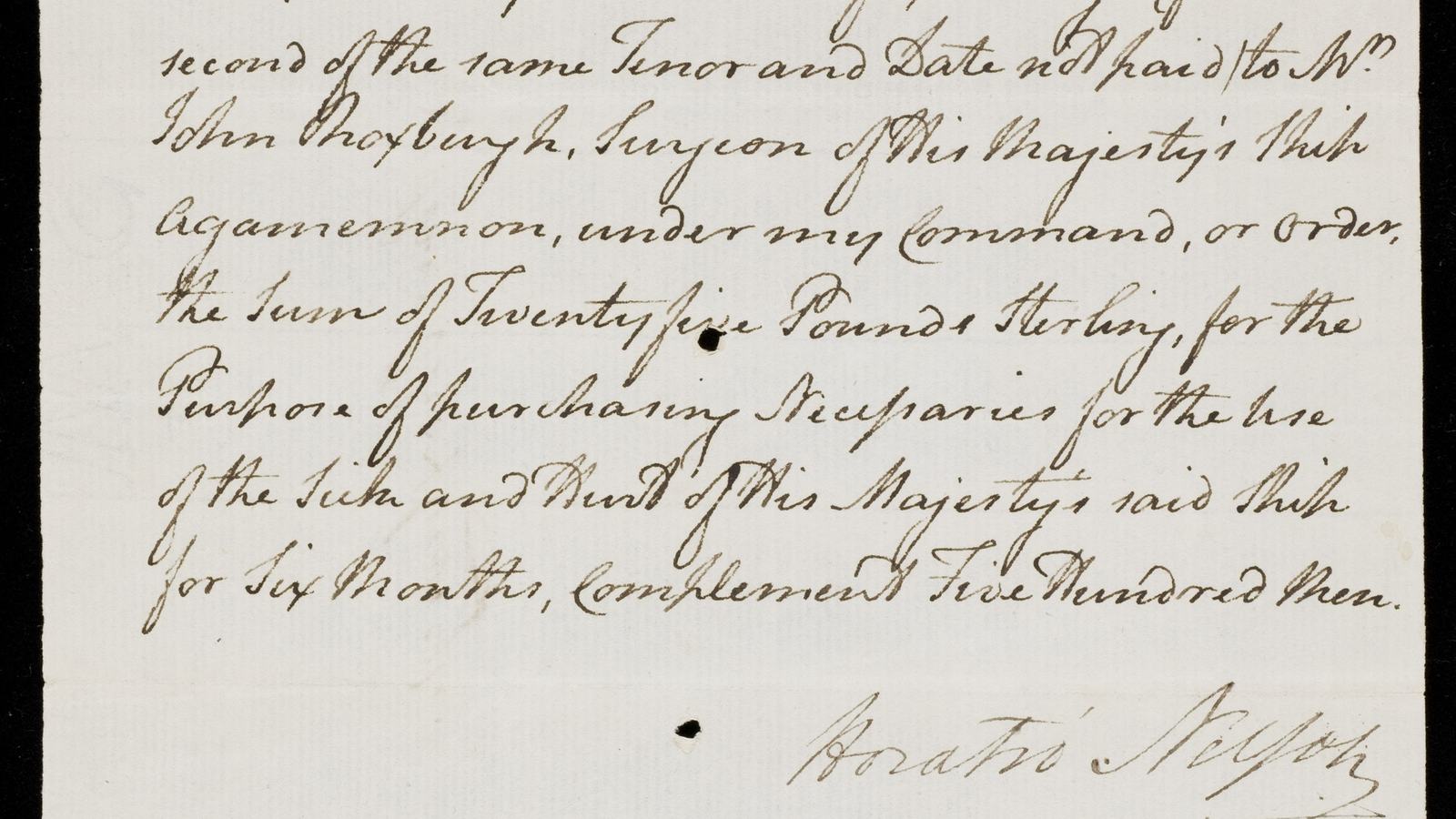
Sotheby’s offers the Clive Richards collection of Nelson papers, an exceptional maritime archive estimated at £4–6 million, with bidding closing on 18 November.
An exceptional opportunity in the market for naval manuscripts is approaching its conclusion at Sotheby's. The auction house has catalogued the Clive Richards collection of letters and papers relating to Horatio Nelson, with an estimate of four to six million pounds and a scheduled closing time on 18 November 2026. The documents are being offered together as one lot, rather than as hundreds of individually priced objects. For a private collector with a serious interest in maritime history, that structure is particularly important: the intellectual value of an archive can arise from relationships between documents that might otherwise be dispersed among unrelated owners.
An archive whose scale is itself noteworthy
Sotheby's divides the collection into four principal groups: papers associated with Nelson, documents relating to the Hamilton family, battle papers and papers of the Nelson family. The published catalogue lists 217 items in the first group, 136 in the second, 46 in the battle-related material and 19 family papers. Taken together, the categories indicate 418 items. The catalogue makes more detailed condition information available through the auction house; a prospective purchaser should obtain that information directly.
The estimate is for the assembled collection, not for a representative letter or an individual battle document. A bidder assessing the collection needs to understand the relative significance of the material and the nature of the relationships between its components. An archive may contain significant documents alongside more routine records whose importance emerges from their proximity to other papers. Evaluating the whole requires the assistance of specialists in manuscripts, naval history and archival conservation, rather than relying on standard comparisons with the price of a single signed letter by a famous historical figure.
From fleet movements to personal relationships
Nelson's career occupies an unusually prominent position in British maritime history. His command responsibilities and the events leading to Trafalgar are familiar to many readers, but the surviving correspondence offers access to a different dimension of the period. Manuscripts can preserve the administrative and personal circumstances surrounding events that appear much simpler in retrospective summaries. They may record requests for supplies, reports of difficulties or matters of immediate personal concern alongside formal decisions.
The division of the Richards collection into naval and family material makes this range particularly relevant. A historian interested in command decisions may formulate questions very different from those of a researcher studying relationships, domestic arrangements or the pressures of separation. The individual documents need to be read within their own historical contexts. A private owner who maintains them together can enable future investigators to compare the evidence from several perspectives. That possibility is one of the reasons substantial manuscript archives often attract interest from institutions and philanthropically minded collectors as well as individuals seeking historically significant objects.
Reading a manuscript as a physical object
The information contained in a document and the document's material identity should not be confused. A printed transcription can preserve much of its wording, but it may not communicate the details of the paper, the arrangement of the text, alterations to handwriting, early endorsements or evidence of how it was folded and circulated. For specialists, those features can assist in establishing relationships between different documents and assessing their authenticity or subsequent history.
Condition review therefore deserves more attention than the attractiveness of the handwriting in a catalogue photograph. A conservator may wish to consider tears, earlier repairs, evidence of fading, the condition of the ink and the way in which the paper has been stored. Some historic administrative papers were intended for practical use rather than permanent display and may have experienced substantial handling before entering a collection. Appropriate conservation is concerned with preserving that material evidence. Cleaning, flattening or other interventions should not be undertaken simply to make an object look neater without an informed assessment of their consequences.
The importance of an attributable chain of ownership
At the highest end of the manuscript market, a catalogue description is only one component of the evidence needed for responsible acquisition. Buyers should examine the available ownership history, previous auction references, specialist assessments and relevant permits or documentation. The fact that papers have been gathered in a substantial private collection does not eliminate the need to establish their individual histories or to identify gaps in the available records.
A professional appraisal of the archive might examine which documents have been published, where earlier transcriptions exist and whether descriptions can be reconciled with the physical material. The purchaser should also understand how the papers have been organised and whether a previous collector's arrangement carries historical information in its own right. Taking a large collection apart to rehouse its elements without recording the original organisation can inadvertently remove useful contextual evidence. A preservation and cataloguing plan agreed with specialists before delivery is therefore a sensible part of an acquisition of this scale.
Preserving naval heritage in an appropriate setting
A superyacht provides an evocative environment in which to enjoy maritime art, but original historic manuscripts require particularly cautious treatment. Light, moisture, temperature changes and accidental exposure to liquids present risks even in carefully finished interiors. Repeated movement and vibration may also make conventional display arrangements inappropriate. The value of a properly controlled shore-based archive or secure specialist storage should not be underestimated.
A private owner can still share the content of the papers aboard a vessel without placing the originals at risk. High-quality facsimiles or responsibly prepared digital reproductions can be used for study or interpretation while the material documents remain under suitable conservation conditions. Rights and reproduction arrangements should be checked with the relevant advisers and institutions. An owner could also develop a modest collection of maritime reference books to help guests understand the historical setting. Such an approach can be more informative than the display of a fragile sheet of paper that few visitors have the opportunity to examine closely.
The obligations of buying a collection across borders
Sotheby's lists the location of the lot at its Greenford Park warehouse in the United Kingdom. The purchase agreement, the auction conditions and the intended destination of the collection will affect the arrangements required after the sale. An owner intending to move historic manuscripts out of the United Kingdom should obtain professional advice about the applicable export regime and any permissions that may be necessary. The auction estimate alone cannot resolve that question.
Transport planning should address not merely the financial value of the collection but the physical sensitivity of its contents. Specialist packing, appropriate handling and suitable environmental conditions may be necessary. An insurer should be informed of the proposed transport, storage and any temporary display arrangements, with the collection described accurately rather than treated as a generic group of valuable papers. These practical issues are best anticipated before a bidder commits to the transaction. In some cases, a purchaser may prefer to retain the documents in a professionally managed archive in the country of acquisition, subject to any agreed arrangements.
Scholarship and the private collector's wider role
One option for a suitably resourced purchaser is to treat an important historical archive as a long-term stewardship commitment. A private collection can support scholarship without requiring the owner to relinquish all control over the material. Arrangements for carefully managed access, digital cataloguing, scholarly collaboration or loans may enable researchers to investigate the documents while preserving their security and condition. The appropriate model depends on the owner's objectives and the circumstances of the collection.
Any decision to make material available should be developed with reference to the actual papers, relevant rights and appropriate professional standards. Individual manuscripts may require different treatment, and some may be particularly fragile. The collection's catalogue should clearly distinguish direct evidence from interpretation or conjecture. This is especially important for subjects involving famous personalities, for whom dramatic anecdotes can easily become detached from the historical records on which they supposedly rest. Thoughtful documentation can be one of the most valuable contributions a private owner makes to the understanding of naval history.
An auction deadline and a long-term responsibility
The closing of bidding on 18 November marks the immediate commercial event, but the archive's next chapter will be determined by what happens after the transaction. Sotheby's estimate identifies the scale of the financial opportunity; the enduring significance of the acquisition lies in the treatment of the documents as a connected body of historical evidence. The future market value of any collection cannot be guaranteed, and the necessary stewardship costs may be substantial.
For the yacht owner whose interest in the sea extends beyond contemporary vessel design and cruising destinations, the Richards collection represents a connection to the human and organisational history of maritime command. It also raises a useful question about the purpose of collecting: whether the most meaningful legacy of a major purchase is the possession of rare objects or the preservation of the knowledge those objects contain. The two ambitions need not conflict, provided the archive receives the professional care and thoughtful management it deserves.
Primary source: Sotheby's official lot catalogue, Nelson, His Life and His Navy, closing 18 November 2026.
Wellcome Collection, London, MS. 7362/1, L0048435, CC BY 4.0, via Wikimedia Commons; resized. A contextual document by Nelson, not represented as part of the offered lot. Official source.

