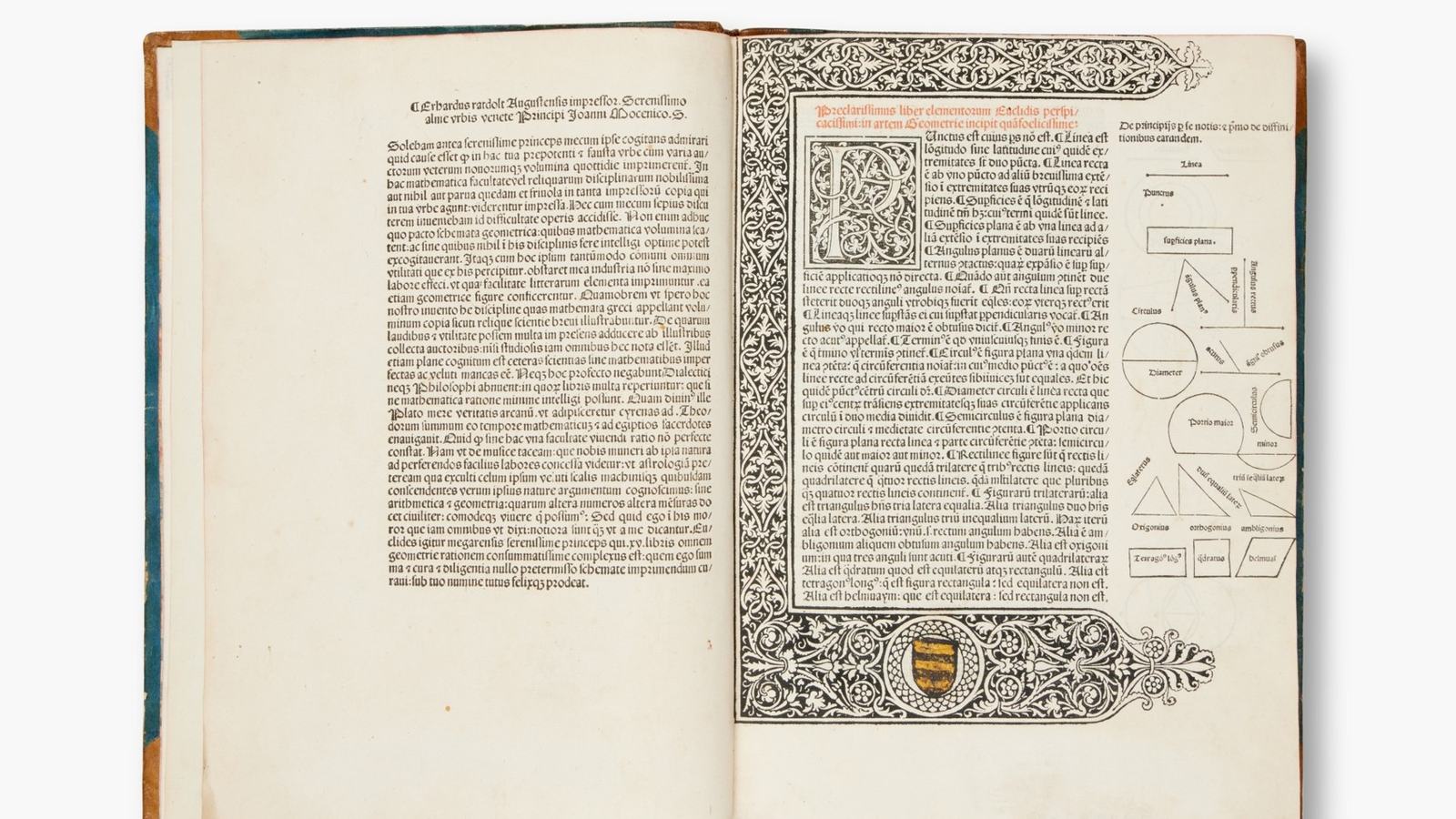
A 156-lot Sotheby's books and manuscripts sale on 20 October explores the history of scientific thinking, including Euclid's 1482 Elements, Archimedes and Copernicus.
A library that traces the spread of scientific ideas
Sotheby's New York is preparing Reason and Revolution: Extraordinary Works from a Distinguished Private Collection, Part 1, a sale of books and manuscripts scheduled for 20 October 2026. The 156-lot catalogue brings together important examples of early printing and scientific scholarship, including mathematics, astronomy and classical natural history.
Its appeal reaches beyond the normal community of rare-book enthusiasts. These volumes help illustrate how ideas circulated between scholars, printers and readers long before digital communication. The books also show that technological progress depends on the preservation and transmission of knowledge as much as on individual discoveries.
Euclid's Elements as a landmark of printing
An early highlight is the Venetian edition of Euclid's Elements printed by Erhard Ratdolt in 1482, considered the first substantial mathematical work to appear in print. The catalogue identifies the copy's connection with the Durazzo collection, adding a layer of provenance to an already significant bibliographic milestone.
Euclid's text provided a foundation for the teaching of geometry over many centuries. Printing allowed diagrams, propositions and explanations to circulate more reliably than through copying manuscripts by hand, although printers still faced the demanding task of combining text with precise mathematical figures.
Other early volumes widen the story
The catalogue also includes a 1503 Venice edition associated with Archimedes, a 1515 printing of Ptolemy's Almagest and a first edition of Nicolaus Copernicus's De revolutionibus from 1543. These works represent different moments in the development of mathematical and astronomical understanding.
A buyer should not assume that every example of an important title has equal rarity or condition. Different editions, bindings, annotations and ownership histories can substantially influence the historical value of a particular copy. Specialists need to establish completeness as well as date and authenticity.
The physical book remains an individual object
Early printed volumes contain evidence of their own use, including bindings, paper, repairs and handwritten notes. A book handled by generations of readers may reveal how scientific knowledge was taught and debated after publication. These features can be part of its appeal, although damage and inappropriate restoration may affect value.
Private owners of significant books need suitable environmental control, careful handling and appropriately trained conservators. Changes in humidity can affect paper and bindings, while light can damage pigments and fragile materials. A secure library should preserve access to its holdings without exposing them to avoidable deterioration.
A sale that crosses disciplines
Mathematics, astronomy and natural history were closely connected in the development of early modern scholarship. A collector might be drawn to Copernicus for the history of science, to Euclid for the relationship between text and illustration, or to an early atlas for its visual treatment of geography.
The historical interest of these objects is not limited to the accuracy of their ideas by modern standards. Some theories were subsequently overturned, but the publications still illustrate the intellectual challenges faced by their readers. That makes a collection compelling even to someone whose principal interest is art or cultural history.
Considerations before the 20 October auction
Sotheby's lists the auction for New York on 20 October, with full descriptions and bidding conditions available through the official catalogue. Prospective purchasers should request bibliographic details, condition reports and information about any restoration or missing leaves before deciding on a bid.
An early scientific book can be an exceptional possession, but the costs of specialist examination, transport, insurance and proper storage must be included in the decision. The sale's announcement concerns an upcoming auction, so estimates and catalogue descriptions should not be confused with achieved prices.