Sotheby's will hold its Important Watches auction in Geneva on 8 November 2026, with a public exhibition at Mandarin Oriental on 5–7 November and catalogue material spanning vintage and modern collectible timepieces.
A Geneva sale spanning two generations of watchmaking
Sotheby's Important Watches auction brings a wide selection of modern and vintage timepieces to Geneva, with online bidding listed from 20 October to 8 November 2026. The official catalogue contains 184 results, ranging from comparatively familiar wristwatch types to unusual complications and exceptional decorative work. For collectors visiting Geneva during its autumn watch-sale period, the occasion offers a chance to study how different generations of watchmaking interpret precision, design and personal expression.
The event is not a report of completed auction results. As of 5 November, the sale remains open, and published catalogue information is not evidence of the prices that buyers will eventually pay. Sotheby's has also described a Geneva preview at Mandarin Oriental, providing an opportunity for prospective bidders to consider individual watches rather than judge them entirely by screen photographs. The eventual transaction prices, including any applicable premium, will only be known after bidding closes.
An unusually broad watch catalogue
One of the strengths of the selection is the contrast between traditional makers and more experimental independent specialists. The catalogue includes Patek Philippe, Rolex, Audemars Piguet, Vacheron Constantin, Cartier and Piaget, while also presenting names such as F.P. Journe, Daniel Roth, Romain Gauthier and MB&F. Collectors with very different tastes can therefore find pieces worth examining without assuming that the most complicated watch must be the most desirable.
The resulting mix illustrates why the collecting market cannot be reduced to a single league table of brands. Some buyers prize the integrity of a classic reference, others the unusual form of a case or dial, and others the inventiveness of an independent movement. The catalogue brings these priorities into one setting, allowing comparisons between historical watches and contemporary creations. It also makes careful reading of individual descriptions essential.
Piaget, hardstone dials and sculptural design
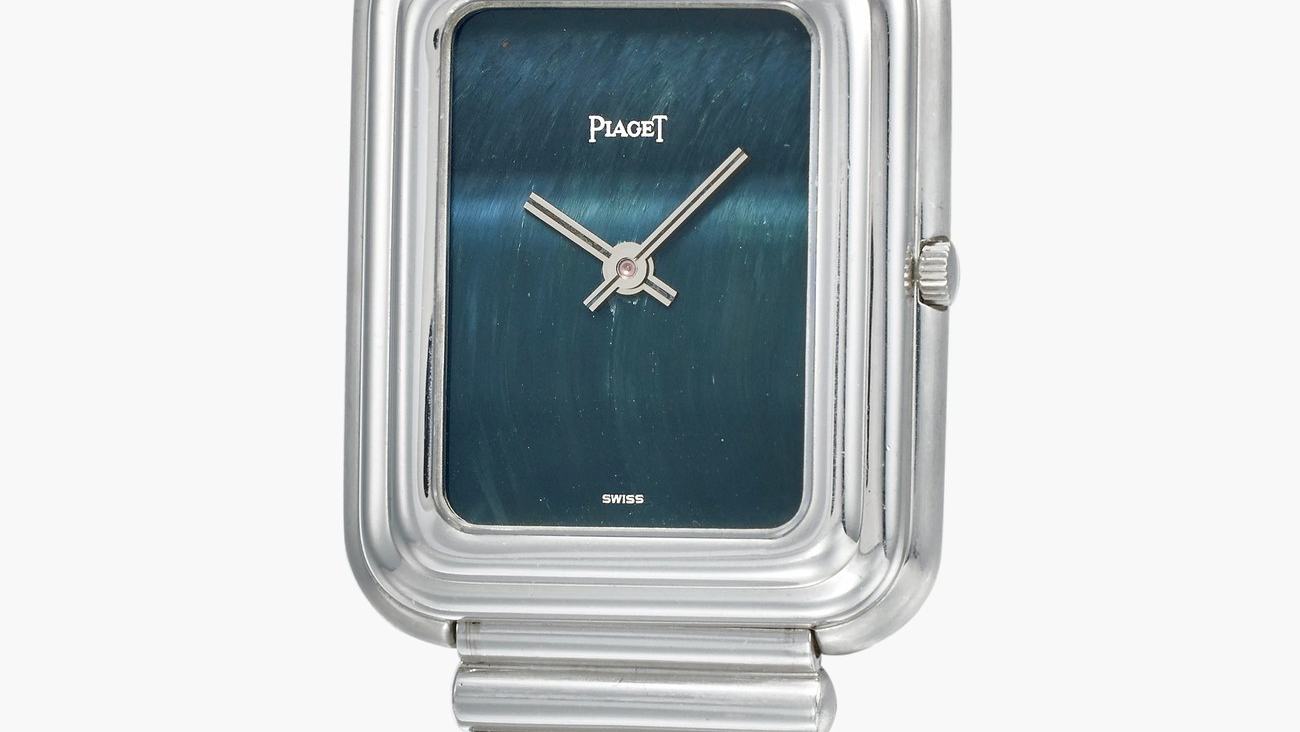
The opening lots include a Piaget Beta 21 white-gold watch with a falcon's-eye dial from around 1972 and a Vacheron Constantin watch with onyx and diamonds from approximately 1982. Such pieces demonstrate an era when fine watchmaking and jewellery design could be closely intertwined. Materials, integrated bracelets and expressive shapes were as important to the visual identity of a watch as the movement within its case.
Hardstone is particularly interesting because no two natural slabs are exactly alike. A dial made from falcon's eye, lapis lazuli or onyx introduces colour, pattern and technical challenges associated with a fragile decorative material. Collectors should investigate originality and condition rather than assume that a striking appearance guarantees historical integrity. Service records and specialist examination can be especially useful when unusual components would be difficult to replace without changing a watch's character.
Cartier moves beyond the conventional circle
The catalogue's Cartier pieces illustrate the house's longstanding experimentation with case shapes. Entries include a Paris Baignoire from around 1965, a later London Baignoire, the modern limited-edition Pebble and a pink-gold Crash dating to approximately 2000. Each represents a different moment in the evolution of jewellery-led watch design. Their appearance together makes it possible to consider proportion and visual identity rather than focus solely on precious-metal content.
Case shapes that look simple in photographs may be surprisingly demanding to manufacture and finish consistently. Small changes to dial printing, crown placement or the relationship between case and strap can alter the entire character of a design. Buyers interested in Cartier should examine the exact reference, period and condition of every component. A modern interpretation and a vintage watch may look related while offering very different collecting propositions.
Rolex shows several forms of collectability
Rolex is represented by familiar sport and dress-watch families, including Daytona chronographs, Day-Date models and a Submariner. Among the listed pieces is a stainless-steel Daytona Big Red reference 6263 from about 1985 described as new-old-stock, alongside a 1991 Zenith-era Daytona and a 2002 cream-dial Panna reference. These are catalogue descriptions that need careful interpretation, particularly when terms such as new-old-stock may depend on the condition and history of a specific watch.
Condition is especially important for references that have changed substantially through servicing, polishing or replacement parts. Two watches with similar designations can have different appeal because of their dials, cases, bracelets and documentation. Collectors may also value a clear chain of ownership or original packaging, although the absence of those items does not automatically make a watch undesirable. The decision should follow examination of the precise lot.
Patek Philippe reaches across generations
Patek Philippe's entries include elegant Calatrava references and more complicated or unusual designs. The catalogue lists a stainless-steel reference 96 made in 1939, a pink-gold reference 2407 from 1948 and a yellow-gold Nautilus Jumbo reference 3700/11J from around 1985. Other examples include a jewelled moon-phase watch and historic pieces linked by the catalogue to commissions commemorating King Abd al-Aziz of Saudi Arabia.
These watches underline how varied the collecting interest in one maker can be. A restrained steel dress watch asks very different questions from a jewelled presentation piece or a gold sports watch. Research should address movement configuration, case details, authenticity and any evidence supporting claims of a special commission. The historical background may add interest, but a narrative does not take the place of technical verification.
Independent makers introduce another vocabulary
Independent watchmaking appears through F.P. Journe, MB&F, Romain Gauthier and other specialists. The catalogue includes an Octa Divine, an Octa Chronographe Ruthenium and a Chronomètre Bleu from F.P. Journe, together with an MB&F Legacy Machine Perpetual. These watches are associated with different ways of displaying mechanical complexity and craftsmanship, from characteristic movement architecture to unconventional dials and case profiles.
An independent watch can be appealing precisely because its maker pursued a design idea outside the conventions of a large manufacturer. That can also make the ownership experience more specialised. Potential buyers should ask about service provision, component availability and the documentation accompanying a watch. Limited production or distinctive engineering may contribute to demand, but neither quality nor future market value can be inferred solely from scarcity.
Complications are more than a checklist
Alongside time-only pieces, the sale includes perpetual calendars, minute repeaters, tourbillons and chronographs. A Gérald Genta skeletonised perpetual calendar with lapis-lazuli moon phases is one example, while the IWC Grande Complication combines several demanding functions. The collection demonstrates different priorities in mechanical watchmaking: some mechanisms make additional information useful, while others express the difficulty of constructing and regulating highly intricate assemblies.
Complicated mechanisms require specialist care and careful handling. A well-maintained example may be rewarding to own, but a buyer should understand the risks of repairs, missing parts and undocumented interventions. A catalogue's functional description is not a substitute for personally reviewing the available condition report. During bidding, enthusiasm for technical ingenuity should be accompanied by a realistic budget for maintenance and insurance.
What collectors should verify before bidding
Sotheby's encourages prospective bidders to inspect lots and review the conditions of business. Important practical questions include the watch's exact reference, case and movement numbers where relevant, the originality of visible components, any restoration and its current operating condition. Buyers should also ask how estimates relate to reserves, and account for buyer's premium, taxes, shipping and insurance where applicable. These factors may materially alter the final cost.
Photographs remain useful for selecting a shortlist, especially when the catalogue spans so many styles and periods. They cannot, however, reproduce the weight of a case, the feel of a bracelet or subtle defects visible under magnification. Collectors unable to attend an exhibition should request additional material and independent advice where appropriate. The willingness to decline a bid can be as important as recognising an exciting opportunity.
A Geneva season of competing collecting ideas
Geneva's autumn watch auctions draw international attention because they assemble rare pieces and specialist expertise within a concentrated period. Sotheby's catalogue highlights the diversity of the field without suggesting that all collectors agree on what matters most. Some will pursue an early Calatrava, some a distinctive Cartier case and others a contemporary independent mechanism. Their tastes can coexist within one market, even when prices fluctuate considerably.
The Important Watches sale concludes on 8 November according to Sotheby's published schedule. Its lasting significance will depend on the pieces that find new owners and the prices actually achieved, neither of which should be predicted as a fact. For now, the catalogue offers a structured look at watchmaking history, contemporary creativity and the importance of provenance. The appropriate next step for an interested collector is careful research before deciding whether to participate.
Editorial source: Sotheby's — Important Watches Geneva 2026. This original lifestyle feature is based on information from the named source; confirm current menus, seasonal schedules and reservation conditions with the hotel before visiting.